

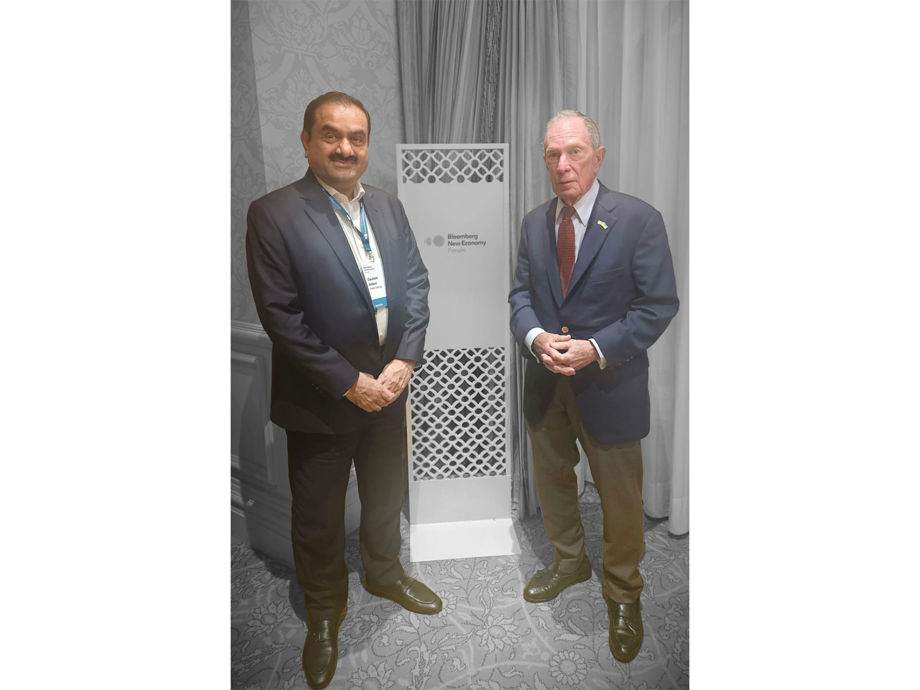
Michael Bloomberg, the former New York City mayor and global business leader, met Gautam Adani, chairman of the Adani Group, on the sidelines of the New Economy Forum in New Delhi. The meeting brought together two figures whose interests intersect across finance, climate policy, infrastructure and technology. Their discussion focused on India's growth roadmap, the country's clean energy transition, resilient urban infrastructure, artificial intelligence and the broader challenge of sustainable development. According to public posts shared after the meeting, both leaders described the conversation as engaging and forward-looking, with an emphasis on accelerating global climate action while supporting economic development in emerging economies.
In a social media post, Michael Bloomberg said, 'It was a pleasure meeting Gautam Adani and discussing his vision for India's future growth and energy transition.' The remark came after Adani described the meeting as a truly engaging discussion on accelerating the global energy transition, resilient urban infrastructure, the future of AI and sustainable growth. Adani added that Michael Bloomberg's vision and commitment to climate action continue to inspire. The exchange underscored a shared interest in practical solutions that can be scaled across India and other fast-growing economies.
In a longer post on Wednesday, Adani expanded on his views about the transition. He argued that decarbonisation cannot be an ideological decree that prices out ordinary citizens, shuts down factories or stalls the Global South. That statement reflects a long-running debate in climate policy: how to cut emissions without undermining economic growth, industrial jobs and access to reliable power in developing countries. For India, which remains one of the world's largest energy consumers and is still expanding its power generation capacity, the balance between affordability and sustainability is especially delicate. Adani said clean energy must become a reliable and affordable option for households and businesses if the transition is to succeed.
India's energy landscape illustrates the scale of the challenge. The country is the world's third-largest energy consumer, and its electricity demand is expected to grow rapidly as urbanization, manufacturing and digital services expand. Coal still provides the majority of electricity generation, even as renewable energy capacity has increased sharply over the past decade. India has set a target of installing 500 gigawatts of non-fossil fuel energy capacity by 2030 and achieving net-zero emissions by 2070. Meeting those goals will require massive investment in solar and wind generation, battery storage, transmission networks, green hydrogen and grid modernization. It will also require policies that keep electricity affordable for consumers and competitive for industries.
Adani emphasized that clean energy must become cheaper and superior, not merely a moral obligation. He cited the need to reduce the additional cost of adopting green energy, often called the green premium, while cautioning against continued dependence on existing energy systems amid climate volatility. 'Real progress demands that capital, policy and execution lock arms to drive down the green premium until clean power is undeniably the cheaper, superior choice,' he said. The argument is that if renewable power remains more expensive than fossil alternatives in many markets, the transition will be uneven and politically fragile. Lower financing costs, better technology, local manufacturing and predictable regulation are among the tools that can narrow the gap.
The Adani Group chairman also highlighted the need for India to expand its power supply, industrial capacity and digital access to support economic development and improve living standards. He said the infrastructure required for long-term growth extends beyond physical assets such as ports, transmission corridors, green hydrogen plants and computing facilities. Reliable data, accountable institutions and effective governance are equally important, he added. That broader definition of infrastructure reflects a growing consensus among economists and development experts: roads, power lines and data centers matter, but so do the rules, institutions and human capital that determine whether investments translate into widespread prosperity.
Adani distilled his approach into what he called four non-negotiable forces for nation-building: patient capital, physical execution, transparent governance and capable local leadership. Patient capital refers to long-term investment that is not driven by short-term speculation, a critical need for projects such as ports, renewable energy parks and transmission systems that take years to build and decades to pay off. Physical execution is the ability to turn plans into completed assets on time and within budget. Transparent governance reduces corruption and builds trust with communities and investors. Capable local leadership ensures that projects respond to local needs and are sustained after the initial construction phase. Together, these forces form a framework for infrastructure that supports durable growth rather than isolated ribbon-cutting moments.
The meeting with Bloomberg also covered urban development, artificial intelligence, advanced manufacturing and green infrastructure. Adani referred to the Dharavi redevelopment project in Mumbai, saying its success should be assessed by improvements in residents' living conditions and livelihoods rather than the amount of real estate developed. Dharavi is one of Asia's largest informal settlements and a hub of small-scale manufacturing, recycling and entrepreneurship. Redeveloping it has been a long-standing challenge because any plan must balance housing, commercial activity, community networks and the economic life of thousands of residents. Adani said the project could become a benchmark for urban renewal if infrastructure development is combined with community trust and protection of local economic activity.
That perspective aligns with a broader shift in urban planning, where the focus is moving from mega-projects to human outcomes. A new metro line, a redeveloped neighborhood or a modern utility network is only as good as its effect on access to jobs, education, healthcare and safety. Reflecting on India's development priorities, Adani said infrastructure should ultimately be judged by what people are able to achieve because of it, rather than by the assets constructed. The point is especially relevant in a country where rapid urbanization is expected to add hundreds of millions of people to cities in the coming decades. How those cities are built, financed and governed will shape India's economic trajectory and its emissions path.
Artificial intelligence and advanced manufacturing also featured in the discussions. Bloomberg addressed the forum on Tuesday, where he spoke about India's progress in AI, advanced manufacturing and green infrastructure. India has become a significant player in the global AI talent pool, with a large number of engineers, data scientists and startup founders. Its advanced manufacturing ambitions are tied to electronics, semiconductors, electric vehicles, defense and clean technologies. Green infrastructure, meanwhile, spans renewable energy, energy storage, electric mobility, sustainable buildings and climate-resilient water systems. The intersection of these fields could create new industries and jobs, but it also raises questions about energy demand, data center power consumption, supply chains and workforce readiness.
For Bloomberg, the meeting and forum appearance are part of a sustained engagement with climate finance and urban policy. As a former mayor and a philanthropist focused on climate action, he has long argued that cities and businesses must play a central role in reducing emissions. His foundation has supported efforts to phase out coal, expand clean energy and strengthen climate resilience. His presence in New Delhi signals continued international interest in India's transition, not only as a climate necessity but also as an investment opportunity. India needs an estimated trillions of dollars in clean energy and infrastructure investment over the next decade, much of it from private capital. Forums that connect policymakers, financiers and industrial leaders can help mobilize that capital, though the gap between announcements and on-the-ground execution remains wide.
The discussion also touched on the Global South's role in climate action. Adani warned that decarbonisation cannot become a policy that prices out ordinary citizens or shuts down factories. Many developing countries argue that they face a dual challenge: they must adapt to climate impacts while expanding energy access for growing populations. Wealthy nations have contributed the majority of historical emissions, yet developing countries often bear the brunt of extreme weather, heatwaves, floods and droughts. Climate finance, technology transfer and fair trade rules are among the contested issues in international negotiations. Adani's comments reflect a view that the transition must be economically viable for emerging economies, not just environmentally desirable for richer ones. Without affordable alternatives, the risk is that climate policy becomes a source of political backlash and stalled progress.
Bloomberg and Adani did not announce any specific deals or projects from the meeting, according to the public posts. But the conversation highlighted several themes likely to shape India's next phase of growth: the need for reliable and affordable clean power, the importance of resilient cities, the promise and risks of artificial intelligence, and the role of governance and local leadership in delivering infrastructure. The New Economy Forum in New Delhi provided a platform for those themes to be discussed alongside global economic and policy challenges. The event continued with sessions on trade, technology and sustainable development, drawing participants from government, business and civil society.
Source: Devdiscourse News