

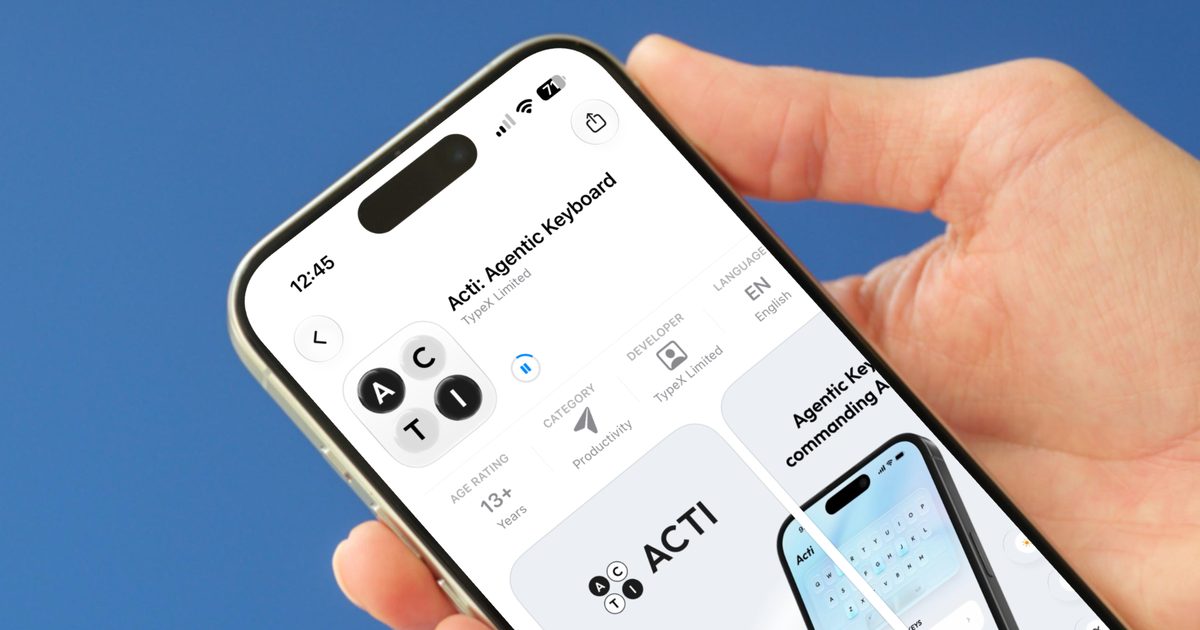
The smartphone keyboard has remained largely unchanged for two decades. While predictive text and autocorrect have improved, the fundamental function of tapping letters to form words has stayed the same. A Singapore-based startup called Acti is challenging this status quo by transforming the keyboard into an active AI assistant. The company's new keyboard app, simply named Acti, aims to turn the most-used part of your phone into a powerful tool for completing tasks without leaving the current app.
Acti, short for "action," is now available on both iOS and Android. The core innovation is the ActiBar, which replaces the traditional space bar. Press it to type normally, or hold it down to trigger an action. For example, if a friend asks your location in a chat, you can type the location name and hold the ActiBar. The keyboard will automatically find the location and drop it into the message. It can also pull up sports scores, nearby restaurants, and even create live mini-apps that allow the recipient to browse the results interactively.
A keyboard that does more than type
The concept of an "agentic keyboard" is not entirely new, but Acti’s implementation is unique because it lives directly within the keyboard, eliminating the need to switch between apps. Most AI agents today require a separate chat interface or a dedicated app. Acti embeds the agent into the input surface itself, making actions feel native and instantaneous. The keyboard can be customized further: users can assign specific actions to any key, linking them with third-party apps. For instance, holding the 'N' key could summon a specific Notion document, while holding 'L' could pull up a LinkedIn profile when a name is mentioned. This kind of deep integration turns the keyboard into a command center for productivity.
The technology behind Acti is built on local-first principles. Personal data remains on the device unless a feature requires external processing. This design choice addresses growing privacy concerns about cloud-based AI assistants. Acti is free to start, with a subscription model planned for premium features like advanced integrations and more complex skills. The company believes that by keeping the core experience free, it can quickly build a user base and a community around shared shortcuts.
The evolution of smartphone keyboards
To understand Acti’s significance, it helps to look at the history of smartphone keyboards. The first iPhone introduced a software keyboard that was a major departure from physical keypads. Over the years, keyboards added gesture typing, emoji prediction, and multilingual support. Google's Gboard and Microsoft's SwiftKey integrated search and translation directly into the keyboard. However, these features still required tapping or swiping to initiate an action. Acti takes the next logical step: the keyboard becomes proactive, offering contextually relevant actions based on the conversation or the app being used.
The rise of large language models has made this kind of proactive assistance possible. Acti uses AI to understand the context of a conversation and suggest appropriate actions. For example, if you type "I'm craving pizza," the keyboard might suggest pulling up nearby pizza places. If you type "Let me check my schedule," it could prompt you to open your calendar. This contextual awareness sets Acti apart from static keyboard shortcuts.
Building custom skills and community sharing
Acti also allows users to build their own shortcuts, called Skills, by describing what they want in plain English. A user could say "Create a skill that sends my current location to any chat when I type 'loc'" and the keyboard will generate it automatically. These skills can be kept private or shared with the Acti community, creating a repository of useful automations. This community aspect mirrors the success of platforms like Shortcuts on iOS but with a lower barrier to entry thanks to natural language creation.
Developers and advanced users may appreciate the ability to chain multiple actions together. For instance, a skill could be created to find the latest news about a topic, summarize it, and then paste it into an email — all within the keyboard. This reduces friction and keeps users in their flow. The keyboard remains aware of which app is active, so actions are app-appropriate. In a messaging app, dropping a location makes sense. In a note-taking app, the same action might insert a map link.
The local-first architecture also means that sensitive data like location, contacts, and messages are not sent to Acti's servers unless the user explicitly enables a sharing feature. This is a crucial differentiator in an era of data breaches and privacy concerns. Acti is positioning itself as a privacy-conscious alternative to cloud-dependent AI assistants.
The future of agentic keyboards
Acti launches at a time when the concept of AI agents is gaining traction. Companies like Microsoft are embedding Copilot into everything, and Google is integrating Gemini into Android. However, most of these solutions require a dedicated interface or a deep integration at the OS level. Acti's approach is lighter and more flexible — it operates as a keyboard extension, which means it works across any app that uses the standard keyboard. This cross-app functionality is a major advantage because users do not have to learn new gestures or remember keyboard shortcuts for each app.
The startup's vision extends beyond simple actions. In the future, Acti could integrate with smart home devices, payment systems, or health tracking. Imagine holding the space bar to check your heart rate data and then sharing a summary with your doctor via text. Or holding a key to unlock your front door for a visitor and send them the code. The keyboard becomes a universal remote for your digital life.
Early reviews from beta testers praise the speed and accuracy of the actions. The AI model is fine-tuned for common scenarios like messaging, email, and social media. Acti claims that the keyboard learns user preferences over time, suggesting more relevant actions as usage increases. The team behind Acti has backgrounds in natural language processing and mobile app development, giving them the expertise to build a polished product.
The launch highlights a broader trend: the keyboard is evolving from an input method to an interface for AI. Just as the mouse and GUI revolutionized personal computing, the keyboard might be the next frontier for human-AI interaction. Acti is one of the first to bring this vision to mobile devices, and if it gains traction, it could force competitors to rethink their own keyboard strategies.
For now, Acti is free to download and use, with a clear path to monetization through premium subscriptions. The company has not announced pricing, but early adopters can expect a freemium model with a generous free tier. As with any new technology, adoption will depend on how quickly users adapt to the new workflow. But given the keyboard's centrality in daily smartphone use, even a small improvement in efficiency can have a significant impact over time. Acti's keyboard is not just a tool; it is a glimpse into the future of mobile interaction.
Source: Digital Trends News