

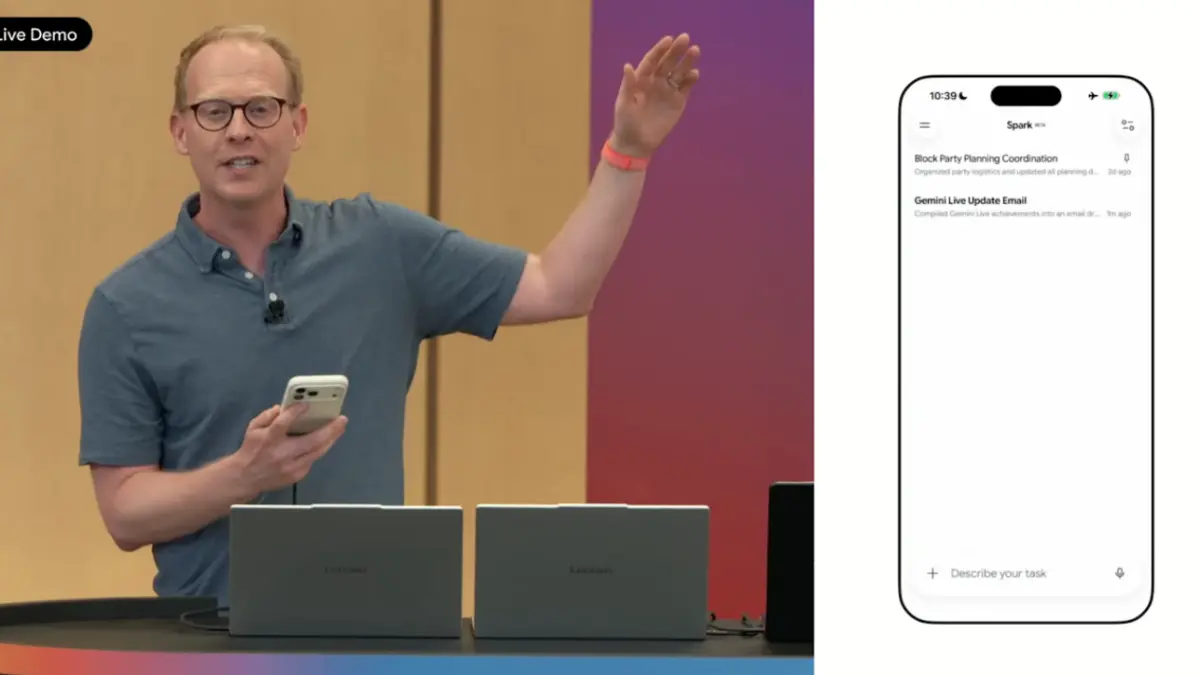
OpenClaw started a mini-revolution in the AI world by showing what was possible with AI agents, and at Google I/O 2026, the company finally unveiled its own AI agent. At its annual developers conference, Google introduced Gemini Spark, a personal AI agent that can draw on users' personal files while leveraging Gemini intelligence.
During the keynote address, Google CEO Sundar Pichai said a beta of Gemini Spark would soon be available to Google AI Ultra subscribers, the company's premium AI subscription plan. In addition, Pichai said that Spark will run on the newly announced Gemini 3.5 Flash model.
While OpenClaw has become hugely popular in the AI and early-adopter communities, Google has a massive reach. Billions of people use Google products, and the company says its Gemini app has 900 million monthly active users. So, Gemini Spark could bring agentic AI into the mainstream for the first time.
Gemini Spark is a cloud-based AI agent
Famously, OpenClaw runs on a local device such as a Mac Mini. Shortly after the tool became a viral hit (first under the name Clawdbot, then Moltbot), Mac Minis quickly sold out at Amazon and other retailers. However, Gemini Spark is a fully cloud-based AI agent. That makes it far more beginner-friendly, as there's no hardware or complicated installation process to worry about. And when you close your laptop, Spark keeps working.
Gemini Spark will be able to run 24/7 in the background, with no additional devices required. This cloud-native design means that users can access Spark from any device with an internet connection, whether it's a laptop, tablet, or smartphone. The agent's processing happens on Google's servers, leveraging the power of the Gemini 3.5 Flash model, which is optimized for speed and efficiency. This eliminates the need for users to invest in expensive hardware or manage software updates themselves. For enterprise users, this also simplifies deployment across an organization, as IT teams don't need to provision and maintain local machines for each agent instance.
The cloud-based approach also enables seamless scaling. If a user needs to run multiple agent tasks simultaneously, Spark can dynamically allocate resources without any user intervention. This is a significant advantage over OpenClaw, which is constrained by the capabilities of the local hardware. Moreover, because Spark runs in the cloud, it can leverage Google's global network infrastructure to reduce latency and ensure fast response times, even for complex tasks like real-time data analysis or multi-step workflow automation.
Gemini Spark will have better access to your data
Second, if you're already a Google user, then Gemini Spark will have native access to your Gmail, Google Docs, and Google Drive. So, if you ask Gemini Spark to plan an event, it can pull in contacts from Gmail, artwork from Google Drive, and a schedule from Google Docs. It will also be built into Google Chrome and works on desktop, Android, and iOS devices.
Yes, all of this can be accomplished if you grant OpenClaw access to all of these tools, but Gemini Spark will make this process instantaneous. The deep integration with Google Workspace means that Spark can understand the context of your documents, emails, and calendar events without needing to go through complex API setups. For example, if you receive an email with an attachment, Spark can automatically extract the relevant information and use it to update a spreadsheet in Google Sheets or draft a response in Gmail. This level of automation is possible because Spark operates within the same ecosystem, using the same authentication and permission systems that users already trust.
Furthermore, Google has announced that Spark will be able to interact with third-party services through an expanded set of APIs, but the native integrations will always be more seamless. For businesses that rely on Google's suite of productivity tools, this could be a game-changer. Imagine an AI agent that can attend a Google Meet call, take notes, summarize action items, automatically create tasks in Google Tasks, and send follow-up emails — all without manual input. Spark is designed to make this a reality, whereas OpenClaw would require custom scripting and additional middleware to achieve similar results.
The data access advantage also extends to personalization. Because Spark has access to your search history, YouTube preferences, and location data (with your permission), it can offer more tailored recommendations and actions. For instance, if you frequently search for recipes, Spark could proactively suggest meal plans and create a shopping list in Google Keep. This level of contextual awareness is difficult for a locally-run agent like OpenClaw to replicate without extensive configuration and data export.
Cybersecurity peace of mind
OpenClaw has a DIY ethos, and, because it has such a high level of control over your hardware, it can be a big cybersecurity challenge. Some of those problems have been addressed now that OpenClaw is a part of Anthropic, of course. Still, billions of people are already familiar with Google and trust it with their emails, private documents, and photos.
Presumably, Spark will be protected with the full might of Google's cybersecurity. Google's security infrastructure includes advanced threat detection, encryption at rest and in transit, and continuous monitoring for malicious activity. For users who are concerned about AI agents making unauthorized purchases or accessing sensitive data, Google has introduced a new mechanism called the Agent Payments Protocol (AP2). This protocol ensures that agents cannot spend money beyond user-defined limits. Users can set specific rules about what Spark can purchase, which merchants it can use, and how much it can spend in a given time period. This gives users granular control and prevents the kind of "rogue agent" scenarios that have worried many early adopters.
Additionally, Google has implemented a layered permissions system for Spark. Each action an agent takes must be explicitly authorized by the user, either through a one-time approval or a persistent permission rule. For example, if Spark wants to send an email on your behalf, it will ask for your confirmation the first time, and then you can choose to allow it permanently for similar tasks. This approach balances convenience with security, ensuring that users remain in control without needing to approve every trivial action.
Another key security feature is the ability to view a full audit log of all actions taken by Spark. Users can review a history of what the agent did, when, and with which data. This transparency helps build trust and allows users to quickly identify any unauthorized behavior. In contrast, OpenClaw's open-source nature means that security is largely the responsibility of the user, who must configure firewalls, update software, and monitor logs manually. For mainstream consumers, Google's managed security model is far more appealing.
Google is introducing Gemini Spark slowly, and a beta will be available soon for AI Ultra subscribers. That lets Google test Spark with Gemini power users before launching it to everyday users. This phased rollout also allows Google to gather feedback on security and privacy features, ensuring that the final product meets the highest standards. For all these reasons, Gemini Spark could be the first AI agent used by countless internet users who have been hesitant to trust such powerful tools with their personal data.
The announcement of Gemini Spark represents a significant milestone in the evolution of AI agents. While OpenClaw captured the imagination of tech enthusiasts, Google's entry into the space could democratize access to agentic AI. By leveraging its existing ecosystem, robust cloud infrastructure, and strong security reputation, Google is well-positioned to make AI agents a everyday tool for billions of people. The beta launch later this year will be a critical test, but early signs suggest that Gemini Spark could indeed be the AI agent that brings this technology into the mainstream.
Source: Mashable News