

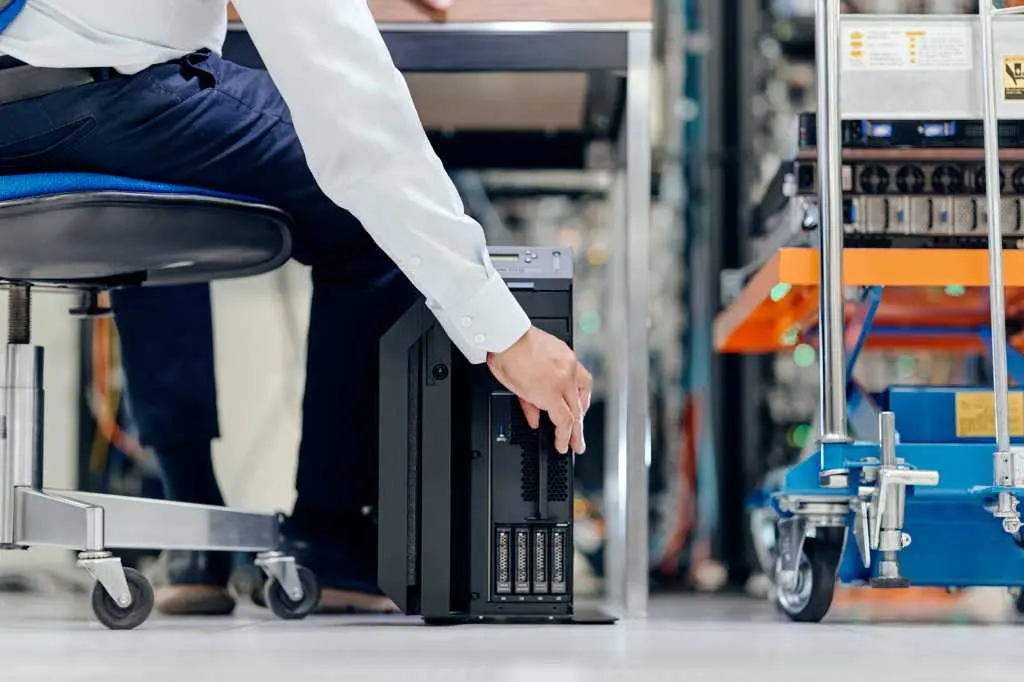
IBM has bolstered its Power server portfolio with a new edge S1112 server and announced IBM Power Autonomous Operations, an AI agent that helps customers monitor Power systems and autonomously resolve issues to keep operations running smoothly. Additional software upgrades are aimed at helping customers deploy and manage AI infrastructure components.
“Each announcement addresses a different layer of the enterprise technology stack, from how infrastructure is deployed and managed to how applications are developed, modernized, and optimized,” wrote Brandon Pederson, senior IBM i product manager, in a blog post about the new products. “Together, they reinforce a broader direction for IBM Power of helping clients move from manually operated infrastructure toward intelligent, resilient, and AI-assisted systems that are easier to manage, easier to modernize, and ready for new workloads.”
IBM Power S1112: A New Edge-Focused Server
The new IBM Power S1112 is a one‑socket Power11 server engineered for IBM i, AIX, and Linux. Aimed at distributed and edge locations, it is Big Blue’s new entry-level i server and is AI‑ready by design, integrating on‑chip Matrix Math Acceleration (MMA) for fast inferencing and other AI‑driven use cases, such as support for AI-assisted decisions, automation, and analytics close to where data is generated and consumed, Pederson stated.
The server supports two configurations: a 10-core 3.05 to 4.0 Ghz Power11 Processor in a rack version only, and a 4-core 3.60 to 4.0 Ghz Power11 in rack and tower form factors, IBM stated.
“For IBM i clients, Power S1112 is especially important because it expands what entry IBM i environments can do. IBM i P05 clients can run IBM i partitions within the P05 software tier while also using additional system resources for AIX, Linux, VIOS, AI, or open-source workloads on the same server,” Pederson wrote. “This creates a flexible path to consolidate workloads, improve utilization, and support modernization without forcing clients into a larger platform than they need.”
The edge computing market has seen explosive growth as organizations seek to process data closer to where it is generated. By deploying AI capabilities at the edge, businesses can reduce latency, improve real-time decision-making, and lower bandwidth costs. IBM’s new S1112 server is designed specifically for these use cases, offering compact form factors and power efficiency suitable for remote or space-constrained locations. The integration of Matrix Math Acceleration directly into the Power11 chip means that even low-end models can handle AI inference tasks without requiring a separate GPU, making it an attractive option for retail, manufacturing, and telecommunications edge deployments.
In addition to its hardware capabilities, the S1112 supports a wide range of operating systems and virtualization options. IBM i clients can run multiple partitions with different OS stacks on a single server, unlocking consolidation opportunities that were previously limited to larger systems. This flexibility allows organizations to modernize gradually, running legacy IBM i applications alongside modern AIX or Linux workloads.
IBM Power Autonomous Operations: AI-Driven IT Management
On the software side, IBM Power Autonomous Operations offers automation capabilities via an embedded AI agent that provides natural language interactions designed to help customers manage, tune, and streamline their environments without relying on deep domain expertise for every task, Pederson stated.
“IBM Power Autonomous Operations is designed to continuously monitor, optimize, protect, and manage Power environments. It combines Power telemetry, AI-powered analytics, automation, and operational workflows into a unified experience that helps IT teams reduce complexity, improve resiliency, and increase productivity,” Pederson wrote.
“Rather than simply showing operators what is happening, Power Autonomous Operations is designed to help teams decide what to do next. The platform analyzes system telemetry, identifies risks and optimization opportunities, and provides intelligent recommendations or automated actions to improve performance, resiliency, and operational efficiency,” Pederson wrote.
This AI agent represents a significant step toward self-managing infrastructure. By embedding an agent that understands natural language commands, IT teams can interact with their Power systems as if they were having a conversation with a human expert. For example, an operator could ask “What is causing the slowdown on my production partition?” and the system would respond with a root cause analysis and suggested remediation steps. Over time, the agent learns from the environment and can take predefined autonomous actions, such as rebalancing workloads or applying patches during maintenance windows.
The autonomous operations capabilities build on IBM’s long history of system management tools, including IBM i Access Client Solutions and the IBM i Service Tools. However, Power Autonomous Operations goes further by integrating telemetry from across the entire Power infrastructure—including storage, networking, and virtualized resources—into a single AI-driven console. This holistic view allows for more accurate anomaly detection and predictive maintenance, reducing downtime and operational costs.
Agentic Engine for IBM i: Empowering Native AI Agents
IBM also issued a preview of the Agentic Engine for IBM i, which is aimed at providing greater AI support for Power systems. IBM described the Agentic Engine as a new enablement layer designed to make it easier to adopt native and integrated AI agents into IBM i workloads and business processes. The engine provides the runtime, IBM i Knowledge Pack, observability, extensibility, MCP server, and foundational agents that help teams build trusted agents for IBM i without starting from scratch. Developers can build agents using their preferred coding tools, run them close to Db2 for i data under native IBM i object-level authority, and extend them into broader enterprise workflows through APIs and agent-to-agent integration.
With security, governance, and instrumentation built in, the Agentic Engine for IBM i helps organizations manage agent behavior, monitor activity, and support responsible adoption across mission-critical environments, Pederson stated.
The Agentic Engine is particularly significant because it addresses a longstanding challenge in the IBM i ecosystem: how to safely integrate AI capabilities with business-critical transactions. By allowing agents to run under object-level authority, the system ensures that AI operations respect existing security policies and data boundaries. The IBM i Knowledge Pack provides domain-specific expertise for common tasks such as performance tuning, security auditing, and compliance reporting, accelerating the development of custom agents.
IBM’s MCP (Model Context Protocol) server support means that agents built for the engine can integrate with external AI models and services, including those from IBM Watsonx and third-party providers. This open architecture allows organizations to leverage the best models for their specific use cases while maintaining control over their data.
IBM Bob Premium Package for i: Modernizing Legacy Applications
Also in the AI agent vein, IBM announced support for its Bob AI application development environment for the i system. The idea here is to help customers quickly modernize applications built on RPG and COBOL.
“These capabilities help developers explain complex RPG and COBOL programs, convert Fixed-Format RPG to modern Free-Format RPG, refactor monolithic applications into modular structures, generate RPG, CL, COBOL and DDS code, create technical documentation, and produce unit tests to support validation,” Pederson wrote. “Rather than relying on generic prompts and inconsistent results, IBM i teams can use expert-built skills that deliver more predictable, repeatable and higher-quality outcomes. Agentic workflows help guide multi-step development tasks from understanding and planning through implementation and validation, allowing developers to modernize incrementally without losing control.”
Modernizing decades-old RPG and COBOL applications has been a top priority for many enterprises still running IBM i. The Bob Premium Package uses large language models trained specifically on IBM i programming languages and patterns, enabling it to generate accurate code transformations. This reduces the risk of introducing bugs when manually converting fixed-format RPG to free-format, and it allows developers to focus on business logic rather than syntax.
IBM also added new development features to the core operating system for i with IBM i 7.6 Technology Refresh 2 and i 7.5 Technology Refresh 8 that include a variety of features designed to enhance RPG and COBOL development, security, and hybrid cloud integration. These technology refreshes deliver continuous improvements to the platform, ensuring that customers can leverage the latest capabilities without a full OS upgrade.
IBM Power S1112 is expected to be generally available on July 24, IBM Power Autonomous Operations is expected to be generally available on September 23, 2026, and IBM Bob Premium Package for i was made generally available on June 24, 2026.
Source: Network World News