

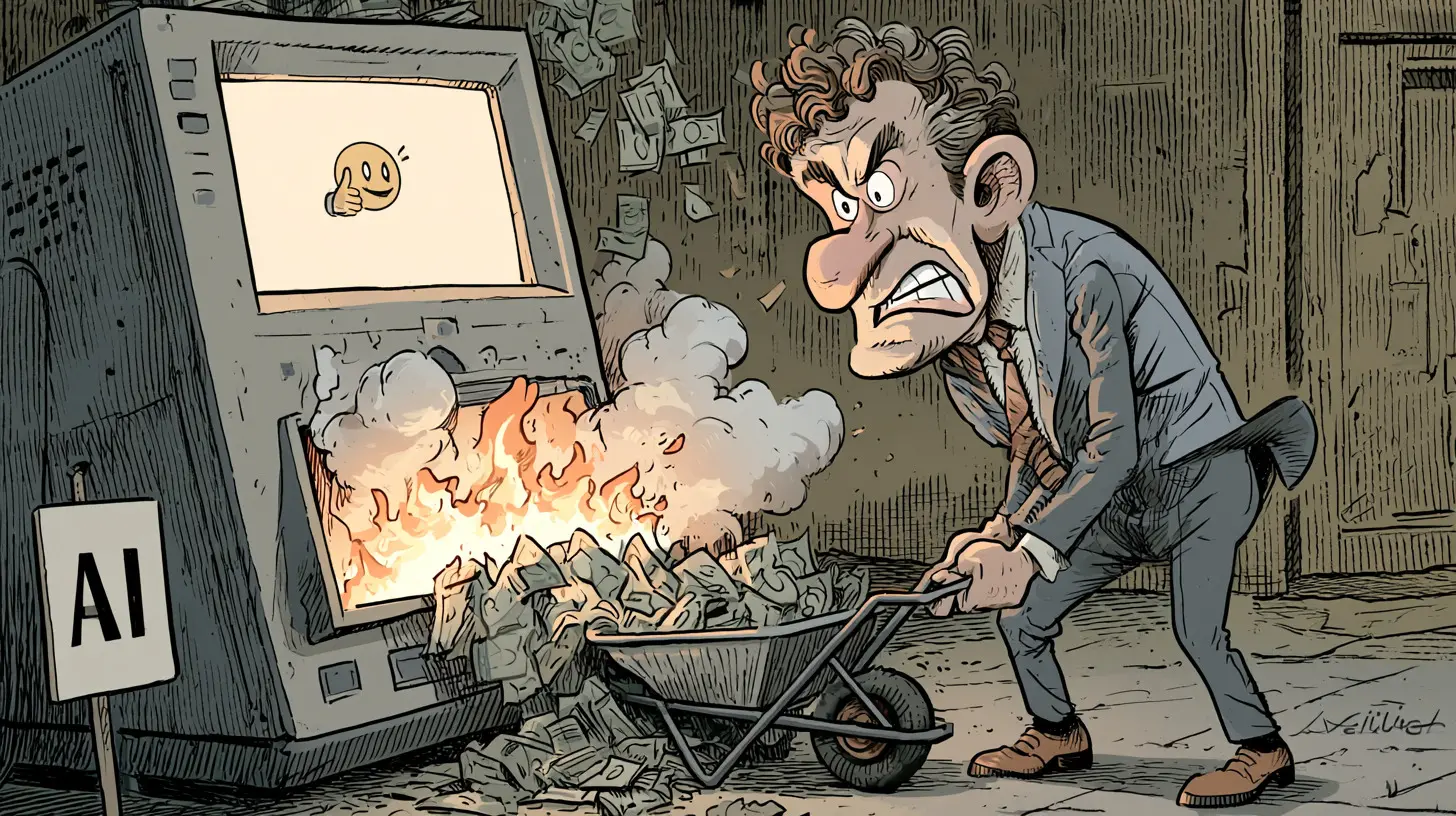
In a startling example of unchecked AI spending, a company recently burned through approximately $500 million in Claude AI credits in just one month. The reason? Management forgot to set usage limits for employees, leaving the doors wide open for unrestrained token consumption. This incident, reported by Axios, highlights a growing corporate headache: the unexpected and often skyrocketing costs of deploying generative AI at scale.
The unnamed company is not alone. Across the enterprise landscape, leaders are beginning to push back on the promise that artificial intelligence will unilaterally reduce costs and boost productivity. Instead, many are finding that the opposite may be true—at least for now. The allure of AI has often been accompanied by cloudy financial projections, and the true cost of token-based models is only now becoming clear as companies implement AI across large teams.
The Rise of Tokenmaxxing and Its Fallout
Termed "tokenmaxxing," the practice of burning through AI credits as quickly as possible has become a common but costly behavior. It stems from a culture that encouraged heavy AI usage to unlock its potential, but without adequate guardrails. The $500 million blow-up is an extreme case, but it underscores a systemic issue: as more employees gain access to powerful language models, the cumulative cost can spiral out of control.
Uber, for example, reportedly saw its engineers exhaust the company's entire AI budget for 2026 within a single month. This revelation came alongside comments from Uber’s new COO, Andrew Macdonald, who stated that AI-related costs and token usage were not improving worker productivity as hoped. Uber is now reassessing its approach to AI and curbing unfettered access.
Corporate Pushback Intensifies
Leaders at major companies such as Costco, Delta Airlines, and IBM have publicly expressed skepticism about the value of AI. They note that while the technology holds promise, the current costs often outweigh tangible benefits. These companies are choosing to retain human workers for tasks that AI was supposed to automate, reversing the trend of layoffs seen at tech giants like Amazon, Meta, and Microsoft.
Microsoft, despite being a major AI investor, has also taken steps to rein in excessive usage. Earlier this month, the company reportedly began canceling Claude subscriptions and discouraging employees from using the model, just six months after aggressively pushing AI adoption across various roles. This reversal indicates that even companies betting heavily on AI are questioning the return on investment.
Shift Toward Usage-Based Billing
Providers such as Google and Anthropic have shifted to usage-based billing and stricter usage limits, which has frustrated non-enterprise users. These pricing models incentivize companies to monitor and limit usage, but they also make it harder for smaller teams to experiment freely. The result is a growing gap between the promise of accessible AI and the reality of escalating costs.
Despite these challenges, AI is not going away. The Gartner report cited in the original article predicts that inference costs for generative AI models in 2030 will be only a tenth of 2025 levels. However, token usage is expected to expand 5 to 30 times, driven by complex AI agents and deeper integration into business processes. Net costs may not decline as hoped.
Historical Context: The AI Hype Cycle
The current turbulence is reminiscent of earlier tech hype cycles, such as the dot-com boom and bust, where initial enthusiasm led to overspending and eventual recalibration. AI adoption is still in its early stages, and the industry is learning hard lessons about the economics of large-scale deployment. The initial cost reductions promised by AI often fail to account for the hidden costs of prompt engineering, fine-tuning, infrastructure, and, yes, token consumption.
Moreover, the rush to deploy AI has exposed vulnerabilities in corporate governance around technology spending. Companies that implement usage limits, monitor costs, and tie AI usage to clear business metrics are likely to fare better than those that simply hand out access without safeguards.
Impact on Workforce and Productivity
The debate over AI's ROI is closely tied to its impact on the workforce. While AI can automate routine tasks and augment human capabilities, many early deployments have failed to deliver the productivity gains expected. In some cases, the time saved is offset by the need for human oversight and correction of AI-generated outputs. Uber's COO noted that token usage did not translate into improved productivity, a sentiment echoed by other executives.
As a result, companies are becoming more selective about where and how they deploy AI. Instead of giving every employee free access to models, organizations are now focusing on high-value use cases such as code generation for engineers, data analysis for finance teams, and content drafting for marketing. This targeted approach helps control costs while still leveraging AI's strengths.
Future Outlook: Less Hype, More Pragmatism
While a complete reversal of the initial AI fervor is unlikely, we are clearly entering a phase of greater pragmatism. Companies will likely budget AI usage more carefully and restrict it to specific activities rather than providing free rein. The AI bubble, if such exists, may deflate, but the underlying technology will continue to evolve. The key will be finding a sustainable balance between cost and value.
The $500 million incident serves as a cautionary tale for every organization adopting AI. It underscores the importance of governance, oversight, and realistic cost modeling. As the industry matures, the winners will be those who learn to harness AI's power without letting it burn a hole in their balance sheet.
Source: Android Authority News