

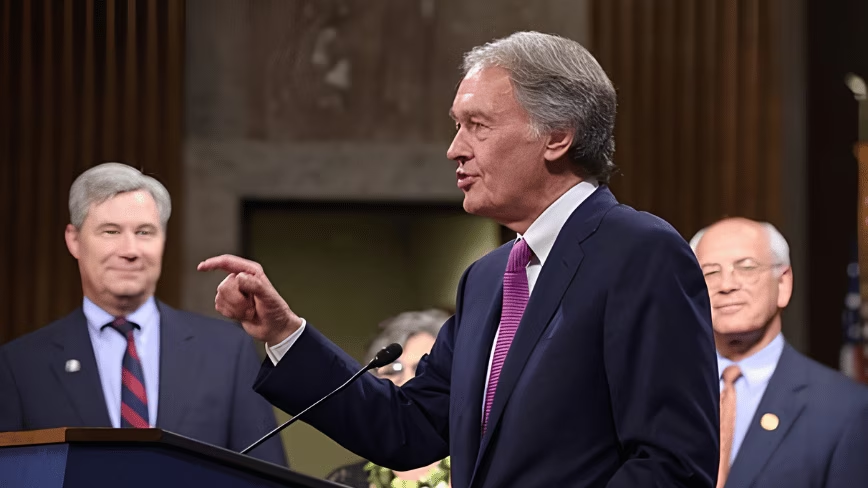
The fight over artificial intelligence's harms has largely played out state by state, with varying degrees of consumer protection and corporate accountability. Now, one US senator wants to make it federal, all at once. On Friday, Senator Ed Markey of Massachusetts unveiled a comprehensive package of bills he calls an 'AI accountability agenda,' built around what he describes as 'taking power back from big tech.' The 79-year-old Democrat, who has already authored close to a dozen AI-focused bills, is attempting to tie them together into a unified legislative framework that could reshape how the United States regulates one of the most transformative and controversial technologies of the modern era.
Markey's long list of worries about artificial intelligence includes thirsty data centres that consume enormous amounts of water and electricity, workplace surveillance systems that encroach on employee privacy, biased algorithms that perpetuate discrimination, and chatbots that can prey on children. The package of bills he introduced seeks to address each of these concerns with targeted federal legislation, marking a significant departure from the hands-off approach that has characterized federal policy since ChatGPT launched in 2022.
Prove Your Data Centre Won't Do Harm
The centrepiece of Markey's agenda is a bill expected to be formally introduced in the coming weeks. Under its provisions, any company that owns or plans to construct a data centre would be required to obtain certification from the Federal Communications Commission (FCC) before construction begins. This certification would have to confirm that the proposed site 'will not harm the public interest.' According to the draft language, the FCC would be tasked with evaluating a proposed data centre's effect on air and water quality, noise levels, energy costs, grid reliability, local wildlife, and the local economy. The commission would consult with the Environmental Protection Agency (EPA) and local zoning boards during its review process. 'We need to make sure these data centres don't turn into pollution bombs,' Markey said in an exclusive interview with the Guardian, emphasizing that the rapid expansion of data centre infrastructure to support AI workloads has created environmental and community burdens that must be addressed.
Data centres are the physical backbone of the internet and cloud computing, but the explosive growth of artificial intelligence has dramatically increased their energy and water demands. For example, a single large data centre can consume as much electricity as a small town, and its cooling systems can strain local water supplies. In some communities, residents have reported discoloured tap water and increased electricity bills after data centres moved in nearby. Markey's bill would put the burden on companies to prove that their facilities will not cause such harms, reversing the current dynamic where communities must fight to force accountability.
The People Behind the Bills
Markey's pitch relies heavily on stories of individuals he says are already being harmed by unregulated AI. During his announcement, he referenced a rural Georgia resident who can no longer drink her tap water after a data centre went up nearby. He spoke of parents who allege that their 14-year-old son died by suicide after forming an emotional attachment to an AI chatbot. He cited a woman who sued over an algorithm she says denied her housing. And he described a veteran nurse who was pressured to trust an AI's judgment over her own clinical experience. Each of these cases maps to a specific bill within the agenda. Markey is proposing legislation that would require independent bias audits before high-stakes algorithms are deployed. He wants to bar employers from relying predominantly on automated systems to make hiring, firing, and promotion decisions. He wants to stop chatbot companies from allowing children to develop emotional dependencies on AI. And he wants hospitals to maintain a human override for any AI-driven medical decisions, ensuring that human judgment remains the final arbiter in critical healthcare contexts.
These stories are not isolated incidents. Across the United States, there has been a growing wave of lawsuits and legislative efforts addressing AI harms. For instance, the Federal Trade Commission has taken action against companies using deceptive AI practices, and some states have begun passing their own laws to regulate algorithmic bias and data privacy. However, the patchwork nature of state-level regulation means that protections vary widely depending on where a person lives. Markey's agenda seeks to establish a baseline of federal safeguards that apply uniformly across the country.
A Federal Answer to a Patchwork
Markey argues that safety should not depend on your postcode. 'Every American is entitled to these safeguards,' he said in his announcement, warning that a state-by-state approach 'would leave too many people exposed.' This is also where Europe enters the picture. The European Union already operates the kind of up-front, precautionary regulatory regime that Markey is reaching for, through its AI Act, General Data Protection Regulation (GDPR), and online-safety rules. These laws require companies to assess risks before deploying high-risk AI systems, to obtain consent for data processing, and to take down illegal content promptly. In contrast, Washington has done almost nothing at the federal level since ChatGPT burst onto the scene in late 2022, even as Silicon Valley itself has started asking for clear rules to avoid a fragmented compliance burden.
Markey's approach is reminiscent of the EU's philosophy of 'ex-ante' regulation, which forces companies to consider and mitigate potential harms before they occur, rather than relying on after-the-fact lawsuits. The EU's AI Act, for example, categorizes AI applications by risk level and imposes strict requirements on those deemed high-risk, such as hiring algorithms and biometric surveillance. Markey's bills would similarly require pre-deployment audits for biased algorithms and certification for data centres, creating a US equivalent to the European model.
Long Odds
The politics are unforgiving. Most of Markey's bills are stuck in committee, and he is just one senator in a Congress that has favoured speed over guardrails when it comes to AI development. The dominant narrative on Capitol Hill has been shaped by industry lobbyists who argue that heavy regulation will stifle innovation and cede leadership to China. Some lawmakers have introduced bills that are narrowly focused on specific issues, like deepfake pornography or AI-generated election disinformation, but a comprehensive federal AI law remains elusive.
Despite the headwinds, Markey says he is optimistic. 'Ultimately, there will be national solutions that will be put on the books,' he told the Guardian. He points to a few footholds that suggest a path forward. In March 2024, the Senate passed a bill tightening online safety rules for children, which would ban targeted advertising to minors and limit the collection of their personal data. Other lawmakers are separately pushing to make Big Tech pay for AI's power bills, as the same data centres that drive up electricity costs have, in at least one case, contaminated a city's water supply with hazardous materials. These incremental steps indicate that lawmakers are beginning to recognize the tangible harms AI infrastructure can cause.
Markey traces the entire fight back to his own father, who lost a finger to a factory machine before modern workplace safety laws existed. His father's experience shaped his worldview: technology keeps outrunning the rules meant to contain it. 'AI is just the newest version of that gap,' Markey said. 'We didn't wait for every factory worker to get mangled before we passed safety laws. We shouldn't wait for every community to have its water poisoned before we regulate data centres.'
The agenda's timing is significant. AI adoption is accelerating across industries, from healthcare and finance to recruitment and content creation. The infrastructure required to power these AI systems is also growing at an unprecedented pace, with hyperscale data centres being built in rural areas that have little experience with industrial operations. At the same time, high-profile incidents of algorithmic bias and chatbot-related tragedies have captured public attention, creating a political window for action. Whether Markey can capitalize on that window remains to be seen, but his package of bills represents the most comprehensive federal effort to date to hold AI accountable for its harms.