

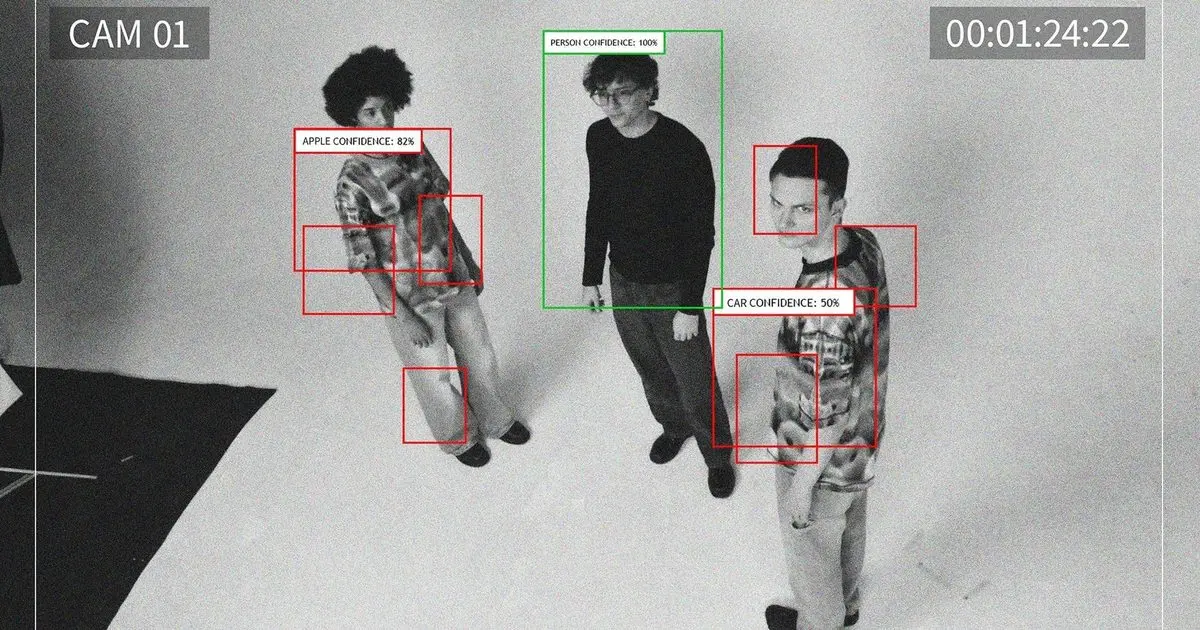
The dream of becoming invisible to the surveillance state has long been a fixture of science fiction, but recent advances in adversarial fashion are bringing that concept closer to reality—if not quite to the point of an invisibility cloak. Anti-surveillance clothing, once limited to art-school experiments and niche prototypes, is now available at prices comparable to ordinary streetwear. However, as researchers and designers caution, these garments do not guarantee anonymity. Instead, they exploit specific weaknesses in computer vision algorithms, making them a tool of protest rather than a definitive shield.
How Can Clothing Confuse a Camera?
Adversarial clothing works by exploiting the shortcuts that software uses to identify people and objects. Most facial recognition systems rely on detecting key features such as eyes, noses, and the overall shape of a face. By introducing patterns that disrupt these features, designers can reduce the probability of accurate identification. One approach, popularized by companies like Urban Privacy, involves scattering fake faces across the fabric. Their Faception Reloaded line uses printed patterns of artificial faces to create visual noise for algorithms. Instead of recognizing a single human face, the software may try to process multiple faces simultaneously, slowing down or failing in its task.
Another technique is based on adversarial machine learning, where patterns are optimized to mislead specific neural networks. Cap_able, a German fashion brand, uses AI-generated knitted designs that cause object-detection systems like YOLO (You Only Look Once) to mistake the wearer for an animal or a small figure. While this can be amusing, the effectiveness depends heavily on the algorithm being used. A pattern that confuses one version of YOLO may have no effect on a newer iteration or on a different brand of recognition software.
Infrared-based approaches target night-vision cameras. Urban Privacy's Urban Ghost coat uses infrared LEDs around the hood to overwhelm compatible sensors. In theory, this creates a bright halo that obscures facial features. However, such a strategy is useless against standard cameras or systems that do not rely on infrared, and it may even draw attention to the wearer.
The Cost of Privacy Fashion
Perhaps the most surprising development is the price point. Urban Privacy's Faception Reloaded T-shirts start at €35, sweatshirts at €59, and hoodies at €65. These figures move adversarial clothing from the realm of wealthy enthusiasts into the hands of everyday consumers. For comparison, an average streetwear hoodie costs between €40 and €80, so the anti-surveillance version is now within a similar budget. This accessibility suggests that the technology is maturing and becoming scalable.
Cap_able, on the other hand, remains positioned as wearable art. Its knitted crop tops cost €560, while a hoodie is priced at €620. The higher cost reflects the handcrafted nature and the integration of AI-designed patterns that are not yet mass-producible. However, the existence of cheaper alternatives from Urban Privacy indicates a trend toward democratization. As manufacturing processes improve and more designers enter the space, prices are expected to continue falling.
It is important to note that affordability does not equal effectiveness. The cheaper garments may use lower-quality prints or less sophisticated patterns, potentially reducing their reliability. Still, the fact that anyone can now buy an anti-surveillance shirt for the price of a video game is a milestone in the fight for digital privacy.
Why Shouldn't You Trust It Completely?
Despite the ingenuity behind these designs, experts urge caution. Controlled testing against a single object-detection model cannot prove that a garment will defeat facial recognition in the wild. Real-world conditions such as lighting, camera angle, distance, and the specific algorithm in use all affect performance. A shirt that works perfectly in a YouTube demonstration might fail entirely under a different streetlight or when viewed from a higher angle.
Moreover, surveillance systems are constantly evolving. As companies like Clearview AI and major tech firms update their algorithms, they may learn to ignore patterns that once caused trouble. Researcher Jennifer Bell, quoted by The Guardian, emphasized that these products have not undergone independent real-world testing. Without such verification, there is no reliable data on how they perform against the variety of cameras deployed in cities, airports, or retail stores.
Another factor is that adversarial patterns can sometimes backfire. If a system detects that a face is partially obscured by an unusual pattern, it may flag the wearer as suspicious, potentially increasing scrutiny. In high-security environments, drawing attention might be the opposite of what the wearer intends.
Historical Context: From Protest Wear to Practical Tool
The roots of anti-surveillance fashion can be traced back to early 2010s art projects, such as Adam Harvey's CV Dazzle, which used hairstyles and makeup to break up facial features. These were conceptual pieces, not practical garments. The idea was to start a conversation about privacy in an era of increased surveillance. Over the past decade, the conversation has shifted from theoretical to practical as facial recognition technology has become ubiquitous in public spaces, from shopping malls to public transportation.
Legislative efforts have lagged behind, with some cities banning government use of facial recognition but leaving private use largely unregulated. In this context, adversarial clothing serves as a form of personal resistance. It allows individuals to opt out of being automatically identified, even if only temporarily. The cost reduction from thousands of dollars for a custom piece to less than €100 for a mass-produced shirt reflects a growing market demand.
At the same time, the technology is not without ethical concerns. If adversarial clothing becomes widespread, it could hinder legitimate uses of surveillance for security, such as finding missing persons or preventing crimes. The debate between privacy and security is unlikely to be resolved by a piece of cloth. However, for individuals who wish to make a statement or reduce their digital footprint, these garments offer a tangible option.
Technical Limitations: Why It's Not Invisibility
The headline of this article hints at a crucial truth: none of these garments make the wearer invisible. Human eyes are still perfectly capable of seeing the person. The garment only interferes with machine vision, and only under specific conditions. Even within machine vision, many systems rely on multiple modalities—combining face recognition with gait analysis, license plate readers, or other behavioral cues. A patterned hoodie might confuse a face detector, but it does nothing to hide the wearer's unique walking style or height.
Urban Privacy's experimental Urban Ghost coat, equipped with infrared LEDs, may work against night-vision cameras, but daylight surveillance is unaffected. Similarly, Cap_able's patterns might fool YOLO but not other object detectors like SSD or Faster R-CNN. The adversarial patterns are often trained on specific models, and transferability to other models is limited. In the worst case, a garment might work flawlessly in a lab but fail in a city where many different camera brands are deployed.
Another often overlooked factor is that cameras can be positioned at angles that the pattern was not designed for. A shirt that confuses face detection when the person is walking straight toward the camera may be ineffective if the camera is mounted high and pointing downward. Lighting also plays a role: a pattern that relies on high contrast may be washed out in bright sunlight or lost in shadow.
Despite these limitations, the existence of affordable anti-surveillance clothing is a sign that privacy-conscious consumers have more options than ever before. The technology is evolving rapidly, and it is possible that future garments will incorporate multiple techniques—combining printed patterns, infrared interference, and even smart fabrics that can dynamically change their appearance. Until such advanced solutions appear, however, the best approach is to treat adversarial clothing as one tool in a broader privacy toolkit, not a miracle cure.
In summary, anti-surveillance clothing has moved from the fringes of fashion to the mainstream marketplace, with prices falling to levels accessible to the average consumer. Designs that use fake faces, AI-generated patterns, and infrared lights can indeed confuse some facial recognition systems, but they are far from foolproof. Independent testing is lacking, and the ever-changing landscape of computer vision ensures that no garment can provide permanent protection. For those who want to make a statement or momentarily disrupt surveillance, these clothes are worth trying. But anyone expecting to vanish from the grid entirely will be disappointed. The camera can still see you—though it might not recognize you.
Source: Digital Trends News