
Generative AI image tools have matured rapidly since early 2023. What began as a novelty has become a serious creative and commercial category. In a new 2026 comparison, six popular paid AI image generators were put through nine challenging prompts. The tests covered photo recontextualization, restoration, original image creation, text rendering, social media layouts, and pop-culture references. More than 50 images were generated, and each tool received 30 individual evaluations that produced an aggregate score.
The outcome was unusually decisive. Google’s Nano Banana Pro, part of Gemini 3, earned a near-perfect 93%. ChatGPT placed second at 74%. Four other tools — Midjourney, Adobe Firefly, Leonardo AI, and Canva — finished between 43% and 54%. The spread suggests that the best image generators are not merely ahead by a small margin; they are operating at a different level.
Key facts at a glance
- Winner: Google Nano Banana Pro, part of Gemini 3, with a 93% score.
- Runner-up: ChatGPT image generation, 74%.
- Other scores: Midjourney 57%, Adobe Firefly 54%, Leonardo AI 52%, Canva 43%.
- Cost of winner: $19.99 per month as part of Google AI Pro.
- Test categories: revising existing images, generating original images, adding text, and leveraging pop culture.
- All six tools performed well when asked to create a simple logo. Beyond that, performance diverged sharply.
- Common weaknesses: mangled text, distorted faces, poor photo cleanup, and inconsistent pop-culture handling.
How the test worked
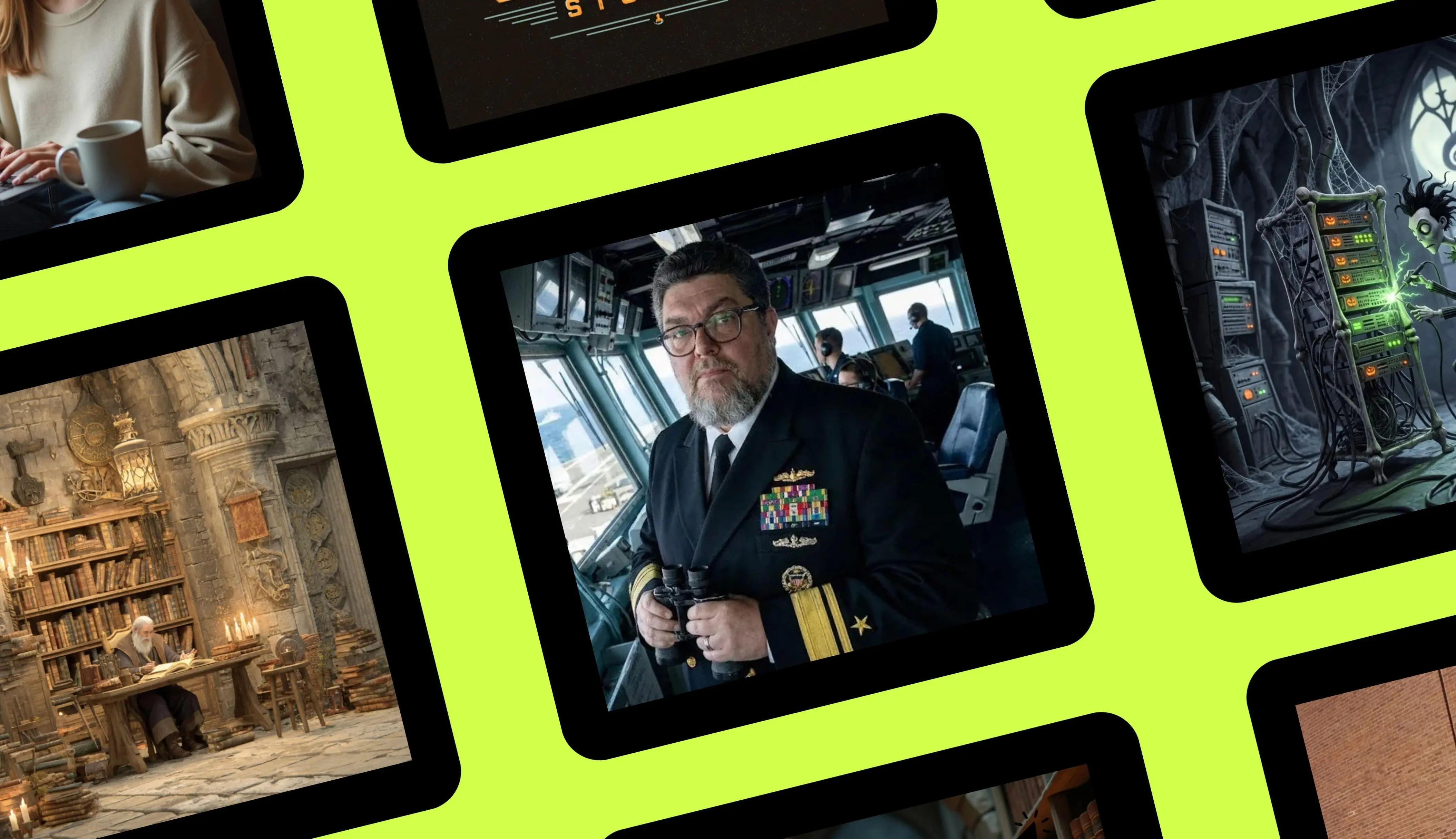
The evaluation used the same nine prompts across all six generators. The prompts included: dressing a man in a US Navy admiral’s uniform on an aircraft carrier bridge; restoring a black-and-white photo; restoring and colorizing a black-and-white truck photo; creating a retro-futuristic logo for a video studio named Space Coast Studios; generating a medieval librarian in a candlelit stone library; creating a photorealistic senior adult holding a flagship smartphone with Facebook-style ad copy; creating a candid student portrait with a MacBook Pro and coffee; designing a poster for a fictional fourth Back to the Future movie set in 1920s New York; and generating a Nightmare Before Christmas-style IT professional in a data center.
Each image was scored on specific criteria. For recontextualization, points depended on proper background, appropriate new clothing, and whether the original subject’s face and clothing were preserved. For restoration, points were given for keeping original elements, cleaning up damage, preserving facial features, and handling colorization. For logos, text accuracy and thematic fit mattered. For social posts, text placement, legibility, and realistic anatomy were considered. For pop culture, recognizability, style, and textual accuracy were judged.
Google Nano Banana Pro: the clear winner
Best AI image generator overall by a wide margin
- Overall score: 93%
- Cost: $19.99 per month as part of Google AI Pro
Nano Banana Pro dominated nearly every category. In the admiral recontextualization test, it kept the subject’s face and glasses, changed the angle he was facing, placed him properly on a ship bridge, and added binoculars to his hands. That level of identity preservation and scene coherence is rare among image generators.
It also performed well on old photo restoration. Given a dark childhood photo, it produced a cleaner, more visible image while preserving the original subject. When asked to restore and colorize a truck photo, it mostly preserved the lettering, though it introduced a small error: the text read something close to “BADICLOGICAL DEFEKSE” instead of “RADIOLOGICAL DEFENSE.” Even so, the result was far more accurate than most competitors.
Creative generation was another strong point. For the Space Coast Studios logo, Nano Banana Pro included a palm tree, a rocket, film imagery, and readable text. For the medieval librarian, it produced candlelight, stone walls, and a convincing character. For social media, it generated a senior adult holding an iPhone-like flagship smartphone with clean, correctly spelled text. It also created a student with a MacBook Pro and coffee in a cozy setting. Interestingly, when asked for a flagship smartphone, Google’s own AI generated what was clearly an iPhone.
Pop-culture prompts revealed the biggest gap. Nano Banana Pro produced a fictional Back to the Future poster with a DeLorean, a skateboard, period clothing, and a marquee reading “New York City 1925.” It added the tagline “The Roaring Twenties Got Heavy,” evoking both the era and a character’s favorite phrase. Its Nightmare Before Christmas-style IT professional also captured the Tim Burton aesthetic. The main drawbacks were a watermark in the bottom corner and one session where it confused an earlier subject with a truck cleanup request. It also occasionally cuts off free users after a limited number of images. Still, with a 93% score, it was the only tool that came close to acing the entire suite.
ChatGPT: strong chat iteration, inconsistent image results
Best for natural-language iteration in chat
- Overall score: 74%
- Cost: $20 per month as part of ChatGPT Plus
ChatGPT’s image generator, now part of the ChatGPT Images update, ranked second. Its biggest advantage is conversational iteration: users can refine an image through natural language in a chat interface. That flexibility makes it useful for brainstorming and quick edits. However, its image quality was uneven across the test suite.
Photo retouching was not a strength. The admiral recontextualization looked like the original subject, but the uniform insignia were unclear and seemed to mix ranks. The childhood photo restoration was good, preserving the original face rather than inserting an adult’s face onto a child’s body. The truck cleanup was acceptable but changed “RADIOLOGICAL DEFENSE” to “RADIO CHEMICAL DEFENSE,” with odd spacing.
Logo generation was fine, though it lacked Florida-specific cues like palm trees or sun. The librarian image met expectations. Social media posts were mostly correct, but both text blocks were placed in the same position, and the light font and poor contrast reduced readability. Points were deducted.
Pop-culture handling was the most inconsistent. A Star Trek-inspired prompt produced excellent results, even duplicating a creature’s man-in-suit look. But Back to the Future and Nightmare Before Christmas prompts were refused or mishandled. That inconsistency dropped the new version from 81% to 74%. The previous version had produced a decent Back to the Future image with a recognizable DeLorean and period city, though the Nightmare IT character had a questionable third hand. For now, ChatGPT remains a solid all-around assistant but not the most reliable dedicated image generator.
Midjourney: cinematic creativity, limited cleanup
Best for hyper-creative cinematic imagery
- Overall score: 57%
- Cost: $10 per month for Midjourney Basic
Midjourney has long been a favorite for artists and designers. It excels at original creative imagery, mood, and cinematic style. In this test, it produced a librarian scene that was almost exactly what was requested. Its social media portraits looked realistic, with believable skin and hands. Its Nightmare Before Christmas-style IT image was a standout: a photo-realistic Lurch-like character in a data center, mixing gothic horror with corporate infrastructure.
Where Midjourney struggled was in editing existing images. The admiral recontextualization did not preserve the subject’s identity. The childhood photo was not cleaned up and was arguably made worse. The truck prompt produced a different truck altogether, and inexplicably included a woman resembling a Star Trek captain. Midjourney also failed to render text on the social media posts, losing points. Its Back to the Future poster had no text and looked too neon for 1920s New York. For pure artistic generation, Midjourney remains powerful. For practical photo editing and text, it lags far behind.
Adobe Firefly: commercial safety at a cost
Best for commercial-safe images
- Overall score: 54%
- Cost: $9.99 per month as part of Firefly Standard, also included in many Adobe plans
Adobe Firefly is designed with copyright and commercial safety in mind. It powers AI features inside Photoshop and other Adobe tools, and it also works as a standalone web interface. Users can now choose other engines, including Nano Banana, but this test used Firefly Image 5 preview.
Firefly was the most restrictive generator. It refused to upload a personal photo because the subject wore a Star Trek-inspired Gorn T-shirt. The image had to be altered by another AI before Firefly would accept it. That caution may appeal to commercial users, but it creates friction. The admiral image barely resembled a uniform and did not preserve the face. The childhood photo transformation was good and visible. The truck colorization looked great, but Firefly did not clean up image artifacts, which was the main task. Logo generation was usable. The librarian image suffered from an uncanny valley face. Social media prompts triggered an error about artist names because the phrase “Facebook-style” was flagged. After removing it, Firefly generated images, but one had a spelling error and the student image had subtle anatomical problems. Pop-culture prompts were simply refused.
Leonardo AI: fantasy strength, editing refusal
Best for fantasy art
- Overall score: 52%
- Cost: $10 per month, also part of Canva Business plan
Leonardo AI refused the existing-image tests entirely. It would not attempt the admiral, restoration, or colorization tasks. That immediately limited its score. It performed better with original creation. The logo was workable. The librarian met the open-ended requirements. Social media posts had issues: the man’s inner elbow looked odd, and the woman’s leg wrapped around the laptop while she balanced coffee on her leg.
Leonardo’s Back to the Future prompt was notable because it was the first tool to actually format a poster. However, it invented sequels four through ten, produced gibberish text like “HAMY JOB OARY OF DOSE,” and included cars and buildings that were not from the 1920s. Its Nightmare Before Christmas-style IT image was a favorite: it captured the gothic feel and data center setting with a photo-realistic Lurch-like character. For fantasy and stylized art, Leonardo has clear strengths, but it is not a general-purpose image editor.
Canva: marketing integration, weak generation
Best to generate art right inside marketing designs
- Overall score: 43%
- Cost: $15 per month for Pro or $20 per month for Business, which includes Leonardo
Canva is a dominant force in marketing design. Its acquisition of Affinity Pro and release of free Affinity tools expanded its creative suite. Canva also offers its own generative AI features, separate from Leonardo, though Canva owns both. The Business plan includes Leonardo, making it an attractive bundle for marketers.
Canva’s image generator finished last. Its photo cleanup and recontextualization results were bizarre. The admiral image appeared to have trees growing on an aircraft carrier. It identified a beard but failed to include the requested truck. A disembodied woman’s head floated above wreckage that looked like a cross between a submarine and a Tesla tower. Logo and librarian images were fine, and logo generation was the only category where Canva earned full points. Social media posts were disappointing: text spacing was off, and the woman’s image had text that lost its way completely. Once again, coffee was balanced on a leg.
For pop culture, Canva produced a Back to the Future 4 poster with a Marty-like character, a DeLorean, and the proper logo format. But the text was gibberish, a girl appeared, an object floated in the sky, generator-like devices lined the road, and half the road was on fire. It also denied a Nightmare Before Christmas-style prompt even though it had allowed the Back to the Future reference. That inconsistency cost points and highlighted the uneven guardrails in its system. Canva’s inconsistent handling of a Back to the Future poster versus a Nightmare Before Christmas prompt remains one of the clearest examples of why the scoring gap is so wide.
Source: ZDNET News