

Should You Buy the Vision Pro?
The $3,500 Apple Vision Pro remains prohibitively expensive for many consumers, and reviews highlight that it does not easily integrate into most existing workflows. Some users have expressed regret after purchasing the headset. The device excels at watching movies, viewing 3D videos, and serving as a display for a Mac. However, its weight of over 1.3 pounds can cause fatigue, although Apple improved comfort with the Dual Knit Band introduced alongside the M5 chip. An external battery pack is required, and travel with the headset is cumbersome, even with Apple's Travel Case.
The Vision Pro is undeniably Apple's most technically advanced product and an impressive engineering feat. Potential buyers should try it at an Apple Store and conduct thorough research on its capabilities before purchasing. The headset is excellent for media consumption and can be used as a Mac display, but it has a limited selection of apps and games. Apple refreshed the Vision Pro with an M5 chip in October 2025, making now a good time to buy, as another update is not expected for at least two years.
Apple Vision Pro Overview
Apple Vision Pro is Apple's augmented and virtual reality headset, launching in February 2024 with an updated M5 model in October 2025. Apple refers to it as a spatial computer that blends digital content with the physical world. It is a mixed reality headset that displays augmented reality content overlaid on the real world and fully immersive virtual content. The headset is not see-through; everything is digital. For AR, cameras map surroundings into a digital image augmented with virtual elements. For VR, the cameras shut off to isolate the user.
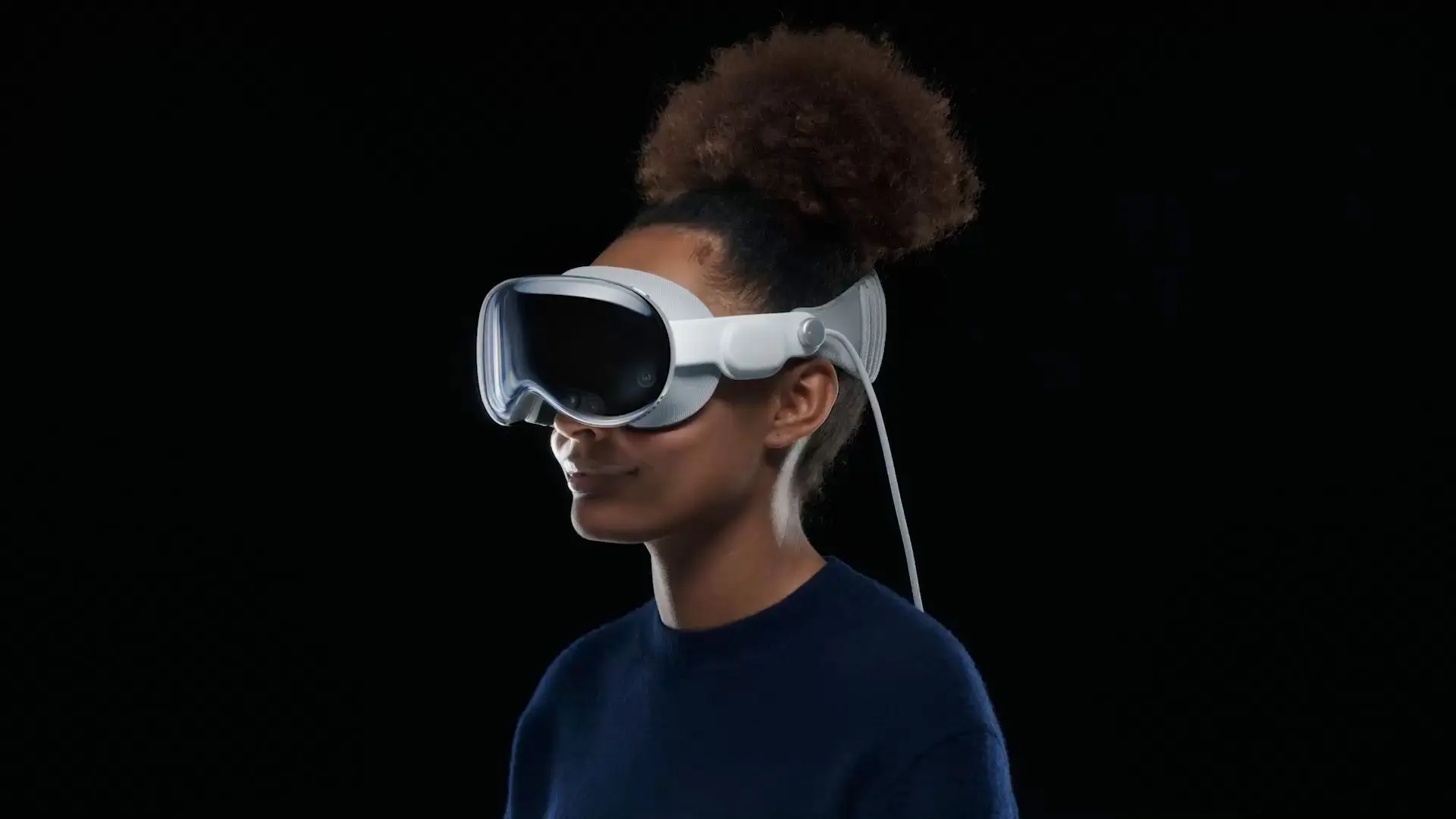
The experience is controlled by a Digital Crown that shifts between real and immersive modes. Design-wise, the Vision Pro resembles ski goggles with a single piece of laminated glass on the front that merges into an aluminum alloy frame. A soft Light Seal attaches magnetically to block out light. Two Audio Straps with built-in speakers deliver Spatial Audio and connect to a 3D knitted headband. The M5 model includes a Dual Knit Band with a second strap over the head for better weight distribution, featuring a Fit Dial for adjustment.
Inside the frame are two micro-OLED displays delivering over 4K resolution per eye (23 million pixels total). An external EyeSight display shows the wearer's eyes to others, indicating whether the user is in immersive mode or can see the surroundings. Custom prescription Zeiss Optical Inserts attach magnetically for glasses wearers. No physical controllers are used; navigation relies on eye tracking, hand gestures, and voice commands. More than a dozen cameras and sensors map the environment and track hand and eye movements. Optic ID uses iris scanning for authentication, similar to Face ID.
How It Works
The Vision Pro uses exterior and interior cameras for augmented reality, mapping the space and projecting the real world back to the wearer. This allows users to see an accurate picture of their environment with 3D windows and objects. The cameras can be turned off for an entirely virtual setting. The headset enables working, content consumption, gaming, and communication anywhere.
Design Details
The Vision Pro is a wearable spatial computing device worn over the head, similar to a high-end pair of ski goggles. It features a laminated glass front attached to a curved aluminum alloy frame, available only in silver. The Light Seal comes in various sizes and shapes for a tight fit that is essential for blocking light and proper operation. The audio straps at the sides have speakers supporting spatial audio, connecting to the Dual Knit Band. The headband is detachable and available in small, medium, and large sizes.
The Dual Knit Band, launched with the M5 model, has two 3D-knitted straps (one behind the head, one on top) knitted as a single piece for cushioning, breathability, and stretch. The lower strap includes flexible fabric ribs with tungsten inserts for counterweight. Physical controls include a Digital Crown for immersion adjustment and a top button for capturing 3D spatial photos and videos. A braided cable attaches to the left side for power, connecting to an external battery pack worn at the waist or a power adapter.
Display and Optics
The Vision Pro has two custom micro-OLED displays with a total of 23 million pixels, more than a 4K TV. The M5 version renders 10% more pixels for sharper text and visuals, with a refresh rate up to 120Hz for reduced motion blur. The external EyeSight display shows the wearer's eyes and can alert others when recording. Zeiss Optical inserts cost $149 for custom prescription or $99 for readers, attaching magnetically. They support prescriptions from -11.00D to +6.75D, but not prisms. Soft contacts are compatible; hard contacts are not.
Cameras and Sensors
The Vision Pro includes 12 cameras and five sensors for hand gesture monitoring and external environment mapping. Two cameras transmit over a billion pixels per second to depict the real world in AR mode. Others handle head tracking, hand tracking, and real-time 3D mapping. Infrared flood illuminators enhance hand tracking in low light, and LiDAR depth sensors determine room object sizes and locations. Four infrared cameras and LEDs inside the headset track eye movements for navigation. Navigation is done through eye movements, hand gestures, and voice commands. Bluetooth keyboards, mice, trackpads, and game controllers can be connected for alternative input.
Optic ID uses iris scanning for security, unlocking the device, authenticating purchases, and replacing passwords. A 3D camera on the exterior captures 3D video and photos viewable on the headset, with a clear indicator when recording to prevent secret capture.
Audio and Connectivity
Speakers are built into the head straps, featuring dual-driver audio pods near each ear that adapt sound to the room. They support spatial audio for an immersive experience. Six microphones handle calls and voice commands. The Vision Pro pairs with AirPods for superior audio; USB-C AirPods Pro 2 and AirPods Pro 3 support 20-bit, 48 kHz lossless audio with ultra-low latency. Connectivity includes Wi-Fi 6 (2.4GHz and 5GHz bands) but not Wi-Fi 6E.
Processors and Performance
The Vision Pro is powered by the M5 chip built on third-generation 3-nanometer technology, with a 10-core CPU (six efficiency cores, four performance cores) and a 10-core GPU. Each GPU core includes a Neural Accelerator for improved AI workloads. The M5 features third-generation ray-tracing, second-generation dynamic caching, and enhanced shader cores. An improved 16-core Neural engine boosts AI performance up to 50% over the M2. Unified memory bandwidth is 153GB/s, allowing the chip to use a single memory pool for AI models. The M5 enables rendering 10% more pixels and refresh rates up to 120Hz for crisper details and reduced motion blur.
The R1 chip works alongside the M5 to process input from cameras, sensors, and microphones, streaming images to the displays within 12 milliseconds for a virtually lag-free view. A thermal system quietly moves air to control heat. The Vision Pro has 16GB of RAM and storage options of 256GB, 512GB, or 1TB.
Battery Life
The M5 Vision Pro offers up to three hours of video playback and up to 2.5 hours of general use, a half-hour improvement over the M2 model. Battery packs are swappable, but only one is included. When plugged into a power adapter, the headset can run all day.
visionOS Operating System
visionOS is the operating system with a full three-dimensional interface navigated by eye movements, hand gestures, and voice. Apps can be placed anywhere in virtual space and resized. Users can adjust immersion using the Digital Crown to see content in their actual surroundings or a virtual Environment. A Persona is created for FaceTime and video apps, reflecting face and hand movements in real time. visionOS supports Spatial Audio and Apple Immersive Videos with 180-degree high-resolution recordings.
Mac integration allows the Vision Pro to serve as a 4K display for a Mac. Travel Mode works on planes, cars, or trains, and Guest Mode lets others try the headset. visionOS 26 (released September 2025) introduced persistent widgets, improved Personas, shared experiences with other Vision Pro users, iPhone viewing, Jupiter Environment, and spatial scenes for 2D images. visionOS 27 (coming September 2026) includes Siri AI with generative AI models, Visual Intelligence, Image Playground, improved Safari, Passwords app upgrades, Freeform improvements, 3D model editing, Dwell Control, screen recordings, 3D panoramas, Thórsmörk Environment, curved windows, extra-small widgets, redesigned Control Center, faster startup and Wi-Fi, and immersive web experiences.
Medical Warnings
Apple advises consulting a healthcare professional before using the Vision Pro for medical conditions such as heart conditions, migraines, dizziness, eye conditions, psychological conditions, inner ear conditions, dry eyes, skin allergies, seizures, and balance issues. Pregnant individuals should exercise caution due to increased risk of nausea or loss of balance. The headset and battery pack may interfere with cardiac pacemakers, hearing aids, and defibrillators.
What's Next for Vision Pro
Apple is developing smart glasses similar to Meta Ray-Bans without a display, featuring speakers, microphones, and a camera for AI. Expected launch in late 2026 or 2027. A cheaper enclosed headset is not in active development; a new Vision Pro model is unlikely before late 2028 or 2029, according to Bloomberg's Mark Gurman. Apple analyst Ming-Chi Kuo believes Apple is not working on a new headset but on two smart glasses products: AI smart glasses and AR smart glasses with a display.
Apple's Long-Term AR/VR Plans
Apple halted work on augmented reality smart glasses connected to the Mac in January 2025 after earlier attempts to pair with iPhone failed. Tim Cook remains focused on AR glasses. First-generation display-less AI smart glasses will rely on Siri, with a future version featuring a small in-lens display that could run visionOS when paired with a Mac or a mobile-friendly interface when paired with an iPhone. Ming-Chi Kuo predicts XR glasses with LCoS display and waveguide optics in 2028, with a variant possibly by 2029. Apple has tested using Vision Pro for mental health diagnosis and eye-tracking for heart failure detection. Future accessibility settings may help eye diseases. Kuo also suggests augmented reality contact lenses could launch in the 2030s, bringing invisible computing.
Source: MacRumors News