
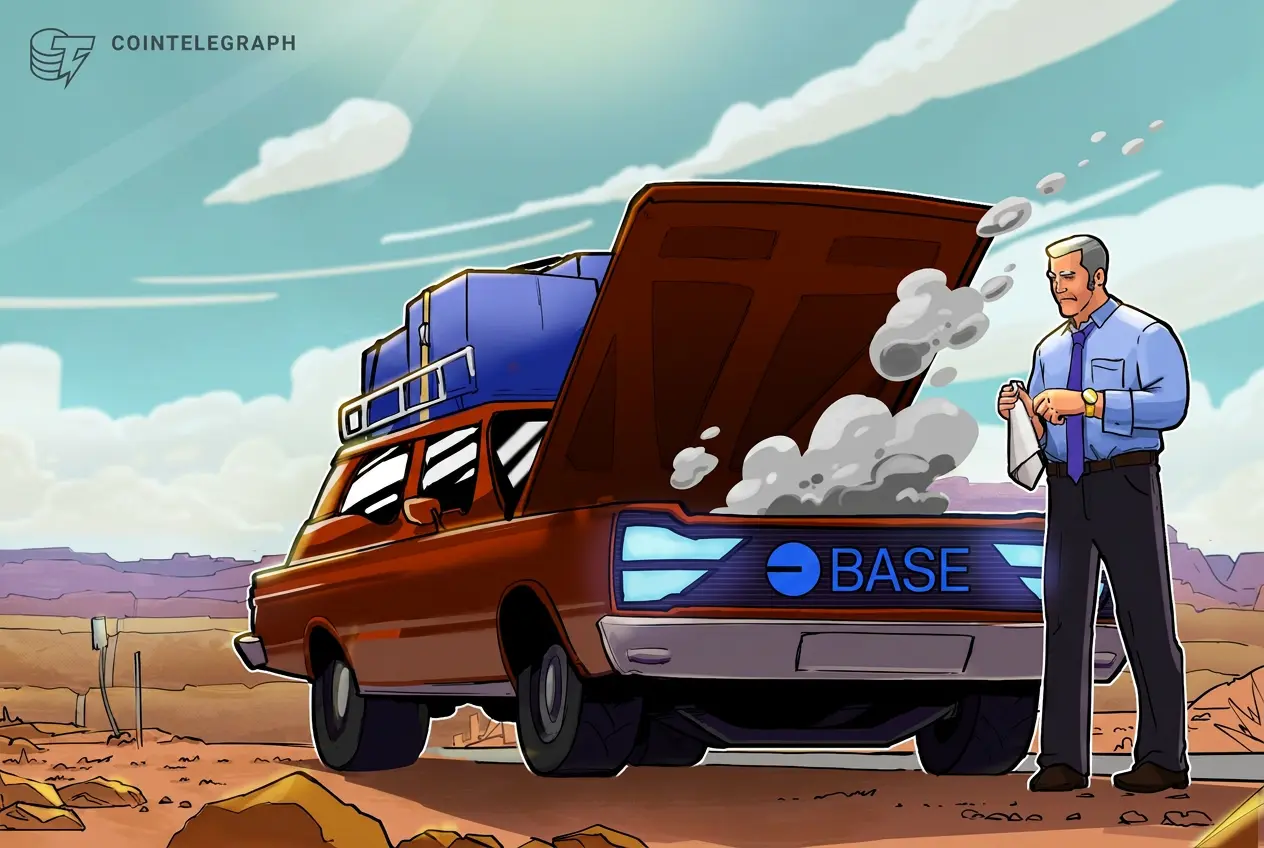
Base, the Ethereum layer-2 blockchain developed and maintained by Coinbase, resumed normal block production on Thursday after a nearly two-hour outage caused by a consensus problem. The disruption began at approximately 4:03 PM UTC, when Base's status page reported that block production had become unhealthy. The team later identified the root cause as an invalid block that had been sequenced by the network's validator set, preventing subsequent blocks from being created. By 5:21 PM UTC, the team had isolated the issue, and by 6:00 PM UTC, they confirmed that healthy blockbuilding had been restored and that ecosystem-wide infrastructure was able to sync.
This outage is a rare but significant event for Base, which is currently the most widely used Ethereum layer-2 network by total value locked and daily transaction volume. The network last experienced a major outage in August 2025, which lasted 33 minutes. That incident was also attributed to a consensus-related anomaly, though the specific details differed. The recurrence of such an issue raises questions about the robustness of Base's sequencer and validator infrastructure, particularly as the network continues to scale to support increasing demand from DeFi, NFTs, and institutional applications.
Base creator Jesse Pollack quickly assured users on social media that all funds on the network remained safe throughout the incident. In a post to X, he emphasized that while a halt is unacceptable, the team would use the event to further strengthen Base as a platform for global, round-the-clock finance. He also noted that the underlying data integrity was preserved, and no transactions were lost or compromised. The outage occurred independently of a highly anticipated network upgrade named Beryl, which was scheduled to activate at 6:00 PM UTC on the same day.
The Beryl upgrade was originally planned to enhance Base's withdrawal mechanism, reducing the time required for users to move assets from the layer-2 back to Ethereum mainnet. It also introduces a new token standard designed specifically for real-world assets (RWAs) and stablecoins, which are areas of increasing focus for institutional adoption. Despite the outage, the upgrade proceeded on schedule, and early reports indicate that it was implemented without further complications. The timing of the two events, however, has drawn attention to the challenges of coordinating infrastructure changes on a live network that processes billions of dollars in transactions daily.
Consensus problems on blockchains are not uncommon, especially on networks that rely on a single sequencer or a small set of validators. Base currently uses a single sequencer model, which is typical for many layer-2 solutions in the Ethereum ecosystem. While this design simplifies transaction ordering and reduces costs, it also creates a single point of failure. If the sequencer produces an invalid block, the entire chain can stall until the issue is resolved. Decentralizing sequencers is an active area of research and development, with several proposals aiming to rotate or share sequencer responsibilities among multiple parties. Base has not yet announced a specific timeline for implementing such changes, but the recent outage may accelerate those plans.
Historical precedents for blockchain downtime include incidents on networks such as Sui, a layer-1 blockchain that experienced two consecutive days of halted block production in May 2026. Sui engineers later explained that a network update had introduced a low-probability bug that caused validators to disagree on the state of the chain. Solana has also faced multiple outages over the years, often linked to congestion or issues with its proof-of-history consensus mechanism. These examples highlight that even mature, well-capitalized blockchain networks are susceptible to temporary disruptions, and the industry continues to learn from each event.
For Base, the outage comes at a time when Coinbase is aggressively expanding its blockchain services beyond crypto trading. The exchange recently announced that users could transfer stock portfolios on its platform, signaling a move toward a full-service financial ecosystem. Base itself is positioned as a cost-effective and developer-friendly environment for building decentralized applications. Its total value locked has grown steadily, supported by major DeFi protocols such as Uniswap, Aave, and Curve. The network also serves as a settlement layer for several fiat-backed stablecoins, including USDC issued by Circle, which has a deep integration with Coinbase.
The broader context of the outage involves the increasing reliance on layer-2 networks for scaling Ethereum's transaction capacity. As Ethereum's mainnet remains congested during peak periods, solutions like Base, Arbitrum, and Optimism have become essential for everyday users and enterprises. However, each layer-2 operates with its own trust assumptions and operational risks. Base, in particular, is still relatively young compared to its competitors, having launched its mainnet in August 2023. Its rapid adoption has outpaced the maturity of its infrastructure, leading to occasional growing pains.
Industry observers have noted that the two-hour downtime did not result in any financial losses, which is a positive indicator of the system's safety design. However, the psychological impact on user confidence cannot be ignored. Traders who rely on speedy transactions for arbitrage or liquidation might have been affected, and some decentralized applications may have seen reduced activity during the blackout. The Base team has committed to publishing a full post-mortem, which will likely include root cause analysis, mitigation steps, and future prevention methods. Such transparency is crucial for maintaining trust among developers and users.
The incident also highlights the importance of robust monitoring and incident response protocols. Base's status page provided near-real-time updates throughout the event, which helped manage community expectations and prevent misinformation. Automated alerts probably triggered the investigation, and the engineering team worked under pressure to restore service within two hours. This turnaround time is relatively fast compared to some other blockchain outages, which have dragged on for several hours or even days.
Looking ahead, Base's roadmap includes further decentralizing its sequencer set, improving cross-chain interoperability, and supporting more complex smart contract use cases. The Beryl upgrade is a step in that direction, particularly with its focus on real-world assets, which could attract traditional financial institutions looking to tokenize stocks, bonds, and commodities. Stablecoin issuers are also exploring Base for lower transaction costs compared to Ethereum mainnet, and the new token standard in Beryl is designed to meet their compliance and operational needs.
While the outage was an unwelcome disruption, it also presents an opportunity for the Base team to demonstrate their resilience and commitment to continuous improvement. The blockchain space is notorious for high risk and frequent technical challenges, and how a project responds to a crisis often determines its long-term reputation. By responding quickly, maintaining open communication, and pledging a thorough investigation, Base appears to be taking the right steps. Users will be watching closely to see if the upcoming post-mortem reveals any systemic weaknesses that require architectural changes.
In summary, the brief halt in Base's block production serves as a reminder that even the most advanced blockchain networks are still evolving. The fact that the network resumed without loss of funds and that the Beryl upgrade went ahead as planned is encouraging. However, the recurrence of consensus-related issues within less than a year suggests that more fundamental improvements are needed. As Coinbase continues to push Base as a foundational layer for the future of finance, reliability will be paramount. The coming weeks will likely see intensified engineering efforts to harden the network against similar failures, ensuring that Base can fulfill its promise of a secure, scalable, and always-available platform for decentralized applications.
Source: Cointelegraph News