

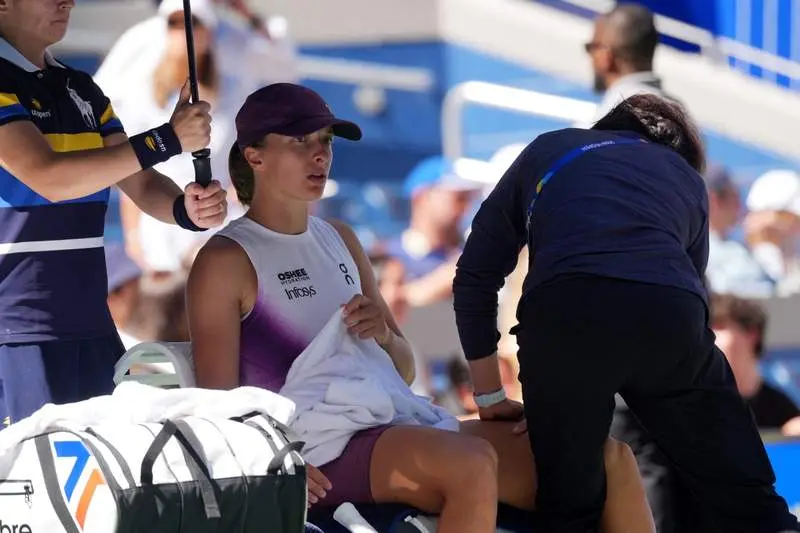
The 2026 US Open was supposed to be the stage where Iga Świątek once again proved she could conquer the fastest-and-bounciest hard courts in the world. Instead, the Polish star turned in one of the most baffling performances of her career and walked away from Flushing Meadows with a fourth-round exit, a bitter smile, and a sharp response to a reporter who dared to ask about the unthinkable. On Monday, September 7, Świątek held a 5-0 lead in the opening set against China’s Zheng Qinwen, only to watch that advantage melt away. She lost the set 7-5, then lost the second 6-3, and with it, she lost her final chance to claim a Grand Slam title in 2026.
The defeat was a fitting—though painful—encapsulation of a season that began with immense promise and ended with the 25-year-old holding just one WTA trophy. Świątek, the former World No. 1 and the 2022 US Open champion, will now look back on 2026 as the first year since 2021 in which she failed to capture a major singles title. It was a stat line that seemed unthinkable when she arrived in New York carrying the form that had produced a title in Toronto and a semifinal run in Cincinnati.
A Stunning Collapse
Świątek’s path through the early rounds in New York had been, by her standards, quite tidy. She dismissed Wang Xiyu 6-2, 6-3 in the first round, eased past Nadia Podoroska 6-3, 6-2 in the second, and then endured a high-pressure battle against Marie Bouzková in the third round, eventually scraping through 7-6(3), 7-6(3). The Pole seemed to be building momentum with each match, and her powerful baseline game looked well suited to the punishing courts of the Billie Jean King National Tennis Center.
But Zheng Qinwen, a qualifier who had once been ranked as high as No. 7 in the world, was no ordinary opponent. The 23-year-old had suffered through a brutal period marked by a lingering elbow injury that ultimately required surgery, sending her tumbling out of the top 100. Coming into the US Open, she had to navigate qualifying just to reach the main draw. Once there, she displayed the kind of grit and shot-making that had once made her a Grand Slam finalist. Zheng opened with three-set victories over Kristina Liutova and Yulia Putintseva, then produced one of the signature wins of the tournament by rallying from 0-5 in the deciding set against Madison Keys, the 2025 Australian Open champion, to win 1-6, 7-6(3), 7-5.
Against Świątek, Zheng again found herself trailing by an alarming margin in the opening set. Świątek came out firing, breaking Zheng multiple times to race to a 5-0 lead with a double-break in hand. The crowd, which had already witnessed a similar comeback in Zheng’s previous match, began to sense that nothing was truly decided. Sure enough, Świątek’s level dipped. Her trademark forehand, usually a laser-guided weapon, started spraying errors. Zheng, by contrast, began reading her opponent’s serve better and stepping inside the court to take time away from the Pole.
“I felt like I started missing too many shots. She started playing in. I let her back into the match,” Świątek admitted in her post-match press conference. The statistics backed that assessment: Świątek’s first-serve percentage dipped below fifty percent in the opening set, and her unforced error count ballooned. Zheng broke back and, after leveling at 5-5, seized the momentum. She took the set 7-5, and the wind appeared to go out of Świątek’s sails. The second set followed a similar pattern, though without the early lead. Zheng broke serve early and never looked back, closing out the match with a confident 6-3 set to seal her place in the quarterfinals.
Press Conference Tension
The questions that followed Świątek into the interview room were perhaps more pointed than usual, and the former World No. 1 seemed in no mood to dwell on what many considered a catastrophic collapse. When a reporter asked how she processed such an unusually lopsided scoreline that had slipped away, Świątek gave a blunt and sarcastic reply.
“It’s just one match. I’ll try to play the same way as usual. What do you mean? Like, do you think it’s something crazy?” she said, her tone making clear that she found the question to be somewhat exaggerated. “You know, you can lose a set from any score. So, nothing special about that. Just that’s what happened, and that’s it.”
Her response drew a few raised eyebrows in the room, but it was consistent with the stoic, almost unbothered public persona that Świątek has often presented in difficult moments. Still, it was difficult to ignore the tension in her voice. When another reporter mentioned the often-chaotic nature of the US Open and asked whether that had affected her comfort level, Świątek was equally curt.
“I think it’s chaotic for everyone. So you just need to deal with it, and I’ve been fine. Thanks.”
She did, however, offer a brief explanation for the medical timeout she took during the third round match against Bouzková, which had raised concerns among fans about her physical condition. The issue, she said, was a tired quadriceps muscle that required a quick treatment from the physio.
“I’ve been fresher, but just little, you know, my quad is quite tired, but it had no influence on the game. Just wanted to give it a little boost, but yeah, it didn’t influence anything.”
Zheng Qinwen’s Cinderella Story
While Świątek’s exit dominated the headlines, the other side of the net belonged to a player whose journey to this moment was arguably even more compelling. Zheng Qinwen had burst onto the scene in 2024, when she reached the Australian Open final and captured the tennis world’s attention with her powerful serve and fearless playing style. She also won gold at the 2024 Paris Olympics, cementing her status as one of the rising stars of the WTA tour. However, a persistent elbow problem soon derailed her trajectory, forcing her to undergo surgery and spend months on the sidelines. Her ranking, once a career-high of No. 7, fell outside the top 100, and she was forced to play qualifying at Flushing Meadows, a stage she had once graced as a seeded player.
But Zheng has never lacked self-belief. After qualifying, she disposed of her first two main-draw opponents in three sets each, grinding out wins against Kristina Liutova and Yulia Putintseva. Then came the third-round encounter with Madison Keys, where Zheng once looked utterly outclassed. She lost the first set 1-6 and fell behind 0-5 in the third set. It was then that the Chinese star found a level that stunned the stadium: she won seven consecutive games to complete one of the most improbable comebacks of the tournament, closing out the match 1-6, 7-6(3), 7-5.
Against Świątek, Zheng again appeared on the brink in the opening set at 0-5, but she did not panic. Instead, she leaned on her experience and her conditioning, steering Świątek into longer rallies and forcing the Pole to go for more than she was comfortable with. The result was a masterclass in pressure management. Zheng’s victory not only earned her a place in the US Open quarterfinals but also served as a powerful statement that she had returned to the game’s elite level. For a player who had dropped so far in the rankings, it was a dramatic redemption arc.
A Season of Missed Opportunities
For Świątek, the US Open loss represented the final chapter of a 2026 major season that had started with so much hope. At the Australian Open, she reached the semifinals before falling in a tense three-setter. At Roland Garros, where she has historically been nearly unbeatable, she was stunned in the quarterfinals—a result that still ranked among the most shocking upsets of the year. Wimbledon, a tournament she has often struggled to master, saw her exit in the fourth round. Combined with the fourth-round defeat in New York, Świątek won just 12 matches in Grand Slam play in 2026, her lowest tally since the year she won her first major title in 2020.
The statistic is all the more striking given that Świątek has been a dominant force on the WTA circuit for the better part of half a decade. She has spent many weeks at the top of the rankings, claimed numerous WTA 1000 titles, and established herself as the most consistent clay-court player of her generation. Yet on hard courts, particularly at the US Open, she has often appeared a step slower or a shot less reliable than her rivals. She had reached the quarterfinals in New York in each of the previous two years, and many analysts believed that with her improved serve and more aggressive mindset, she was finally ready to challenge for a second title at the event.
The American swing did offer some encouragement. Świątek won the WTA 1000 event in Toronto, defeating several top-20 players along the way. She then advanced to the semifinals in Cincinnati, where she lost narrowly to the defending champion. These results were enough to place her among the pre-tournament favorites in New York, and her early-round form only reinforced that impression. Yet in her fourth-round match against Zheng, the old vulnerabilities resurfaced: a lapse in focus, a dramatic dip in first-serve percentage, and an inability to close out a set she had thoroughly dominated. The 5-0 collapse was not an anomaly; it was, as one commentator put it, the worst possible scenario for a player trying to prove she could be trusted at the majors.
What’s Next for Świątek
The immediate future for Świątek involves turning her attention to the Asian hard-court swing, a segment of the season where she has traditionally collected significant points. She is scheduled to play at a WTA 500 event in Guangzhou, followed by the WTA 1000 tournament in Beijing, where she has enjoyed strong support from the Chinese fans. These results will be crucial for her ambitions of qualifying for the WTA Finals, which will be held in Fort Worth, Texas later this year. With her rivals accumulating points at the majors, Świątek needs to reach the latter stages of several more tournaments to secure her spot in the year-end championship.
But the most pressing concern remains mental rather than technical. Świątek has often spoken about the importance of staying present on court, yet her body language during the match against suggested she struggled to recover from the shock of losing a 5-0 lead. The question that she dismissed with such irritation is the same one that tennis observers have repeatedly asked over the years: how can a player of her caliber, with so many titles and such deep experience, repeatedly find herself vulnerable to momentum swings of this magnitude?
Świątek’s response—that losing a set from any score is common—was technically correct. Players have blown big leads before, and tennis is famously a game of momentum shifts. But the manner of this defeat, coming at a Grand Slam against a qualifier who had to rally from 0-5 in her previous match, suggests that there may be deeper issues to address. The Pole does not lack for confidence, nor does she lack for skill. What she seems to be searching for is a way to bridge the gap between her often flawless groundstrokes and the erratic decision-making that surfaces when pressure reaches its peak.
With the Asian swing beginning in a matter of days, Świątek will have an opportunity to reset and rebuild her rhythm. The WTA Finals remain within reach, and a string of deep runs could still make this season look respectable from a points perspective. But no amount of wins in smaller tournaments will erase the sting of this US Open exit if she fails to address the pattern that produced it. For now, her fans can only hope that her blunt answer to a lingering question will not prove to be the most memorable moment of her 2026 season.
Source: AOL.com News