

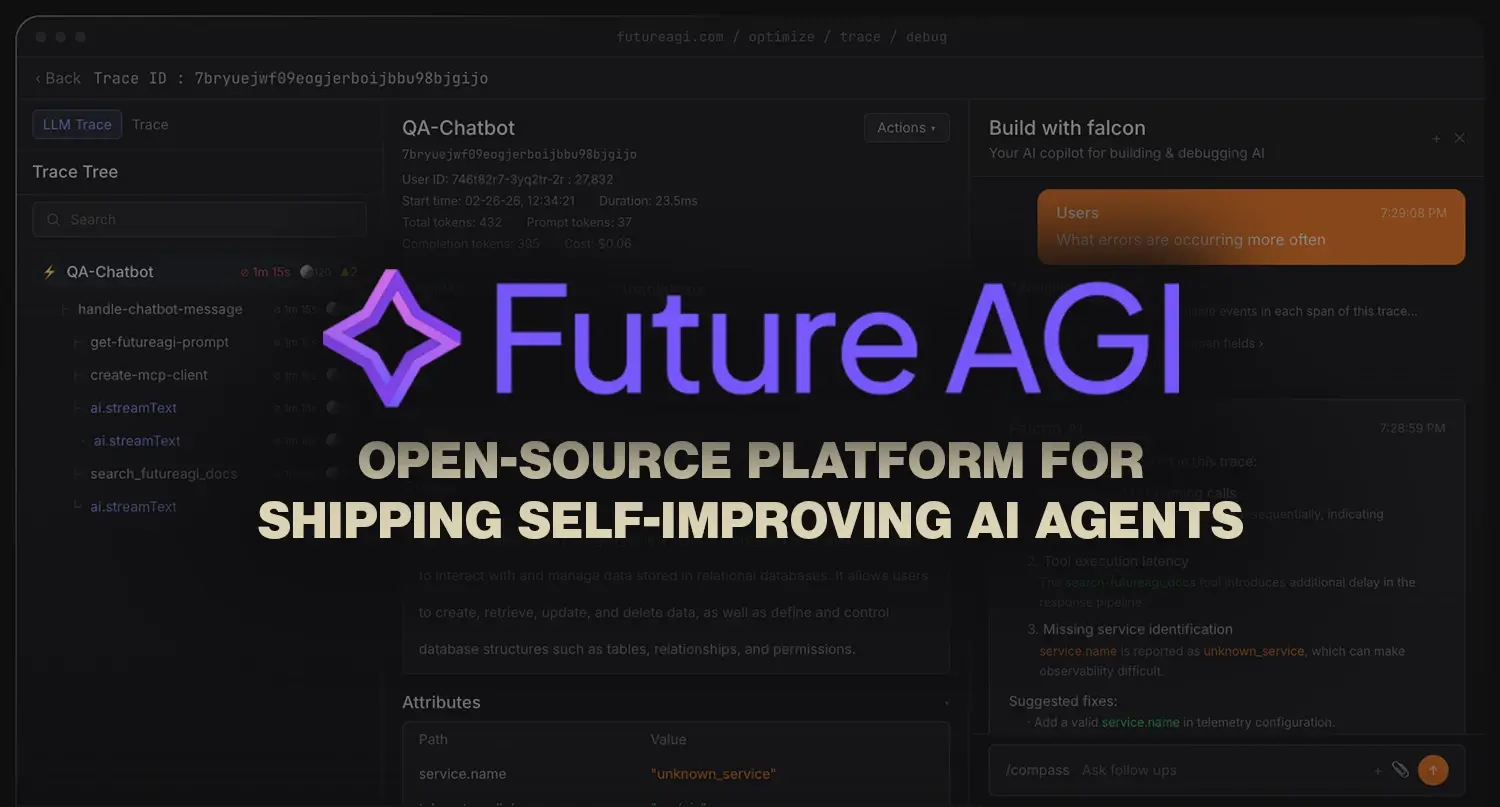
Future AGI has arrived as an open-source platform for teams that want to build, observe, and protect self-improving AI agents. The project is distributed under the Apache 2.0 license and is designed to be self-hosted, giving organizations full control over the infrastructure where their agent traces, prompts, and model outputs are stored. Its stated mission is to cover the entire lifecycle of LLM agents, including tracing, evaluation, simulation, and guardrailing, in a single deployable stack.
The rise of self-improving AI agents
Modern AI agents are no longer limited to single-turn question answering. They can be given a goal, break it into subtasks, call external tools, consult databases, and revisit their own reasoning based on the results. Some frameworks allow agents to learn from past interactions and iteratively improve their performance, which is what the phrase 'self-improving' refers to in practice. These agents are powerful, but they also introduce a level of complexity that traditional monitoring cannot handle.
Because agent behavior is generated rather than deterministic, teams need a way to inspect every step. They also need the ability to replay scenarios, test different model configurations, and identify the exact cause of unexpected outputs. Future AGI's tracing component is intended to provide that detailed record. All spans land in ClickHouse, an open-source analytics database optimized for high-volume queries. Prompt text, model output, and tool calls are captured by the tracer on the way into storage, giving developers a clear audit trail for each run.
Telemetry and data governance
One of the first things an operator will notice is that the platform can register itself with Future AGI on first boot. The self-hosted instance sends an instance ID, a version string, a deployment type, and the email addresses and domains of active admin users. This registration fires only once, before anyone signs in to the dashboard. An environment variable named FUTURE_AGI_TELEMETRY_DISABLED, set to 1 in the .env file, opts out of that call entirely.
The timing matters. If the environment variable is not set before the first start, the one-time registration has already taken place and the admin list has left the network. Disabling telemetry also suppresses periodic heartbeats and removes email addresses from the census ping, leaving only a basic instance ID, version, and deployment type if that data was already sent. For organizations with strict data sovereignty requirements, the project's documentation advises turning off networking at the edge for full silence. This makes Future AGI compatible with air-gapped and on-premise deployments, a fact that is likely to appeal to regulated industries.
Telemetry is a common point of tension in open-source infrastructure. Some users prefer zero network calls, while developers say anonymized data helps improve compatibility. Future AGI has taken a middle path: it is transparent about what is collected, when it is sent, and how to disable it, but the operator must make the choice before initial startup.
What the installer includes
Future AGI is not a single binary. It provides an installer that brings up a complete backend stack with ClickHouse, PostgreSQL, Redis, RabbitMQ, and Temporal, all sitting behind a dashboard on localhost:3000. Each of those components plays a specific role. ClickHouse stores trace data for fast analytics. PostgreSQL handles relational metadata. Redis provides caching and message queuing support. RabbitMQ manages task distribution. Temporal supplies durable workflow execution for long-running agent tasks.
Spans from agent executions are stored in ClickHouse, and the tracer is positioned so that prompt text, model output, and tool calls pass through it before being written to the store. That detail is important for both security and debugging. A comprehensive trace can help replicate an issue, prove compliance with audit policies, and understand a model's behavior under adversarial conditions.
Wide framework support through OpenTelemetry
The platform relies on OpenTelemetry to provide instrumentation across more than 50 agent frameworks, including LangChain, LlamaIndex, CrewAI, and DSPy. OpenTelemetry is a widely adopted observation standard, and using it means Future AGI can connect to the broader monitoring ecosystem. Teams that already use OpenTelemetry for their microservices can extend the same principles to AI agent behavior.
The choice of frameworks matters because the agent stack is fragmented. Some teams rely on orchestration libraries like LangChain to manage chain-of-thought workflows. Others use CrewAI to create teams of agents with distinct roles. DSPy is popular for programming rather than prompting, allowing users to optimize LM pipelines. By supporting multiple frameworks, the platform tries to be a neutral layer of observability and protection rather than forcing teams to migrate to a single agent framework.
The gateway in front of everything
The Agent Command Center is the control plane of Future AGI. It functions as an OpenAI-compatible proxy that fronts more than 100 providers. This design has immediate implications for security and cost control. Every provider credential in a deployment terminates at the gateway, meaning developers no longer need to scatter API keys across separate services. The gateway supports routing strategies, semantic caching, virtual keys, Model Context Protocol (MCP), and Agent-to-Agent (A2A) communication.
Semantic caching is especially useful for LLM workloads. Instead of caching exact strings, the gateway can detect that two prompts have the same meaning and serve a cached response, reducing latency and cost. Virtual keys allow administrators to issue scoped credentials to different teams or agents without revealing the underlying provider key. Routing strategies enable intelligent selection among models based on cost, latency, or capability requirements. MCP and A2A make it easier for agents to exchange context and collaborate with other agents.
Built-in security scanners and guardrails
Security is not an afterthought in the platform. Protect, the safety layer, ships with 18 built-in scanners designed to identify PII, jailbreak attempts, and prompt injection attacks. Prompt injection is one of the most urgent risks in generative AI, because a malicious input can trick an agent into performing unintended actions or leaking data. PII scanning is equally important in regulated environments where user data must not enter model contexts without approval.
In addition to the built-in scanners, Future AGI provides vendor adapters for Lakera, Presidio, and Llama Guard. This allows organizations to use specialized services they may already have in their security stack. Scanners can run inline in the gateway or standalone through the SDK. Inline scanning introduces a latency cost, but the project reports P99 latency at or under 21 milliseconds on its benchmark harness. That number is significant for production environments where slow responses can frustrate users and disrupt real-time agent workflows.
Open-source availability and deployment options
Future AGI is freely available on GitHub, consistent with its Apache 2.0 license. Self-hosted deployment is a core use case, and the documentation stresses that air-gapped and on-premise installations are supported. Since the entire stack is containerized through the installer, a team can bring up the platform without relying on a commercial SaaS control plane.
This openness also makes it possible for security researchers and auditors to inspect the code that handles prompts, credentials, and telemetry. In an environment where AI security incidents are increasing, the ability to verify claims through source code is a practical advantage.
What this means for AI agent teams
The combination of tracing, evaluation, simulation, and guardrailing in one open-source platform could give teams more confidence in moving agents from prototype to production. AI agents remain difficult to control, but a self-hosted platform that captures every step and applies multiple layers of filtering addresses some of the core pain points. The emphasis on OpenTelemetry also suggests a future where AI infrastructure is monitored with the same maturity as conventional cloud applications.
Operators considering Future AGI should be aware of the telemetry registration process and configure the environment variable before the first boot if they want to run completely silent. From there, the platform offers a comprehensive set of tools for evaluating, protecting, and routing agent workflows. With support for over 100 providers and 50 frameworks, it is positioned as a flexible option in a quickly changing landscape.
Source: Help Net Security News