

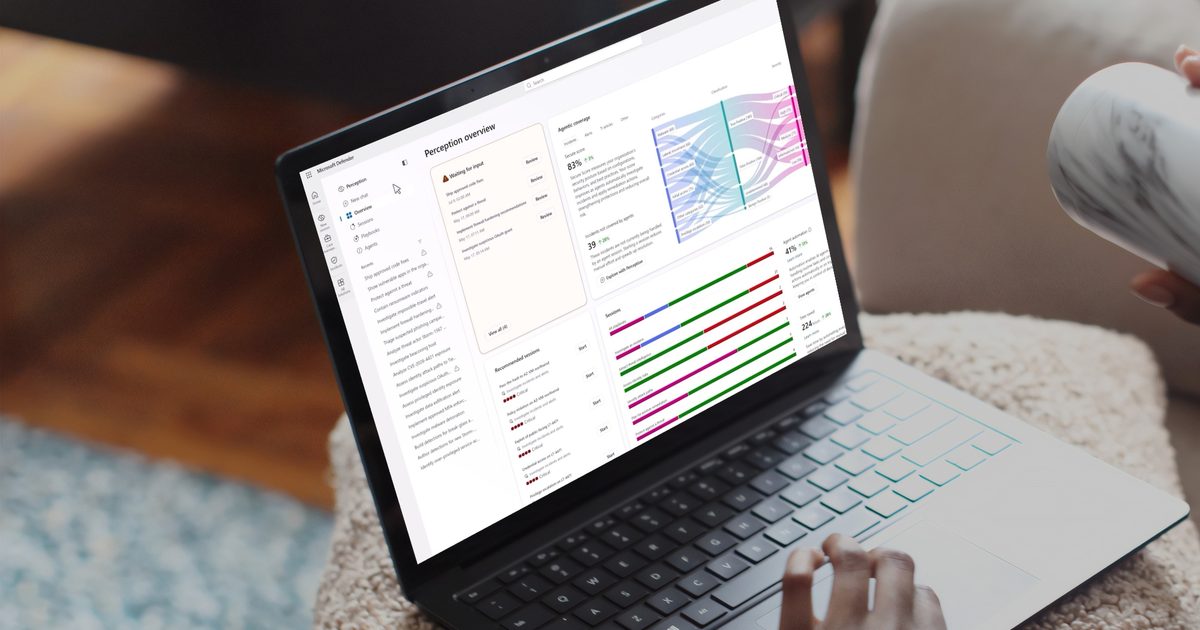
In the escalating arms race of cybersecurity, artificial intelligence has become both a weapon and a shield. Attackers now leverage AI to generate sophisticated exploits, automate reconnaissance, and execute breaches at machine speed. Traditional security tools, designed for a slower, human-paced world, are struggling to keep up. Microsoft believes it has the answer with Project Perception, an AI agentic security system that anticipates and neutralizes threats before they can cause damage.
What is Project Perception?
At its core, Project Perception is an AI-driven security framework that continuously monitors, reasons, and acts across an organization's entire digital footprint. Instead of overwhelming security teams with alerts, it uses three specialized AI agents operating in a coordinated loop:
- Red team agents proactively hunt for vulnerabilities and weaknesses before attackers can exploit them.
- Blue team agents investigate those identified weaknesses, analyzing context and severity to distinguish real threats from noise.
- Green team agents automatically apply fixes or remediations, closing security gaps without manual intervention.
These agents work together in a continuous learning cycle, improving their effectiveness over time. Crucially, a human operator retains final authority, ensuring oversight and accountability.
Why Microsoft's approach stands out
Microsoft argues that its unique advantage lies in unparalleled visibility. The company can see across identities, devices, applications, data, and cloud systems, giving it a holistic view of the attack surface. This visibility is paired with a multi-model AI architecture that selects the most appropriate model for each task rather than relying on a single monolithic system.
Underpinning Project Perception is what Microsoft calls its new cyber stack: a chain that converts raw telemetry signals into contextual insights, which are then fed to models and agents that execute actions. The goal is to provide defenders with actionable information rather than just more alerts.
One concrete example is MAI-Cyber-1-Flash, a specialized AI model now integrated into MDASH, Microsoft's vulnerability management tool. According to Microsoft, this model achieves a 96% score on the CyberGym benchmark—12 percentage points higher than the current best model, Mythos—while reducing operational costs by nearly half.
Project Perception enters public preview on August 3, 2024. Microsoft emphasizes that the system is built from the ground up with its Responsible AI principles, addressing concerns about bias, transparency, and control.
Key facts at a glance
- Microsoft introduces Project Perception, an AI agentic security system using red, blue, and green agents.
- The system leverages Microsoft's extensive visibility across identities, devices, apps, data, and cloud.
- It employs a multi-model AI approach, selecting the best model for each task.
- MAI-Cyber-1-Flash, the first specialized model, scores 96% on the CyberGym benchmark, outperforming Mythos by 12 points while cutting costs nearly in half.
- Public preview begins August 3, 2024.
- Built with Microsoft's Responsible AI principles.
Expanded analysis: AI in cybersecurity
The rise of generative AI has dramatically lowered the barrier for creating malicious code and automating attacks. Phishing emails once riddled with grammatical errors are now polished and convincing. Malware can be modified on the fly to evade signature-based detection. Automated scanning tools can identify vulnerabilities and launch coordinated attacks in minutes. Defenders face an asymmetric challenge: human analysts cannot keep pace with machine-speed operations.
Microsoft's Project Perception attempts to close this gap by giving defenders an AI-powered counterpart. The multi-agent architecture mirrors the way many organizations already structure their security operations centers: red teams for offensive testing, blue teams for defensive analysis, and green teams for implementation. By automating these roles with AI, Microsoft aims to compress the time from vulnerability discovery to remediation.
The emphasis on a 'human in the loop' is critical. While AI agents can act quickly, they are not infallible. False positives and context misinterpretation could lead to unnecessary changes or missed threats. Microsoft's design ensures that critical decisions require human approval, creating a safety net.
The cyber stack concept also represents a shift from alert-centric security to action-centric security. Rather than bombarding analysts with notifications, the system triages, prioritizes, and even resolves issues autonomously when appropriate. This aligns with industry trends toward automation and orchestration.
However, challenges remain. The effectiveness of Project Perception depends on the quality and breadth of data fed into it, which may limit its applicability for organizations with fragmented or incomplete visibility. Moreover, adversaries will also adopt similar AI techniques, leading to an ongoing escalation. The question is not whether AI will define the future of cybersecurity, but which side learns to wield it more effectively and faster.
Microsoft's track record in enterprise security, combined with its vast ecosystem, positions it well to set new standards. Yet, as with any technology, trust and transparency will be key to adoption. The public preview starting August 3 will provide early users a chance to test these capabilities in real-world environments, shaping the final product.
Source: Digital Trends News