

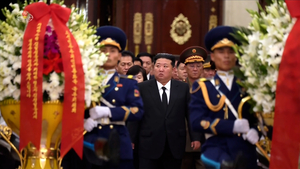
North Korean leader Kim Jong-un visited the mausoleum of state founder Kim Il-sung early Wednesday to mark the 32nd anniversary of his grandfather's death, prompting analysis that Pyongyang is seeking to reinforce the legitimacy of the ruling bloodline while further consolidating Kim's leadership.
Kim visited the Kumsusan Palace of the Sun at midnight, accompanied by senior party, government and military officials, according to the North's state media, the Korean Central News Agency (KCNA). At the palace, where the embalmed bodies of Kim Il-sung and Kim Jong-il — Kim's father — lie in state, the North Korean leader laid flower baskets before their statues and paid tribute. The KCNA reported: "Comrade Kim Jong-un made deep bows to them, praying for their immortality."
The state-run Rodong Sinmun described July 8 as "the greatest memorial day of our party, state and people," saying participants pledged to more resolutely carry forward the revolutionary cause pioneered by Kim Il-sung and work for "the eternal dignity and glory of our Party, state and people." Kim Il-sung died of heart failure on July 8, 1994, at the age of 82. His son and successor, Kim Jong-il, died of a heart attack on Dec. 17, 2011, at age 69.
This year's commemoration is expected to be relatively subdued, as North Korea typically reserves major state ceremonies, mass rallies and other large-scale commemorative events for milestone anniversaries ending in five or zero. The latest visit comes as Kim Jong-un has increasingly sought to establish his own political identity, relying less on the legacies of his father and grandfather to legitimize his rule.
Yang Moo-jin, a distinguished professor at the University of North Korean Studies, said the North's characterization of Kim Il-sung's death anniversary as "the greatest memorial day of our party, state and people" reflects both ideological and political messaging. According to Yang, North Korea previously referred to the occasion as "the greatest memorial day of the nation." It replaced "nation" with "our party, state and people" after Kim Jong-un declared the two Koreas to be separate and hostile states in late 2023. The revised wording was also used for the anniversary of Kim Jong-il's death in December 2025.
Yang said the wording change appears to reaffirm Pyongyang's “two hostile states” policy while underscoring its “our state-first principle” as a core governing ideology. He also noted that since 2024, North Korean state media has increasingly avoided the term “Day of the Sun” for Kim Il-sung's April 15 birthday, instead referring to the occasion as “April 15” or the “April holiday.” Kim Jong-un has also skipped some commemorative visits to the Kumsusan Palace of the Sun marking the birthdays of his predecessors, a pattern Yang said suggests Pyongyang is adjusting how it commemorates past leaders while elevating Kim's own leadership.
Yang said the contrasting treatment of birthdays and death anniversaries reflects a carefully calibrated propaganda strategy. "By downplaying the birthdays of past leaders while continuing to observe their memorial days with full respect, Kim seeks to reduce dependence on the mystique surrounding his predecessors and elevate his own status as an independent supreme leader under 'Kim Jong-unism,'" he said. "At the same time, paying formal tribute on memorial days preserves the legitimacy of the Mount Paektu bloodline and reinforces his image as the rightful heir carrying forward the legacies of his predecessors." The Mount Paektu bloodline refers to the Kim family's hereditary claim to legitimacy, rooted in the official North Korean narrative that Kim Il-sung led the anti-Japanese guerrilla struggle from Mount Paektu, a mountain regarded as sacred in Korean history.
The Kim dynasty has ruled North Korea since its founding in 1948. Kim Il-sung established a cult of personality that was passed on to his son Kim Jong-il, who further developed the ideology of Juche (self-reliance) and Songun (military-first politics). After Kim Jong-il's death in 2011, Kim Jong-un took power at the age of 27, initially presenting himself as a continuation of the lineage but later increasingly emphasizing his own policies and achievements. Under Kim Jong-un, North Korea has accelerated its nuclear weapons and ballistic missile programs, conducted numerous tests in defiance of UN sanctions, and engaged in high-stakes diplomacy with the United States and South Korea.
The death anniversary of Kim Il-sung is one of the most important dates in the North Korean political calendar. Traditionally, the day is marked by visits to the Kumsusan Palace, floral tributes, and solemn ceremonies. However, as Yang noted, the regime has become more selective in the scale of commemoration, reserving grand events for round-number anniversaries. For example, the 30th anniversary of Kim Il-sung's death in 2024 saw a massive military parade and mass games, while this year's 32nd anniversary was more low-key.
Kim's leadership style has also evolved. He has purged potential rivals, consolidated control over the party and military, and introduced economic reforms that allow limited market activity. At the same time, he has maintained the core tenets of the Kim family cult, including the mandatory wearing of badges bearing the images of Kim Il-sung and Kim Jong-il, and the construction of statues and mosaics. The shift in language from "nation" to "party, state and people" reflects a more defined separation of North Korea as a distinct state entity, especially in the context of inter-Korean relations. Since 2023, Kim has called for constitutional amendments to designate South Korea as a "hostile state" and has destroyed the symbolic Arch of Reunification in Pyongyang.
Analysts say that by emphasizing death anniversaries over birthdays, Kim Jong-un is subtly reshaping the narrative around the Kim dynasty. Birthdays celebrate the birth of a leader and are often associated with his personal achievements and charisma. Death anniversaries, on the other hand, invoke the legacy and sacrifice of the deceased, reminding the public of the revolutionary continuity. By maintaining solemn commemorations for deaths while gradually downplaying birthdays, Kim Jong-un can honor his predecessors without being overshadowed by their mythical births. This allows him to build his own mythology as a leader who carries the revolution forward rather than simply inheriting it.
The term "Kim Jong-unism" has been increasingly used in North Korean propaganda since the Eighth Party Congress in 2021. It refers to the leader's unique contributions to ideology, including the concept of "people-first" politics and the development of tactical nuclear weapons. While Kim Jong-un has not completely discarded Juche and Songun, he has reinterpreted them to fit his own era. The Kim family's Mount Paektu bloodline remains a central pillar of regime legitimacy, and the careful management of anniversaries helps to sustain that legitimacy without allowing the past to overshadow the present leader.
International observers watch these rituals closely for signs of internal dynamics. The presence of senior officials at the Kumsusan Palace, including perhaps Kim Yo-jong, the leader's sister, and Premier Kim Tok-hun, indicates unity and loyalty. Any absence or rearrangement of seating could hint at shifts in power. This year, the North Korean media released photos of Kim Jong-un standing before the statues, flanked by uniformed officers and party officials. The images were carefully staged to convey stability and continuity.
The Korean Peninsula remains tense. North Korea's weapons tests continue, and the US and South Korea have increased military exercises in response. Kim's focus on consolidating domestic leadership through rituals like the death anniversary visit may be aimed at shoring up support amid external pressure. The wording change from "nation" to "our party, state and people" also serves to rally the population around the state as a separate entity from South Korea, reinforcing the narrative of two hostile states. This is consistent with Kim's recent policy shift away from reunification and toward recognition of the North as a nuclear-armed state that will never give up its weapons.
In summary, Kim Jong-un's midnight visit to the Kumsusan Palace on the 32nd anniversary of Kim Il-sung's death is more than a routine homage. It is a carefully orchestrated political act that reinforces his own leadership, adjusts the narrative around the Kim dynasty, and aligns with Pyongyang's current ideological and diplomatic posture. By balancing respect for the past with a distinct identity for the present, Kim continues to strengthen his grip on power while guiding North Korea through a period of international isolation and internal transformation.
Source: The Korea Herald News