

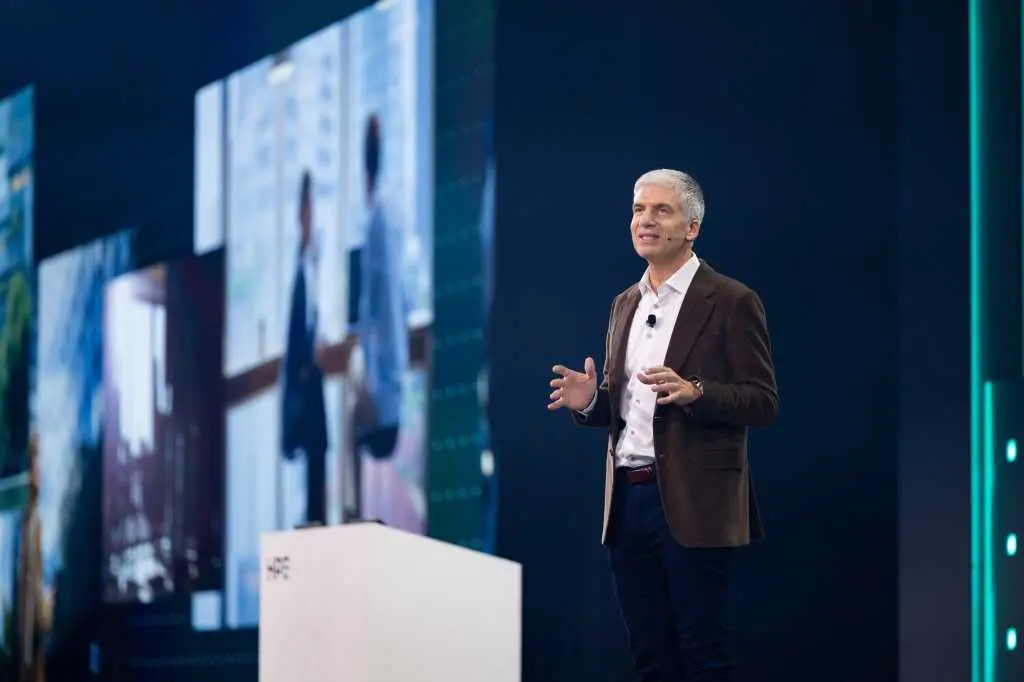
At the recent HPE Discover event in Las Vegas, Rami Rahim, former CEO of Juniper Networks and now president and general manager of HPE Networking, took the stage to deliver a stark message for network professionals: legacy networks are fundamentally incapable of handling the demands of artificial intelligence. His keynote, which followed HPE CEO Antonio Neri's opening address, focused on a single critical point: the network is the foundation upon which AI success is built, and without a modern, intelligent foundation, even the most powerful GPUs will be wasted.
Rahim framed his argument around the analogy of a skyscraper built on a weak foundation. The Millennium Tower in San Francisco, a visually stunning building, began to tilt because its foundation could not withstand the environmental realities. Similarly, enterprises investing in AI must recognize that their networks must be designed for massive data movement, real-time inference, and explosive scale. Static, manual, and reactive networking simply cannot keep up.
1. The network is now the AI foundation
Rahim emphasized that the network is no longer just background infrastructure. It has become the strategic platform for how organizations operate, innovate, and scale. He warned that spending millions on GPUs is pointless if the network introduces latency, bottlenecks, and instability. For network engineers, this means they must architect for AI-era baselines, not legacy traffic patterns. East-west flows, low jitter, and deterministic paths become critical. Engineers must also learn to translate network health into business outcomes, linking metrics like latency and loss to model training time and inference SLAs. Getting involved early in AI projects is essential to ensure connectivity, security, and data movement are engineered from the start.
2. AI for networks: Self-driving operations become table stakes
The core thesis of Rahim's presentation was that the old model of networking is obsolete. He presented an alternative: an AI-native, self-driving operations model spanning Aruba Central and Mist platforms, powered by Marvis, Marvis Minis, and an agentic AI framework. Sunalini Sankhavaram, VP of product management at HPE, elaborated on this shift, explaining that the system uses real-life experience data—every user, every minute—validated against actual support cases and enriched with digital twins. In a demo, Marvis detected that over 6% of user minutes were bad, isolated the issue to overutilized access points, and autonomously fixed it by enabling dual-band 5 GHz, reducing peak utilization from 90% to 54% before any user could complain. This represents a fundamental shift for network engineers: from being the resolver to configuring, supervising, and governing these AI systems. Engineers should lean into AIOps, redefine their role as guardrail designers, and learn to speak in experience metrics like SLAs and bad user minutes.
3. One AI-native fabric across campus, branch, and routing
A major structural message was the unification of Juniper and Aruba capabilities, with Mist and Central platforms tied together by a common AI engine. Sankhavaram noted that self-driving innovations are developed once and deployed on both platforms, much like a single app running on both iOS and Android. Marvis is being integrated into Aruba Central with features like the Marvis Trust List, allowing fully autonomous actions such as recovering a dead camera port without human intervention. On the hardware side, HPE has shipped a dual-platform access point and is bringing the CX portfolio to Mist. Engineers should design for platform optionality, assume management planes may change, and choose equipment that can switch ecosystems without rip-and-replace. They should also embed digital twins into workflows and build API-first automation skills, as Sankhavaram emphasized an API-first approach for programmatic access.
4. Networking and security are converging with AI-aware controls
Rahim repeatedly stressed that networking and security can no longer operate separately. Attackers use the network as their weapon of choice, and with AI making threats faster and smarter, defenders must use the network as part of their defense. Customer voices reinforced this point. Marlon Drummond of Royal Bank of Canada explained that security is job number one, and they troubleshoot at the network layer using SD-WAN and deep packet inspection to create user personas and detect anomalies. HPE announced a unified SASE orchestrator combining Edge Connect SD-WAN with an SSE stack in a single console. An AI-aware firewall distinguishes sanctioned, unsanctioned, and tolerated AI apps, enforcing fine-grained controls on uploads, prompts, and keywords. Network engineers should expect to own more of the zero-trust and AI-governance story, instrument the network as a primary security sensor, and treat self-driving changes as security-sensitive, ensuring autonomous routing shifts respect segmentation and zero-trust boundaries.
5. Experience-first networking at real-world scale
The most compelling parts of the keynote came from customer segments. Rob Lowden, CIO of Ohio State University, described a campus that is like a small city with 66,000 students, 8,500 faculty, and 22,000 HPE access points. On game day, the football stadium sees over 200,000 people. With such density, AI ops is essential to crunch data in real time, reducing problem resolution from hours to minutes. Tom Johnson from Sentara Health highlighted how their network must be resilient and always available because data delay directly impacts patient care. Ambient AI that listens to patient conversations and generates clinical notes is in production, requiring real-time, reliable network delivery. Ben Croy from Disney explained that a single animated feature can generate a petabyte of content, with over 200 concurrent productions globally. The network must be foundational yet invisible, allowing filmmakers to focus on story rather than connectivity. For engineers, these stories underscore the need to measure what users feel, adopt SLAs around application quality, use AI-driven twins and synthetic tests to pre-verify high-impact events, and become domain experts in verticals like healthcare, finance, education, or media.
Rahim closed with a challenge: the old way of operating networks has reached its limits. Scale is too large, complexity too high, and AI is accelerating everything. Self-driving networks are not a futuristic idea but a practical necessity. The opportunity for network engineers is to build, govern, and extend that self-driving foundation before someone else does it for them. Engineers who fear AI should remember that AI won't take their job, but another person who uses AI will.
Source: Network World News