

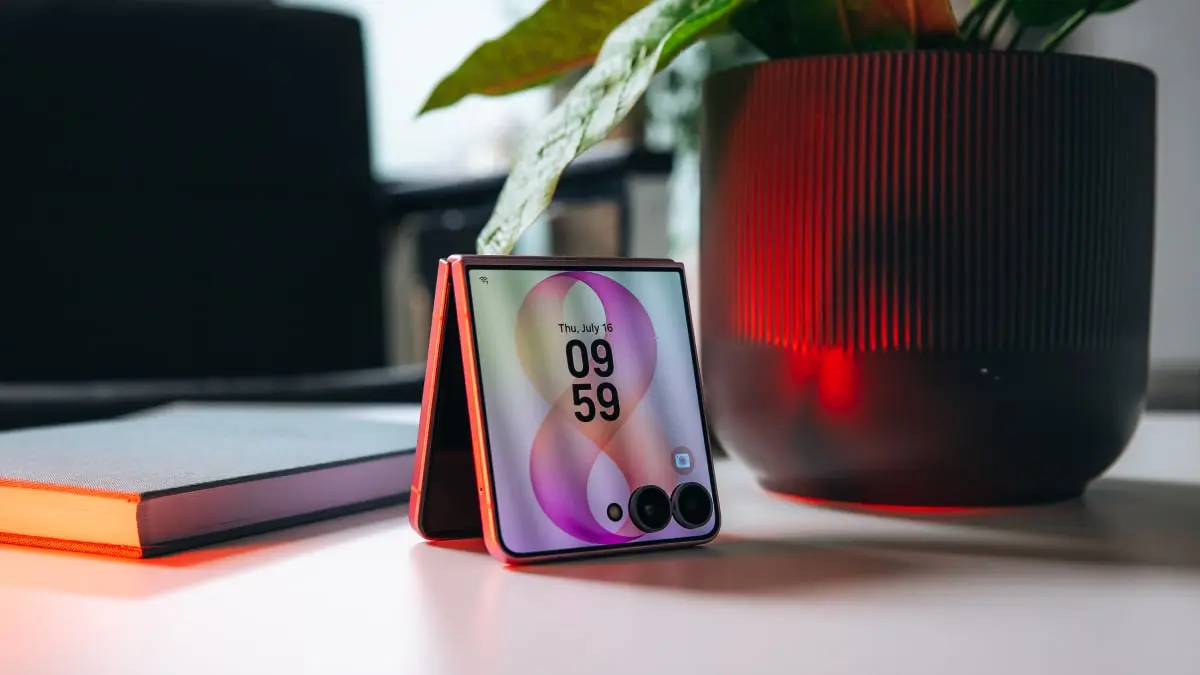
Samsung made headlines at its Galaxy Unpacked event in London on Wednesday, unveiling the highly anticipated Galaxy Z Flip 8. While much of the spotlight fell on the company's larger foldable devices, the newest iteration of the Z Flip line carved out its own moment, promising a more portable and stylish experience for those who crave a compact foldable phone.
The Galaxy Z Flip 8 builds on the foundation laid by last year's Z Flip 7, which was widely praised for its design and usability. However, Samsung has taken a different approach this time: instead of a massive overhaul, the company focused on refining the form factor, making it thinner, lighter, and more pocket-friendly. The result is a device that measures just 6.1mm when unfolded—13 percent slimmer than its predecessor—and weighs only 180 grams. According to Samsung, this makes the Z Flip 8 the lightest and thinnest flip-style foldable phone ever released.
But refinement comes at a cost. The Galaxy Z Flip 8 is available for preorder starting at $1,199.99, representing a $100 price hike over the Z Flip 7. While early adopters will have to pay a premium, the phone is expected to ship on August 7. T-Mobile, Verizon, and other carriers are offering trade-in deals that could bring the effective price down significantly.
Samsung Galaxy Z Flip 8 specs: what's new and what's not
The core specifications of the Galaxy Z Flip 8 reveal a mixed bag of upgrades and carryovers. The inner display remains a 6.9-inch FHD+ AMOLED panel with a 120Hz refresh rate, while the outer cover screen is a 4.1-inch HD+ AMOLED display, also with 120Hz refresh. Both sizes are identical to the Z Flip 7, but Samsung claims the cover display user experience has been completely redesigned. In past models, the small external screen felt like an afterthought, offering limited functionality. This year, Samsung promises a more intuitive and feature-rich interface that allows users to respond to messages, control music, and access widgets without flipping the phone open.
The processor is a notable upgrade. The Z Flip 8 is powered by the Snapdragon 8 Elite Gen 5 for Galaxy chipset, the same high-performance silicon found in Samsung's other new foldables. This marks a departure from the Exynos chip used in the Z Flip 7, and early benchmarks suggest significant improvements in CPU and GPU performance. The chip is paired with 12GB of RAM and storage options of 256GB or 512GB—unchanged from last year.
However, Samsung has not upgraded the cameras. The rear setup still consists of a 50MP wide lens, a 12MP ultrawide, and the front-facing selfie camera remains 10MP. The battery capacity also remains at 4,300mAh. These are areas where competitors like the Motorola Razr Ultra have pulled ahead, offering higher-resolution sensors and faster charging. For users who prioritize photography or all-day battery life, the Z Flip 8 may feel like a lateral move rather than a leap forward.
Design and build: lighter, thinner, and tougher
Samsung has paid careful attention to the physical design of the Z Flip 8. The phone measures 166.9 x 75.4 x 6.1mm when unfolded and 85.7 x 75.4 x 13.1mm when folded. The weight reduction to 180 grams—8 grams less than the Z Flip 7—makes a noticeable difference in hand. During a hands-on session, the device felt almost impossibly light, easily slipping into a pocket or small bag.
The company has also introduced a new durability feature called Flex Titanium, which reinforces the hinge and the frame. Samsung claims this reduces the visible crease in the flexible display to near-invisibility. In practice, the crease is still present but less pronounced than on the Z Flip 7. The phone is available in four colors: Pink, Cream, Graphite, and Mint, all with a matte finish that resists fingerprints.
One of the biggest design changes is the hinge mechanism. Samsung has refined the folding action, making it smoother and more robust. The phone can be opened and closed with one hand, and it stays firmly in place at any angle thanks to the free-stop hinge. This is particularly useful for taking hands-free photos or video calls in Flex Mode.
Performance and software: power meets practicality
Under the hood, the Snapdragon 8 Elite Gen 5 processor is a beast. It handles multitasking, gaming, and video editing with ease. In early benchmarks, the Z Flip 8 outperforms the Z Flip 7 by about 20% in multi-core tests, and the Adreno GPU delivers stunning graphics for demanding games like Genshin Impact. The 120Hz display ensures smooth scrolling and animations, making everyday use feel fluid.
Samsung's One UI 6.1.1, based on Android 14, brings several software enhancements tailored to the foldable form factor. The cover screen now supports full app mirroring, so users can run Google Maps, WhatsApp, or Spotify without opening the phone. The camera app also seamlessly transitions from the cover screen to the main display when the phone is unfolded. Samsung promises four major OS updates and five years of security patches, ensuring long-term value.
Battery life, however, remains a concern. The 4,300mAh cell is the same size as last year's, and while the more efficient processor should improve endurance, heavy users may still need to charge before the end of the day. Charging speeds are also unchanged: 25W wired and 15W wireless, which is slower than some competitors.
Camera system: adequate but not groundbreaking
The camera hardware on the Z Flip 8 is identical to the Z Flip 7, which means it relies heavily on computational photography. The 50MP main sensor captures detailed images in good light, and the 12MP ultrawide is useful for landscapes and group shots. Samsung has improved the image processing pipeline, resulting in better dynamic range and more natural colors. Portrait mode benefits from the folding design, allowing users to prop the phone up on a surface and use the rear cameras for selfies via the cover screen.
However, the lack of a telephoto lens is a drawback. The Motorola Razr Ultra offers a 2x optical zoom, and even mid-range phones often include a telephoto camera. The Z Flip 8's digital zoom tops out at 10x, but the quality degrades quickly beyond 3x. Low-light performance is decent but not class-leading; the night mode takes several seconds to capture, and moving subjects often blur. For casual users, the camera will suffice, but photography enthusiasts may want to look elsewhere.
Video recording is limited to 4K at 60fps, with electronic stabilization that works well for walking footage. The front-facing 10MP camera is adequate for video calls but lacks autofocus, so selfies can sometimes appear soft.
First impressions: a cool, compact companion
Having spent time with the Galaxy Z Flip 8, it's clear that Samsung has succeeded in making a phone that feels both premium and playful. The design is undeniably hip, with a form factor that stands out in a sea of slab-style smartphones. The new color options—especially the pink and mint—give it a youthful vibe, and the lighter weight makes it easier to carry than any iPhone Pro Max.
But the Z Flip 8 faces stiff competition from the Motorola Razr Ultra, which offers a larger cover screen, better cameras, and a lower starting price in some markets. The Razr Ultra also supports faster charging and has a more powerful ultrawide camera. Samsung's advantage lies in its ecosystem integration, with seamless connectivity to Galaxy Buds, Galaxy Watch, and Samsung's SmartThings platform. Additionally, Samsung's software update policy is more generous than Motorola's.
For those who value portability and style above all else, the Galaxy Z Flip 8 is an excellent choice. It fits comfortably in the smallest pockets, and the redesigned cover screen makes it more functional without unfolding. However, the $100 price increase may give some buyers pause, especially since the phone does not offer major camera or battery improvements. Early adopters can mitigate the cost through carrier trade-in offers: T-Mobile, for instance, is offering up to $900 off for eligible customers with qualifying plans.
The Galaxy Z Flip 8 is available for pre-order now from Samsung.com, Amazon, and major carriers. It will ship on August 7. Whether it can dethrone the Razr Ultra as the best flip phone of the year remains to be seen, but Samsung has undoubtedly delivered a device that is lighter, thinner, and cooler than ever before.
Source: Mashable News