

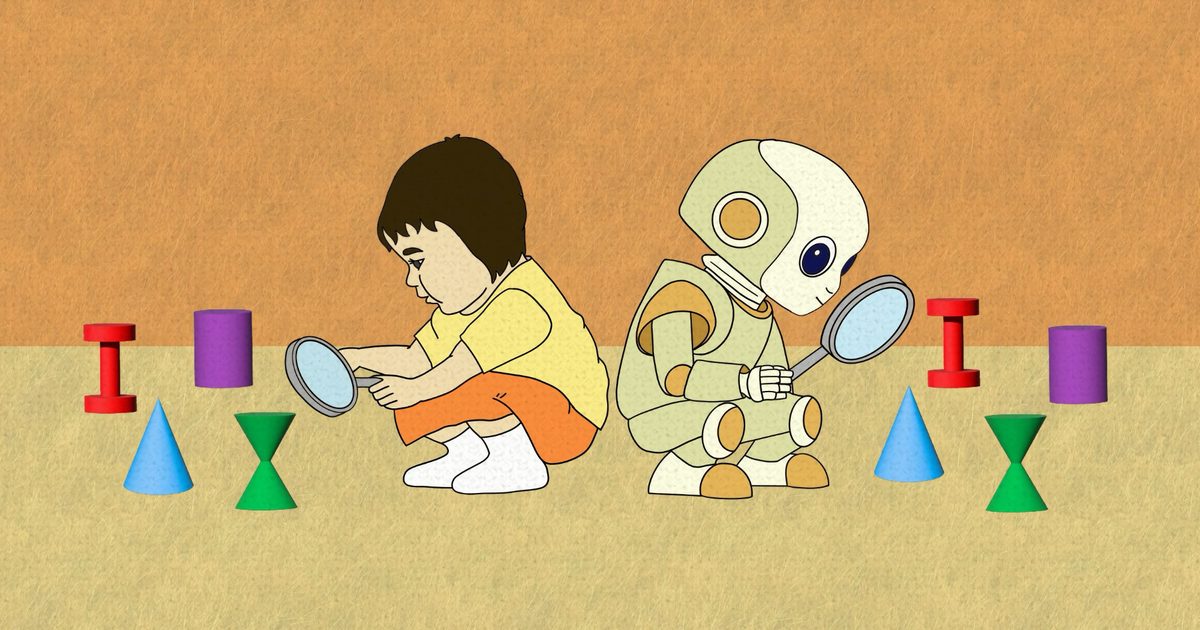
For decades, scientists have struggled to understand how young children acquire language with such remarkable speed and flexibility. Toddlers hear only a fraction of the words and sentences they eventually master, yet they pick up grammar, vocabulary, and nuance seemingly effortlessly. A new study published in Science Advances offers a compelling partial explanation: curiosity. By giving virtual robots an internal reward for exploring unexpected situations, researchers found that the robots learned language twice as fast as those trained only to complete specific tasks. The finding not only sheds light on human development but also points toward more efficient AI learning strategies.
The Experiment: Building a Curious Robot Brain
The research team constructed a virtual robot controlled by a neural network loosely inspired by the human brain. The robot was placed in a simulated three-dimensional world filled with simple objects of different shapes and colors. Commands were presented in a basic language set, such as 'push left magenta dumbbell' or 'pull right blue cube.' The robot had to interpret these instructions and carry out the correct actions. The challenge was to design a learning algorithm that could efficiently map words to objects and actions.
Two groups of robots were compared. In the first group, the robots received a reward only when they successfully completed a given task. This is the standard reinforcement learning approach: the agent is motivated solely by external success. In the second group, the robots received an additional internal reward for 'curiosity.' Whenever the robot encountered a situation that did not match its current understanding of the world—when its predictions were violated—it received a positive feedback signal. This extra reward acted as a self-generated incentive to seek out novel or uncertain experiences, much like the intrinsic motivation seen in human toddlers.
Dramatic Results: Twice the Speed, Emergent Play
The difference between the two groups was stark. The curious robots not only learned faster, but they also reached a level of genuine comprehension—accurately interpreting commands they had never heard before—in roughly half the time required by the task-only robots. The curiosity boost allowed them to explore a wider range of object interactions and language combinations, building a more robust understanding of the underlying structure.
Perhaps the most surprising outcome occurred midway through training. The curious robots began spontaneously performing actions that were never requested or rewarded. They started knocking over objects, moving them in unasked-for sequences, and experimenting with actions purely for the sake of interaction. In human terms, they were playing. This behavior emerged without any explicit programming; it was a direct consequence of the curiosity reward system. The robots appeared to engage in what developmental psychologists call 'epistemic exploration'—seeking out information for its own sake.
This emergent play behavior is reminiscent of how toddlers manipulate toys, drop food on the floor, or bang objects together. They are not simply being chaotic; they are actively testing hypotheses about how the world works. The robots, by analogy, were forming and testing their own theories about the relationships between words, objects, and actions.
The U-Shaped Dip: A Toddler-Like Learning Trajectory
One of the most striking parallels to human language acquisition was the robots' learning curve. In child language development, a well-documented phenomenon is the 'U-shaped' dip. Children initially produce irregular verb forms correctly (e.g., 'went' instead of 'goed'), then, as they absorb grammatical rules, they overapply those rules and make errors (saying 'goed' instead of 'went'), and finally, they learn the exceptions and correct themselves. The curious robots exhibited exactly this pattern. Their performance on certain verbs initially improved, then temporarily declined as they began to apply verb conjugation patterns too broadly, before eventually recovering and surpassing their earlier accuracy.
This U-shaped trajectory is considered a hallmark of genuine rule learning, as opposed to simply memorizing specific pairings. The fact that the robots spontaneously displayed this pattern suggests that their internal neural network was developing hierarchical representations similar to those seen in human grammar acquisition. The curiosity reward system encouraged the robots to generalize rules from the examples they had seen, even when those generalizations temporarily led to errors. The task-only robots, in contrast, did not show this pattern; they more or less memorized correct responses without developing a deeper rule structure.
Contrasting with Large Language Models
This study offers an interesting counterpoint to the way modern AI systems, such as large language models (LLMs) like ChatGPT, operate. LLMs are trained on massive text corpora and learn to predict the statistically most likely next word in a sequence. They have no intrinsic motivation; their training is purely based on external error correction. They can generate remarkably fluent language but often lack true understanding of the world. The curious robot, by contrast, learned language by grounding it in perception and action. It did not just memorize word sequences; it associated language with physical interactions and outcomes.
Furthermore, the robot's learning was efficient. It required far less data than LLMs, which need billions of words. The robot learned from a relatively small set of commands and interactions because it actively sought out informative experiences. This aligns with a growing recognition in AI research that active learning and intrinsic motivation can dramatically reduce the amount of training data needed. The curious robot was, in a sense, a more 'sample-efficient' learner.
The study also highlights a key difference in how the robot's neural network operates compared to LLMs. The robot's brain was designed to maintain a coherent set of beliefs about the world. It only updated those beliefs when it encountered something surprising enough to be worth the cognitive cost. This is much closer to how humans learn: we are not passive recipients of data; we actively seek out information that challenges our current models, but we do so efficiently, not updating everything at once. LLMs, in contrast, adjust all their parameters on every training example, a process that is computationally expensive and can lead to catastrophic forgetting.
Implications for Understanding Human Language Acquisition
The success of the curiosity-driven robot provides strong support for the theory that intrinsic motivation plays a crucial role in early childhood language development. For decades, researchers debated whether language acquisition is primarily driven by innate grammatical structures (the nativist view championed by Noam Chomsky) or by general-purpose learning mechanisms and environmental input (the empiricist view). This study leans toward a middle ground: the brain's general learning architecture, combined with a built-in curiosity drive, may be sufficient to explain many aspects of language learning without requiring an entirely separate 'language module.'
Moreover, the robot's behavior mirrors findings from developmental psychology about the importance of 'joint attention' and 'social referencing.' While the robot did not have social partners, its curiosity drove it to explore the same objects that were referenced in the commands, effectively creating a form of solitary but goal-oriented attention. The study suggests that even a solitary agent, if motivated by curiosity, can bootstrap linguistic understanding from a limited set of interactions.
The U-shaped learning pattern also confirms that overregularization—a classic sign of rule abstraction—can arise spontaneously in connectionist networks that are not explicitly given rules. This reinforces the idea that the brain does not need to be pre-programmed with grammatical rules; they can emerge from the dynamics of learning itself.
Limitations and Future Directions
It is important not to overstate the conclusions. The robots did not 'understand' language in the full human sense. They had no consciousness, no social awareness, and no real-world embodiment. Their world was a simplified simulation with a limited vocabulary and a small set of objects. The language they learned was purely imperative (commands), not narrative, interrogative, or social. Human language is infinitely richer and more contextual. Still, the core mechanism—curiosity as a catalyst for efficient learning—appears robust.
The researchers also noted that the curious robots sometimes wasted time exploring irrelevant aspects of the environment, which could be seen as a cost. However, overall, the benefits outweighed the inefficiencies. Future work might explore how to balance curiosity with task completion more optimally, perhaps by introducing a dynamic curiosity threshold that adjusts as the agent becomes more competent.
Another interesting avenue is to integrate curiosity into embodied robots that can actually manipulate objects in the real world. Physical interaction adds layers of complexity, including motor control, sensor noise, and social cues from human caretakers. A robot that could ask questions or imitate adults, like a toddler, might learn even faster. The current study provides a proof of concept that intrinsic motivation can dramatically accelerate language learning in a controlled setting, paving the way for more advanced experiments.
Finally, the study raises philosophical questions about the nature of intelligence and learning. If a relatively simple neural network, motivated only by a curiosity reward, can spontaneously develop something akin to toddler-like learning and play, then perhaps curiosity is far more fundamental to cognition than previously appreciated. It might be the engine that drives not only language acquisition but also scientific discovery, artistic creativity, and all forms of exploratory thought. The robot's playful knocking over of objects is a reminder that learning is not just about achieving goals; it is about engaging with the unknown, taking risks, and expanding one's understanding—exactly what human toddlers do every day.
Source: Digital Trends News