

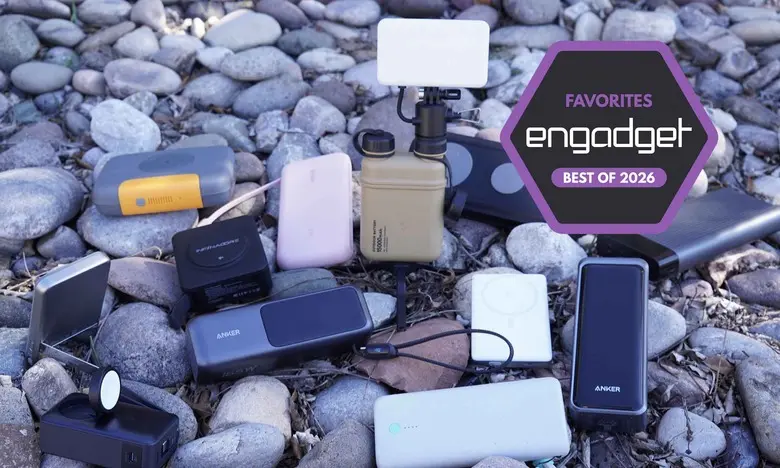
Finding yourself far from a wall socket when your phone hits five percent is positively nerve-wracking. If you stash a portable battery in your bag, you can avoid that feeling altogether. But there are thousands of power banks out there, and it can be tough to pick the right one for what you need. After years of testing dozens of batteries, we have found the best power banks for different scenarios. Whether you need a quick refill for your phone or a huge brick to keep your laptop alive, you will find something fitting here.
Best power banks for 2026
Best MagSafe power bank: Anker MagGo Power Bank (10K)
Capacity: 10,000mAh | Maximum Output: 15W wireless | Ports: One USB-C in/out | Included cable: USB-C to USB-C | Number of charges for iPhone 15: 1.64 | Charge time for iPhone: 4 to 100% in 2h 26m | Weight: 8.82 oz
Anker's MagGo Power Bank was one of the first Qi2-certified products on the market, and the new standard has made the brand's popular MagSafe/kickstand model much faster. It is the most well-rounded MagSafe battery we have tested. It brought an iPhone 15 from near-dead to half-full in about 45 minutes. For reference, it took our former top pick in this category an hour and a half to do the same. After that initial refill, the MagGo 10K had enough left over to get the phone up to 70 percent on a subsequent charge.
In addition to faster charging speeds, this wireless power bank adds an LCD display to indicate the battery percentage left in the bank, plus the approximate amount of time before it is full or empty. A strong MagSafe connection makes it easy to use the phone while it charges, and the small kickstand creates a surprisingly sturdy base for watching videos. If you twist the phone to landscape, StandBy mode kicks in. The MagGo also has a USB-C port, so if you need to charge something without wireless capabilities, you can.
- Pros: Qi2 tech enables extra-fast wireless charging; sturdy kickstand; LED display
- Cons: More expensive than other MagSafe packs
Best portable charger for Android: Anker Nano Battery (Foldable USB-C)
Capacity: 5,000mAh | Maximum Output: 22.5W | Ports: One USB-C and one built-in USB-C connector | Number of charges for Galaxy S23 Ultra: 0.65 | Weight: 3.5 oz
The Anker Nano power bank has impressive power delivery for its size. It is the exact size and shape of a lipstick case and has a built-in USB-C connector that folds down when not in use. In addition to being ultra-portable, you do not need to remember to grab a charging cable when you toss it in your bag. There is also a built-in USB-C port that can refill the battery or charge a different device with an adapter cable. Four indicator lights let you know how much charge remains.
In our testing, the 5,000mAh battery provided enough charge to get a depleted Galaxy S23 Ultra back up to 65 percent in about an hour. That is relatively quick, but the Nano is also small enough that, with its sturdy connection, you can use your phone while it charges without feeling too awkward. The charger's small size also makes it a good pick for recharging earbuds.
- Pros: Very portable; affordable
- Cons: Small enough to get misplaced
Best low-capacity power bank: Anker 10K Fusion
Capacity: 10,000mAh | Maximum Output: 30W | Ports: One USB-C in/out, one built-in USB-C cable, wall prongs | Number of charges for iPhone 15: 1.86 | Weight: 8.8 oz
The toughest thing about using a power bank is remembering to bring it along. You also have to remember a cable and, if you want to refill the bank itself, a wall adapter. Anker's 10K Fusion solves two of those problems with its attached USB-C cable for your gadget and foldable two-prong plug for charging the bank itself. Despite the attachments, it is compact, just a smidge wider than a stick of butter, yet still packs a 10,000mAh capacity.
The 30 watts of power enabled super-fast charging on a Galaxy S23 and got it from five percent to full in just over an hour. In just 20 minutes, the 10K Fusion bumped a near-dead iPhone 15 to 45 percent. There is an additional USB-C port for charging devices that may require a different cable, and both it and the built-in connector can be used to refill the power bank. The onboard display indicates the Fusion's remaining charge as a percentage and was one of the more accurate readouts we have tested.
- Pros: Built-in USB-C cable; built-in wall prongs; fairly accurate display; affordable
- Cons: iPhone charging is slower than other banks in its range
Best medium-capacity power bank: Belkin BoostCharge 20K with Integrated Cable
Capacity: 20,000mAh | Maximum Output: 30W | Ports: One built-in USB-C cable, one USB-A, one USB-C | Number of charges for iPhone 15: 3 to 3.5 | Weight: 14 oz | Price: $50
An integrated cable seems to be the hot new feature in portable chargers, and we are all for it. There have been times when we had a dead phone and a dead power bank but no way to connect the two. The Belkin BoostCharge 20K with Integrated Cable is one such bank we have tested and also one of the more affordable examples.
It can output a maximum of 30 watts, which does not make it the fastest charger around, but it was not a slouch. It charged a Samsung Galaxy S24 Ultra from near-dead to full in an hour and 15 minutes and bumped an iPhone 15 from five to 87 percent in just over an hour. The 20,000mAh capacity means it can achieve those numbers around three times over. In addition to the built-in, conveniently magnetized USB-C cable, there are two other ports: an out-only USB-A and an in/out USB-C. That means you can technically charge three devices at the same time, though charging speeds will drop. There is no digital screen, just four indicator LEDs, but they are accurate and useful.
- Pros: Built-in USB-C cable; four color options; affordable; great capacity for the price
- Cons: Charge is not as fast as other banks
Best medium-high capacity power bank: Nimble Champ Pro
Capacity: 20,000mAh | Maximum Output: 65W | Ports: Two USB-C in/out | Number of charges for iPhone 11: 2.95 | Weight: 12.9 oz | Price: $100
Nimble's Champ Pro battery delivers a screaming-fast charge and got a Galaxy S23 Ultra from five percent to full in under an hour. That is faster than every other battery we tested except for Anker's premium laptop power bank, and this model costs $30 less. It lent nearly three full charges to both an iPhone and a Galaxy device and has enough juice to refill an iPad more than once. The battery itself also recharges from the wall noticeably faster than other models.
Nimble is a certified B-Corp, meaning it aims for higher environmental and social standards and verifies its efforts through independent testing. The Champ Pro uses 90 percent post-consumer plastic and comes in packaging made from paper scrap with a bag for shipping back your old battery for recycling. The unit feels sturdy and has a compact shape that is a little narrower than a smartphone and about as long. The attached adjustable lanyard is a nice touch, and the marbled effect from recycled plastics gives it a pleasant aesthetic. You can charge devices from both USB-C ports simultaneously, and both are input/output plugs.
- Pros: Super-fast charging; made from recycled materials; sturdy and compact design
- Cons: Indicator lights may underestimate remaining charge
Best multi-device power bank: BioLite Charge 100 Max
Capacity: 25,000mAh | Maximum Output: 120W | Ports: Wireless pad, two USB-C, one USB-A, one USB-C | Number of charges for iPhone 15: 5 | Weight: 1.28 lbs
The compact and rounded design of the BioLite Charge 100 Max makes it more packable and travel-friendly than many larger batteries. It has four USB ports and a MagSafe-compatible wireless charging pad on one side with a maximum output of 15 watts. The magnetic hold is enough to keep a phone in place while it charges, though it is not as strong as smaller MagSafe batteries, so we would not carry it around during a refill.
In addition to charging performance, BioLite is a climate-neutral-certified B-Corp that helps bring lights and clean cookstoves to energy-impoverished areas around the world. The rubberized texture and yellow accents are a welcome aesthetic change from the techy black look of most large batteries. The 10 LED pips accurately indicate the remaining charge, and the pack is easy to hold and use on the go.
- Pros: Compact and colorful design; fast charge for phones, tablets, and laptops; climate-neutral-certified company
- Cons: More expensive than similar-capacity batteries
Best laptop power bank: Anker Laptop Power Bank with Built-in Cable
Capacity: 25,000mAh | Maximum Output: 165W | Ports: Two built-in USB-C in/out cables, one USB-A, one USB-C | Number of charges for iPhone 15: 4 to 5 | Weight: 1.31 lbs
The only thing worse than needing a power bank and not having one is having one but no way to connect it to your device. The Anker laptop power bank with built-in cable makes sure you are never left without a way to charge your stuff. It has two attached USB-C cables: one attached to the side of the battery that acts as a carrying loop and another retractable cord that extends up to two feet. Both handle in/out functions, so you can use them to charge a device or recharge the battery itself.
The display shows the amount of charge remaining in the battery pack as well as the output wattage going to each port. When refilling the battery, you can also see an estimate of how long it will be until the unit is full. In testing, the unit outputs the same or a higher amount of charge compared with other 25,000mAh batteries. It is an attractive, high-capacity bank with a matte silver exterior, and it feels more durable than Anker's previous Prime bank, which had a large screen that was easily scratched. At just $15 more than Anker's popular PowerCore bank, it is well worth the premium because of the built-in cables.
- Pros: Two built-in USB-C cables; durable build; detailed charging display; fast charge
- Cons: Screen picks up smudges easily
Best premium power bank: Anker Prime Power Bank 26K 300W
Capacity: 26,250mAh | Maximum Combined Output: 300W | Ports: Two USB-C (140W), one USB-A (22.5W) | Number of charges for iPhone 15: 5 to 5.5 | Weight: 1.32 lbs
Anker's latest Prime Power Bank stands out in a crowded market, but not because of its companion app. The app lets you see the remaining charge, power output, and other data on your phone, but most of that same information is available on the built-in display anyway. What is actually impressive are the speeds, the large capacity, and the convenient optional charging base.
The three ports can be used all at once, with the two USB-C ports delivering up to 140 watts each. Most devices recharge far below that wattage, but if you need to partially charge two high-powered laptops at the same time, you can. More commonly, the battery will give phones, tablets, and laptops speedy refills. It got a near-dead iPhone 15 to 60 percent in a half hour and delivered more charge to a MacBook Pro than any other battery tested. The display shows remaining charge and battery temperature, which is useful for monitoring lithium-ion health. The sleek design has a shiny black front and matte silver body, and it is more compact than most 27,000mAh batteries.
The charging power base is a separate and optional purchase, but it makes recharging extra convenient; you just place the battery on it and walk away. Unfortunately, the base costs about $110, making the combined price more than $300. If you want a truly premium power bank, this is it.
- Pros: Super-fast charging; sleek premium design; display shows remaining charge and battery temperature
- Cons: Pricey, especially with the optional base
Best power bank for outdoors: Nestout 15000mAh Outdoor Battery Power Bank
Capacity: 15,000mAh | Maximum Output: 32W | Ports: One USB-C in/out, one USB-C in, one USB-A | Weight: 12.8 oz
Plenty of battery packs are built to withstand drops, but very few are waterproof or even water-resistant. The Nestout Portable Charger has an IP67 rating, meaning it can handle being submerged in water for a number of minutes. We tested it by dropping the battery in a five-gallon bucket of water for five minutes. After drying it off, the unit performed as if it had never been wet.
The water resistance comes from screw-on caps with silicone gaskets that keep water out. The company also claims the battery meets a military-standard shock and drop specification. In our testing, it survived repeated drops from chest height onto a hard surface. Charging speeds were not the fastest, but the battery is durable and capable. Nestout also makes useful accessories, including a snap-on LED worklight, a small tripod, and a portable solar panel.
- Pros: Waterproof with caps secured; clever accessories; survived drop tests
- Cons: Not the fastest charge times; included cable is short
What to look for in a portable battery pack
Battery type
Nearly every rechargeable power bank you can buy contains a lithium-ion battery. These batteries beat other current battery types in terms of size-to-charge capacity and have even increased in energy density by eightfold in the past 14 years. They also do not suffer from the memory effect, meaning a battery's lifespan is not damaged by partial charges.
Flying with portable batteries
You may have heard about lithium-ion batteries overheating and catching fire. Current TSA restrictions allow external batteries rated at 100Wh or less to fly with you, but only in your carry-on luggage. They cannot be checked. Some airlines have gone further; for example, Southwest Airlines now requires passengers to keep power banks in clear view when using them to recharge a device. If the portable charger is not actively in use, it can stay in a carry-on bag in the overhead bin.
Capacity
Power bank manufacturers almost always list a battery's capacity in milliamp hours, or mAh. Smaller batteries with a 5,000mAh capacity make good phone chargers and can fill a smartphone to between 50 and 75 percent. Larger batteries that can recharge laptops and tablets, or give phones multiple charges, can exceed 25,000mAh. Prices generally go up as mAh capacity increases, and size and weight also increase with capacity.
You might think that a 10,000mAh power bank could charge a 5,000mAh phone to 100 percent twice, but that is not the case. Energy loss through heat dissipation and voltage conversion reduce the amount of juice that reaches your phone. In our tests, 10,000mAh of battery pack capacity translated to roughly 5,800mAh of device charge; 20,000mAh chargers delivered around 11,250mAh to a device; and 25,000mAh banks translated to about 16,200mAh of charge. That is an average efficiency rate of around 60 percent.
Wireless
Wireless charging is less efficient than wired connections, but it is convenient. Power banks with wireless charging have improved significantly since the arrival of Qi2-certified products. Qi2 devices support speeds of up to 15 watts and include magnetic attachment points. MagSafe technology was once the only Qi2-compatible option, but Google's Pixelsnap now brings similar speed and magnetic grip to Pixel 10 phones. The latest Qi2 25W standard is supported by newer flagship phones, and compatible battery packs are starting to hit the market.
Ports
USB-C ports can deliver faster charges than USB-A ports, but USB-A jacks are still handy for older accessories or specialized cables. Larger banks with multiple ports often list different wattages for each port. Be sure to match your cable to the maximum wattage; a cable rated for 60W will not deliver 100W speeds. Many of the best power banks now include a built-in USB-C cable, which is convenient and ensures you always have the right cord.
Design
Power banks now come in different colors, shapes, and finishes. Some include extra features such as MagSafe compatibility, a built-in wall plug, a kickstand, or an LED display. Nearly all have some indicator to show how much charge remains. Newer models often include a digital percentage readout, which is more precise than simple LED pips.
How we test power banks
We consider brands that have a track record of reliable performance and then acquire the most promising candidates for hands-on testing. Each battery is used to charge both an iPhone and an Android phone, as well as an iPad and a MacBook Pro for larger portable chargers. We drain devices to between zero and five percent and then charge them until they are full or the power bank dies. We also evaluate charging speed, portability, ease of use, display accuracy, and build quality.
Reference device battery capacities used in testing include: iPhone 11 at 3,110mAh, iPhone 14 Plus at 4,325mAh, iPhone 15 at 3,349mAh, Galaxy S22 Ultra at 4,855mAh, iPad Air at 7,729mAh, and the 16-inch MacBook Pro at 27,027mAh.
Other power banks we tested
Belkin Stage PowerGrip
If you are into phone photography, this clever accessory could be worth a look. Belkin's Stage PowerGrip is a 9,300mAh power bank with a wireless charging pad, built-in cable, Bluetooth shutter, and a quarter-inch tripod thread. It resembles a standard digital camera and provides a sturdy grip once you magnetically attach your phone. The shutter is conveniently placed, and the remote speed is quick. As a power bank, it is slow, taking about two hours to get an iPhone 16 from three to 98 percent, but it has enough juice for a full refill plus a little more.
Anker MagGo for Apple Watch Power Bank
The Anker MagGo for Apple Watch combines a 10K battery with a built-in USB-C cable and a pop-up Apple Watch charger. It is a niche product, but it is useful for Apple Watch owners. It can refill a watch quickly when a regular power bank cannot, and it also charges phones via the onboard cable.
HyperJuice 245W
Hyper's large power bank packs a hefty 27,000mAh capacity, enough to refill a phone about four times and get a MacBook Pro from near-dead to 75 percent. It has four USB-C ports but no USB-A, which could be inconvenient for older peripherals. It is fast, but comparable options with better port variety or built-in cables are available at similar prices.
EcoFlow Rapid Magnetic Power Bank
EcoFlow, known for larger power stations, released its first portable power bank in the Rapid series. It is a Qi2-enabled magnetic charger with a 5,000mAh capacity, a pull-out stand, and an attached USB-C cable. It looks nice but did not outperform our top MagSafe pick in charging speed or total charge delivered.
Mophie Snap+ Powerstation Mini
The Mophie Snap+ Powerstation Mini is well-built and feels premium, but its 5,000mAh capacity only provides a partial charge for most newer phones. Our top MagSafe pick offers double the capacity, a stand, and a display for just $20 more.
Power bank FAQs
What is the difference between a portable power bank and a portable charger?
Portable power bank, portable charger, external battery pack, and USB charger are all terms used to describe the same thing: a lithium-ion battery that stores a charge so you can refill a smartphone, tablet, earbuds, console controller, ereader, laptop, or other rechargeable device. The main specs to consider are capacity in mAh, size, and weight. Power stations, on the other hand, are much larger units that cannot be taken on airplanes.
Does fast charging ruin your battery?
Not exactly. The real enemy of battery longevity is heat. Faster charging generates more heat, but modern phones have physical heat shields, heat sinks, and software to manage temperatures. Studies on EV batteries, which use similar lithium-ion technology, have shown only a slight decrease in capacity over time with fast charging, while ambient heat had a larger effect. In short, fast charging may be slightly harder on your battery, but the safeguards in most smartphones make the difference fairly negligible.
Can you use a power bank for all your devices?
It depends on the size of the bank and the size of your device's battery. A small 5,000mAh battery is not strong enough to charge laptops, but a 20,000mAh portable charger can give a laptop a partial refill. Port compatibility also matters. If your device has a USB port, you will likely be able to connect it to a power bank. Devices with unique DC or AC ports may not be compatible with standard portable chargers.
Source: Engadget News