

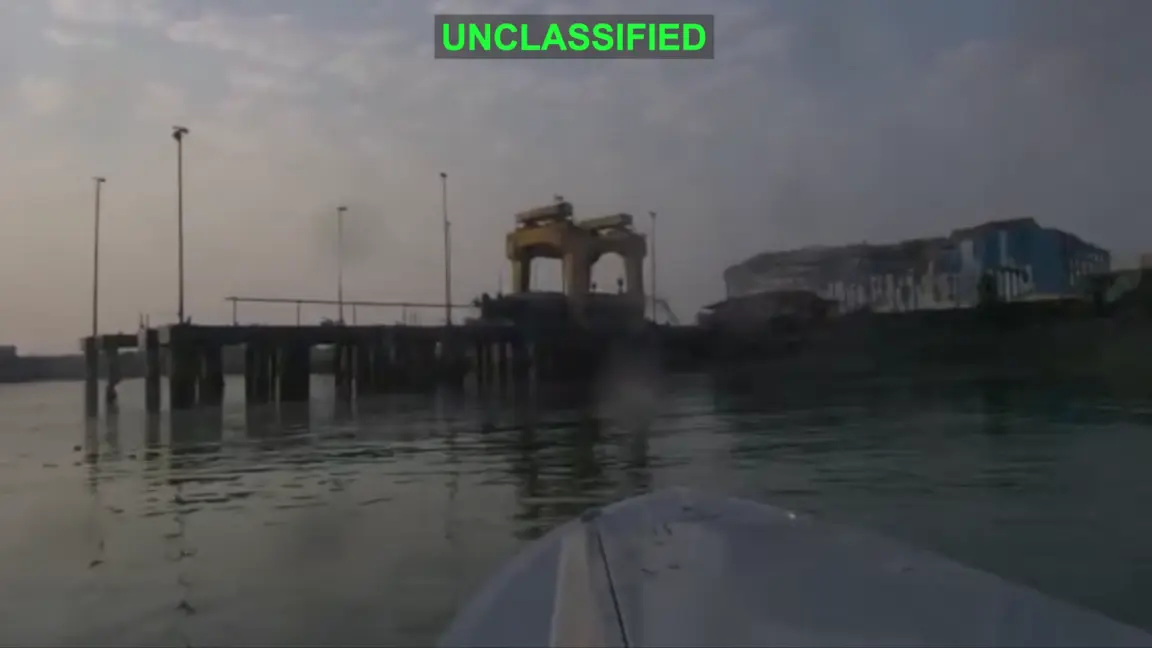
For the first time in its history, the US military sent explosive-laden drone boats into combat by attacking an Iranian midget submarine and naval port. The unprecedented use of such kamikaze sea drones by the United States comes nearly a decade after Iranian and Houthi forces first demonstrated such weapons.
The US military shared a video showing three “one-way attack surface drones” exploding after approaching an Iranian midget submarine and ship maintenance facility at Iran’s Bandar Abbas Naval Base on the night of July 12. US Central Command, the US military combat command responsible for Middle East operations, described the strikes in a social media post as the “first time American forces have employed sea drones in combat operations.”
The US drone boats were able to “make a low-speed, uncontested approach” to their targets before exploding, according to USNI News, a news service from the nonprofit US Naval Institute. USNI News also identified one of the targets as an Iranian Ghadir-class midget submarine that was out of the water while being suspended from a gantry. Such submarines are typically used for covert operations in shallow waters, making them a significant threat to naval vessels.
The technology behind the strikes involved Saronic Corsair autonomous surface vessels developed by Saronic Technologies, a defense company based in Austin, Texas. The company’s website describes the drone boat as being 24 feet in length and capable of carrying up to 1,000 pounds over 1,000 nautical miles at a top speed surpassing 34 knots. These specifications make it a versatile platform for various missions, including reconnaissance, patrol, and strike operations.
Such Corsair drone boats supposedly have the capability to operate autonomously without direct human control, including long-range navigation and patrol missions along with regulating power consumption and engine use to loiter at a specific position, according to a Saronic blog post. They are designed to perform a wide variety of missions and were likely equipped with explosives for this specific strike. The autonomous nature of these vessels reduces the risk to human operators and allows for persistent operations in contested environments.
This marks the second notable US military use of drone boats during the war, which began with the United States and Israel attacking Iran on February 28, 2026. The US military already used a Corsair sea drone to rescue two US Army helicopter pilots in the waters off the coast of Oman on June 8, after their US Army AH-64 Apache helicopter was taken down by a cheap Iranian Shahed drone. That rescue operation demonstrated the dual-use potential of such unmanned surface vehicles, highlighting their ability to perform both combat and humanitarian missions.
A history of drone boat violence
The United States is far from the first country to have used exploding drone boats, also colloquially described as kamikaze or suicide drone boats. The first confirmed use of such weapons occurred on January 30, 2017, when the Houthi faction based in Yemen struck the Royal Saudi Naval frigate Al Madinah using an uncrewed remote-controlled boat. A US Navy commander told Defense News that the Houthi weapon was likely developed with the technical assistance of Iran, which has long supported the Houthis. This attack signaled a new era of naval warfare, where low-cost unmanned systems could threaten billion-dollar warships.
In more recent years, the Ukrainian military has also developed and deployed drone boats for asymmetric warfare at sea since Russia launched a full-scale invasion of Ukraine in February 2022. Despite lacking a traditional navy, Ukraine has used a combination of flying drones and explosive drone boats to strike Russian warships and tankers, forcing Russia to withdraw its Black Sea Fleet to bases farther from Ukraine and cutting off vital Russian shipping routes. The Ukrainian Magura V5 drone boat, for instance, has been used in multiple attacks, showcasing the effectiveness of this technology.
Ukrainian drone boats have also achieved several milestones in military history by using missiles to shoot down Russian helicopters and acting as surface platforms to deploy small flying drones to strike Russian air defenses. Most recently, a Ukrainian drone boat even deployed an armed ground robot onto contested coastal territory in an unprecedented amphibious operation. These innovations have forced major naval powers to rethink their strategies and invest heavily in counter-unmanned systems.
The US military has been actively investing in unmanned surface vessels for years, with programs like the Sea Hunter and the Medium Unmanned Surface Vehicle (MUSV) under the Navy's Unmanned Task Force. However, the Corsair drone boats used in this strike represent a more affordable and rapidly deployable option. Unlike larger unmanned vessels, the Corsair can be launched from a variety of platforms, including small support ships and even from shore. The low cost and high versatility of such systems make them ideal for the kind of distributed maritime operations envisioned by the Navy.
It’s unclear how the US military may continue deploying drone boats as President Donald Trump once again ramps up the war with Iran following the collapse of a supposed ceasefire. The US drone boat strikes came as part of a broader attack by conventional US military forces on Iranian targets in recent days, including strikes by US fighter aircraft and warships. The use of drone boats fits into a larger pattern of the US military seeking to reduce its reliance on expensive, crewed platforms and instead field larger numbers of cheaper, expendable systems.
The US military has also been using one-way aerial attack drones for the first time during its war with Iran—LUCAS drones based in large part on Iranian-developed Shahed drones. These drones, sometimes called “suicide drones,” have been used to target Iranian air defenses and command centers. Along with the drone boats, the United States is following the example of less powerful countries or factions that have used inexpensive drone weapons to pursue asymmetric warfare. This shift represents a major transformation in how the US fights, moving away from overwhelming technological superiority to a more cost-conscious approach that embraces mass and attrition.
The Israeli military, a key US ally in the region, has also developed and used drone boats, though largely for surveillance and patrol missions. However, the Israeli Navy has reportedly experimented with arming unmanned surface vessels for defense against Hamas and Hezbollah naval threats. The US strikes in Iran could accelerate cooperation between the two nations on unmanned naval systems, particularly in the context of shared threats in the Persian Gulf and Strait of Hormuz.
From a technological standpoint, the Corsair drone boats are part of a broader trend in military affairs: the miniaturization and commoditization of advanced capabilities. With advances in GPS, satellite communications, and artificial intelligence, even small unmanned boats can now navigate autonomously, avoid obstacles, and execute complex mission profiles. This democratization of naval strike capabilities poses significant challenges for traditional naval forces, which must now defend against a multitude of cheap, unmanned threats across vast ocean areas.
The Saronic Corsair itself is designed for multi-domain operations. According to Saronic Technologies, the vessel can be integrated with various payloads, including electronic warfare suites, sonar systems, and weapons. The modular design allows for rapid reconfiguration to suit different mission types. In the context of the July 12 strike, the drone boats were likely fitted with warheads similar to those used on naval missiles, but with a much lower cost per unit.
The US Navy has been cautious about adopting such systems widely, partly due to concerns over autonomy and the risk of fratricide. However, the success of this mission may accelerate the Navy's plans to field operational unmanned surface vessels within its fleet. The Chief of Naval Operations has previously stated the goal of having a hybrid fleet consisting of both manned and unmanned vessels by the mid-2030s.
In parallel, the Iranian military has been developing its own fleet of unmanned boats, including the Shahid Zeinoddin-class fast attack craft and various small explosive boats. The Iranian Navy has long relied on swarming tactics using small, fast craft to overwhelm larger opponents. The use of US drone boats now mirrors that approach, but with advanced technology enabling precise targeting.
The broader implications of this strike are significant. It demonstrates that the United States is willing to employ unmanned kamikaze systems in a major conflict, potentially lowering the threshold for the use of force. At the same time, it highlights the vulnerability of naval bases and submarines to such attacks. As rival nations continue to develop countermeasures, including directed energy weapons and electronic jamming, the race between offensive and defensive unmanned systems will intensify.
The July 12 attack also underscores the increasing blurring of lines between traditional naval vessels and unmanned systems. In the future, the distinction between a manned warship and an unmanned drone boat may become less relevant, as both will operate in the same battlespace and share similar sensors and effectors. This evolution has already begun in aerial warfare, and the naval domain is now catching up.
For now, the US military's first combat use of explosive drone boats serves as both a warning to adversaries and a demonstration of its ability to adapt to the changing character of war. The success of the Corsair in this mission will likely lead to increased funding and production of such systems, further transforming the Navy's capabilities in the years ahead.
Source: Ars Technica News