

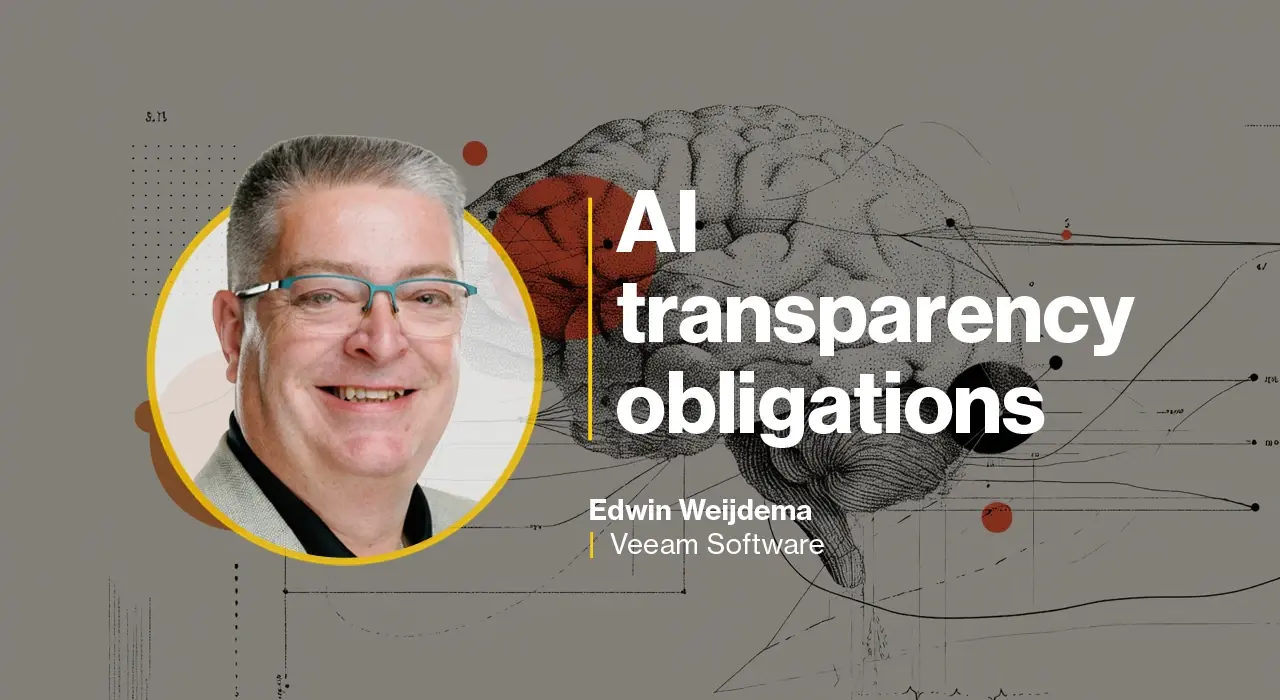
The first year of EU AI Act transparency enforcement is expected to focus on corrective measures rather than headline-grabbing fines. Article 50 of the regulation imposes transparency obligations on organisations when people interact with AI systems, and exposes them to penalties of up to €15 million or three percent of worldwide annual turnover. Yet enforcement reality will vary by member state, and early actions may be shaped more by operational disruption than by financial punishment.
In an interview, Edwin Weijdema, Field CTO at Veeam, explained that regulators across the EU are likely to treat the first year as a bedding-in period. Although the framework allows for substantial fines, national authorities will weigh proportionality, scale of impact, intent, cooperation, and existing governance controls. As a result, corrective orders and withdrawal requirements may significantly outnumber major financial penalties. Weijdema noted that some regulators may issue one or two large fines to demonstrate seriousness, but that may not happen until later. The larger practical risk for organisations is being ordered to suspend, relabel, change, or withdraw an AI-enabled process at speed, which can be far more disruptive than a fine.
Key facts
- Article 50 breaches carry exposure of up to €15 million or 3% of worldwide turnover.
- First-year enforcement is likely to favor corrective orders over major fines.
- AI systems interacting through ticketing queues or portals may count as direct interaction if no meaningful human review exists.
- Security teams running simulated phishing using cloned voices should not assume an exemption from transparency rules.
- The first Article 50 case is likely to be regulator-led on paper, but complaint-led in practice.
- Clients are struggling to prove what an AI agent did, why it did it, and who was accountable.
What Article 50 requires
Article 50 sits within the EU AI Act's general transparency rules. It recognises that people should know when they are interacting with an AI system, when content is AI-generated or manipulated, and when emotion recognition or biometric categorisation is being used. For providers and deployers, the obligations vary. Systems intended to interact with natural persons must be built and used in a way that keeps users informed unless this is obvious. AI-generated text, audio, or images may need to be labelled. Deepfakes must be disclosed. Synthetic content is subject to specific marking. The provisions overlap with other existing rules, including GDPR, and national regulators may interpret them in different ways.
The Act entered into force in August 2024 and obligations have been applying in stages. As the first year of operational enforcement begins, market surveillance authorities across member states are still at different levels of readiness. By mid-June, only nine of the twenty-seven member states had designated both a market surveillance authority and a notifying authority. Twelve had partial designations, and six had neither. That uneven foundation will affect how quickly and consistently Article 50 is enforced.
Interaction through queues and portals
One of the most difficult areas is determining when an AI system is interacting directly with a natural person. Under Article 50, transparency obligations apply when a person is interacting with an AI system and needs to be informed that they are dealing with AI, unless it is obvious from the circumstances. The channel is not decisive. A ticketing queue, shared inbox, or procurement portal does not automatically mean direct interaction, but it can. The key question is whether the AI system itself is communicating with a natural person, or whether a human intermediary exercises meaningful review and control.
If an AI drafts a response and a human reviews and sends it, the risk profile is very different from an agent autonomously replying to a customer, supplier, or employee. The latter can begin to look like direct interaction, even if it happens through a ticketing system or a procurement portal rather than a chatbot window. Weijdema said companies need to make deliberate choices to separate internal agents from customer-facing ones, and to configure barriers, access controls, and privacy safeguards across the organisation. Telling an agent not to enter a room is not enough; the door needs a lock.
Security testing and cloned voices
Security teams often run simulated phishing and vishing exercises, sometimes using AI to clone an executive's voice. These exercises are not automatically exempt from the AI Act's transparency requirements. Organisations sometimes assume that disclosure would ruin the test, but cloning a real person's voice can create a deepfake scenario. A security purpose does not automatically create a compliance exemption, and the argument that the exercise works better without disclosure is not, by itself, enough.
Weijdema advises organisations to assess the legal basis and risk carefully before deciding to omit labels. Best practice includes involving legal and compliance departments early, documenting reasoning, and including privacy, HR, and employee representatives when real voices or likenesses are used. He recommends considering alternatives such as fictional personas, synthetic voices that do not imitate real employees, prior general notice that simulations may use synthetic media, and immediate post-exercise disclosure. The documentation should show the purpose, scope, AI tools used, whether any real person was imitated, what disclosure was provided and when, what personal data was processed, why the approach was necessary and proportionate, what safeguards were in place, and how employees were debriefed afterwards. As he put it: "A security objective does not magically turn an undisclosed deepfake into a compliant one. If you have to clone the CEO's voice to make the test work, legal should be in the room before anyone presses send."
Where the first Article 50 action will start
Enforcement responsibility for Article 50 sits with national market surveillance authorities. The first formal action is most likely to come from one of those authorities, but the practical trigger could come from someone else. Defamation claims are possible, especially when synthetic audio or video damages reputation, but they are more likely to operate as parallel legal routes than as the first clean Article 50 enforcement case. Consumer groups could also force an early challenge for systems that affect large numbers of people. Still, regulator-led action appears most likely, even if some markets are still setting up their authorities. Weijdema expects the first case to be regulator-led on paper, but very possibly complaint-led in reality, triggered by a consumer group, competitor, employee, journalist, civil society organisation, or affected individual.
Accountability questions remain unresolved
Underneath the transparency rules lies a more fundamental problem. Clients keep asking how to prove what an AI agent did, why it did it, and who was accountable. Evidence matters in cybersecurity and governance, but agentic AI can reason, retrieve data, generate content, and take actions across multiple systems. Governance therefore has to move from policy documents into technical controls.
Weijdema advises treating AI agents like privileged digital identities. They should have an owner, a defined role, least-privilege access, monitoring, approval gates, and a kill switch. Organisations that do this well will be more compliant and more resilient. Another recurring question is where transparency ends and security testing begins. Security teams need realistic simulations, but the AI Act pushes toward disclosure when people interact with AI or are exposed to deepfakes. Designing exercises that remain realistic without crossing legal, ethical, or employee trust boundaries is hard. Security teams want realism, regulators want transparency, and the challenge is to satisfy both.
There are also unanswered questions about ultimate accountability when an AI system causes harm. Does responsibility fall on the vendor, the deployer, the business owner, or the executive team? How can organisations prove to regulators, customers, and the board that AI governance works in practice, not just in policy? And how much business value are they willing to lose to remain compliant, transparent, and auditable when using AI at scale? These questions will shape the first year and beyond.
Source: Help Net Security News