

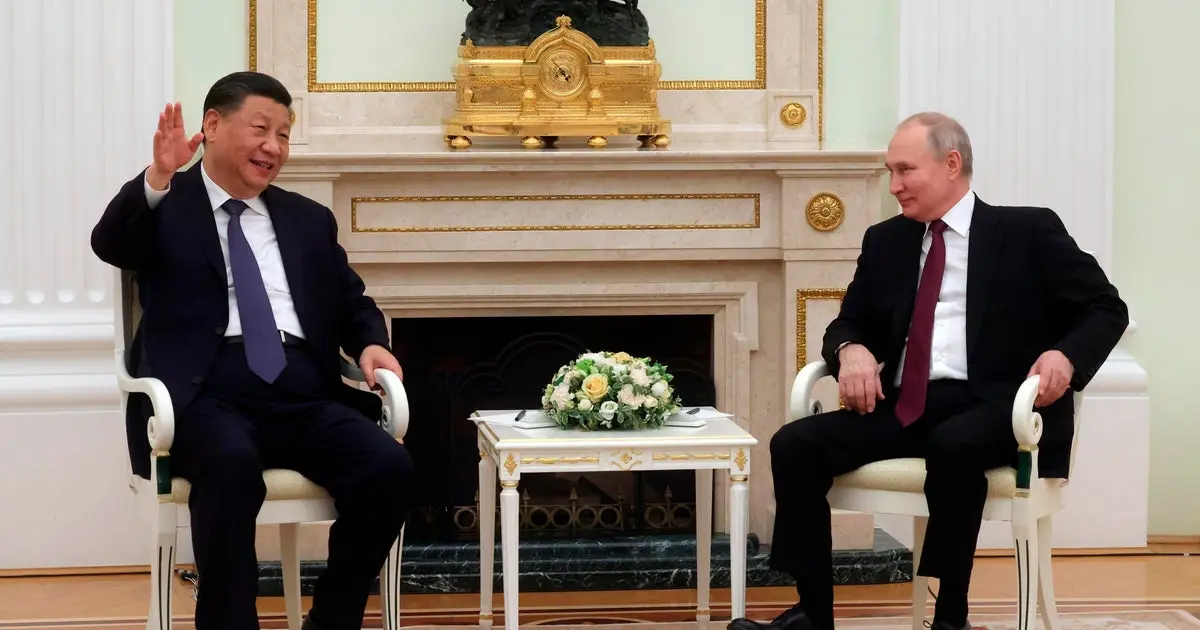
Russian President Vladimir Putin will meet with Chinese leader Xi Jinping on a two-day trip to Beijing next week, the Kremlin confirmed on Saturday. The visit, scheduled for May 19-20, comes just days after U.S. President Donald Trump wrapped up his own state visit to China, underscoring the intensifying geopolitical competition between Washington and Beijing as Moscow deepens its ties with its eastern neighbor.
The Kremlin’s announcement highlighted that the meeting between Putin and Xi would focus on bilateral relations, economic cooperation, and “key international and regional issues.” The trip coincides with the 25th anniversary of the 2001 Sino-Russian Treaty of Friendship, a landmark agreement that has served as the foundation for the two nations’ strategic partnership. Following the talks, officials are expected to issue a joint statement “at the highest level” and sign several bilateral intergovernmental, interdepartmental, and other documents.
Timing and Geopolitical Context
The timing of Putin’s visit is significant. It comes less than 24 hours after Trump’s departure from Beijing, where he met with Xi to discuss trade disputes, the ongoing war in Iran, and other contentious issues. During his trip, Trump touted the success of his meetings, claiming Chinese officials opened the door to new areas of cooperation with the United States. However, concrete agreements remained elusive, and experts questioned whether the president achieved any breakthrough deals. Wendy Cutler, a former negotiator in the Office of the U.S. Trade Representative, told CBS News that “so far, it doesn’t seem like Trump and his team have a lot to show for the visit.”
The juxtaposition of the two leaders’ visits highlights the shifting dynamics in global diplomacy. While Trump sought to reassert American influence and secure economic concessions, Putin’s mission aims to solidify an already robust partnership with China—one that has grown increasingly vital for Russia as Western sanctions over its invasion of Ukraine continue to isolate Moscow.
The Deepening Sino-Russian Partnership
Relations between China and Russia have deepened markedly since the start of Russia’s full-scale invasion of Ukraine in early 2022. Western sanctions have left Moscow shunned on the global stage and heavily reliant on Beijing for trade, energy exports, and diplomatic cover. In return, China has gained access to Russian natural resources, expanded its influence in Central Asia, and secured a reliable partner to counterbalance U.S. hegemony.
When Putin last visited China in September 2025, Xi warmly welcomed him as an “old friend,” and Putin reciprocated by addressing Xi as “dear friend.” These personal bonds reflect the strategic alignment between the two authoritarian leaders, who have met dozens of times over the past decade. Their relationship has been further bolstered by joint military exercises, increased energy cooperation, and mutual support in international forums such as the United Nations Security Council.
Key Issues on the Agenda
During the upcoming summit, Xi and Putin are expected to discuss a range of topics. Economic cooperation will likely top the list, particularly as Russia seeks to diversify its export markets away from Europe. China-Russia bilateral trade surpassed $250 billion in 2024, driven by Chinese purchases of Russian oil, gas, coal, and agricultural products. New agreements on infrastructure projects, including the Power of Siberia 2 natural gas pipeline, are anticipated to be signed during the visit.
Regional security issues will also feature prominently. The two leaders are expected to coordinate their positions on the Korean Peninsula, the South China Sea, and the ongoing conflict in Ukraine. China has consistently refrained from condemning Russia’s invasion and has provided economic support, although it has stopped short of supplying weapons. Putin will likely seek additional assurances of Chinese backing as the war in Ukraine enters its fourth year.
The Kremlin also noted that discussions would cover “key international and regional issues,” a phrase that usually encompasses topics such as Chinese territorial claims in the South China Sea, Russia’s involvement in Syria, and the situation in Afghanistan. Both nations have called for a “multipolar world order” that reduces U.S. dominance, a theme that resonates deeply with their shared vision of global governance.
Trump’s Visit: A Tale of Two Summits
Trump’s visit to Beijing, which concluded on Friday, was marked by warm rhetoric but little tangible progress. On Saturday, Trump posted two photos of himself and Xi during the summit on Truth Social, captioning them as “A Great Honor to be with a Leader who is respected by all!” One image showed the two leaders walking on a red carpet in front of saluting service members; another captured them shaking hands. Despite the cordial optics, analysts noted that no significant trade deals were announced, and Trump left without securing commitments on key issues such as intellectual property protection and market access.
One lingering issue from Trump’s visit was the status of U.S. aid to Taiwan. Trump has not yet made a decision on whether to move forward with a delayed $14 billion arms sale that Congress approved in January. Leaders from both major U.S. political parties have urged the president to support the island territory. Taiwan remains a core point of contention in U.S.-China relations, and any movement on the arms sale could provoke a strong reaction from Beijing. The timing of Putin’s visit, so close to Trump’s, may be intended to signal that China has other powerful partners in its corner.
Historical Milestones
The 25th anniversary of the Sino-Russian Treaty of Friendship provides an opportunity to reflect on the evolution of the bilateral relationship. Signed in 2001 by then-Presidents Jiang Zemin and Vladimir Putin, the treaty formalized a “strategic partnership of coordination” and established mechanisms for regular high-level exchanges. Over the years, the relationship has grown from cautious cooperation to a robust alliance, particularly as both nations faced criticism from the West over human rights issues and political systems.
Under Xi Jinping and Putin, the partnership has reached new heights. They have conducted over 40 bilateral meetings since 2013, more than any other pair of world leaders. Their summits often produce a flurry of agreements in energy, trade, and security. The upcoming meeting is expected to continue this trend, with multiple documents set to be signed.
Economic Dimensions
Economic ties between China and Russia have expanded rapidly, especially after Western sanctions limited Russia’s trade with Europe. China is now Russia’s largest trading partner, and Russia is China’s top supplier of crude oil. The two countries have reduced their reliance on the U.S. dollar in bilateral transactions, increasingly using their own currencies. This de-dollarization effort, which China has also promoted with other partners, aims to weaken U.S. financial hegemony.
During the summit, new agreements may be announced to facilitate trade in local currencies, increase Chinese investment in Russian infrastructure, and expand agricultural trade. Russia has been eager to sell more grain, meat, and dairy products to China, while China seeks to secure long-term energy supplies. The Power of Siberia 2 pipeline, which will carry natural gas from Russia’s Yamal Peninsula to China via Mongolia, is a flagship project that could be approved during the visit. This pipeline would diversify Russia’s gas export routes and provide China with a stable energy source.
Expert Perspectives
International relations experts view the summit as a reaffirmation of the China-Russia axis at a time when the United States is perceived as increasingly unpredictable. “Putin and Xi are signaling that their partnership is strong and that they will coordinate their policies to resist U.S. pressure,” said Dr. Li Wei, a China scholar at the Institute of International Studies. “The fact that Putin is visiting so soon after Trump shows that Beijing values its relationship with Moscow as much as, if not more than, its ties with Washington.”
Other analysts point out that the relationship is not without tensions. China has maintained a neutral stance on the Ukraine war, declining to provide direct military support to Russia. Some Russian nationalists view China’s caution as insufficient solidarity. Conversely, China is concerned about becoming too dependent on Russia for energy, as overreliance could give Moscow leverage. Nonetheless, the overall trajectory remains one of deepening cooperation.
Future Engagements
Putin’s visit to Beijing in May will be followed by another trip to China later this year. He is scheduled to attend the Asia-Pacific Economic Cooperation (APEC) summit in the city of Shenzhen in November. This will provide another opportunity for the two leaders to discuss regional trade and investment. The APEC summit, hosted by China, will likely see Putin and Xi jointly advocate for economic integration in the Asia-Pacific region—an arrangement that excludes the United States.
The cumulative effect of these interactions is to cement a strategic alignment that challenges Western-led international institutions. As the world watches the interplay between the Trump, Xi, and Putin summits, it becomes clear that the center of gravity in global politics is shifting. The U.S. may still be the world’s leading power, but China and Russia are forging an alternative bloc that could reshape trade, security, and diplomacy for decades to come.
On Saturday, Trump posted two photos of himself and Xi during the summit on Truth Social, saying it had been “A Great Honor to be with a Leader who is respected by all!” One image shows Trump and Xi walking on a red carpet in front of saluting service members. The other shows the two world leaders shaking hands. Yet, the lack of concrete outcomes from his visit stands in contrast to the expected flurry of agreements from the Putin-Xi meet. The coming days will reveal whether China can balance its relationships with both the United States and Russia, or whether it must ultimately choose sides in the emerging global divide.
Source: Cbsnews News