

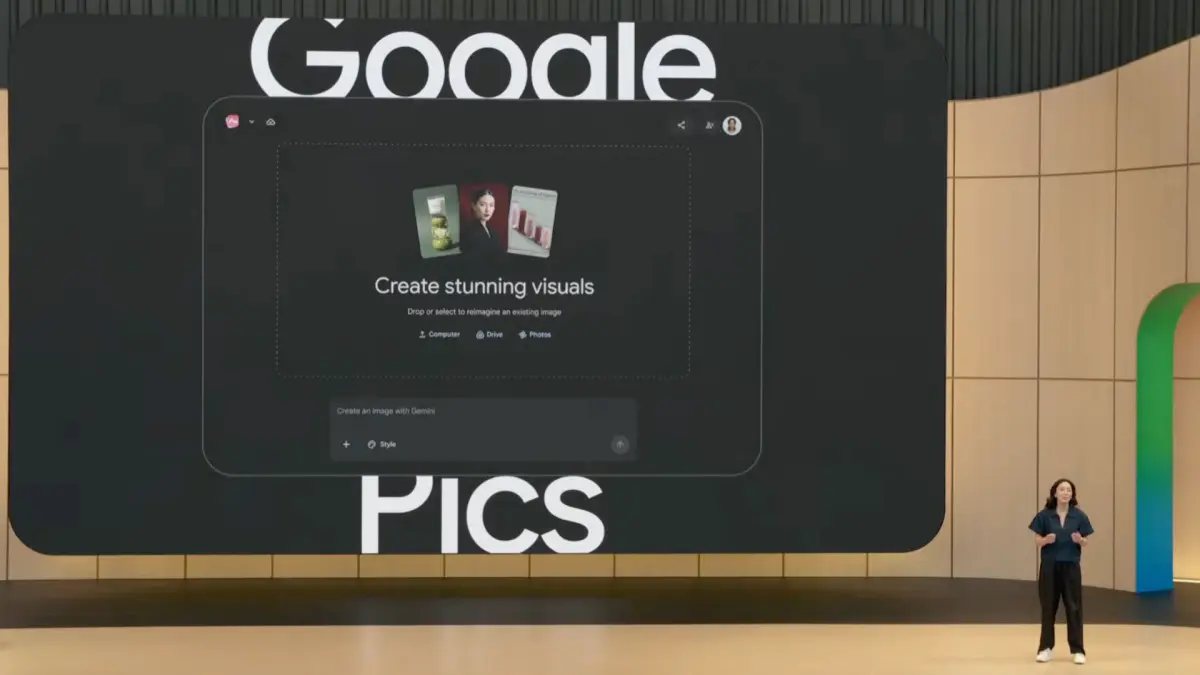
At Google I/O 2026, Google unveiled Google Pics, a new Workspace tool designed to handle photo editing, graphic design, and image creation. The announcement positions Google Pics as a direct competitor to Canva, the popular online design platform. With AI integration at its core, Google Pics aims to streamline creative tasks for professionals and casual users alike within the Google ecosystem.
What is Google Pics?
Google Pics is a platform that allows users to edit existing photos, generate new images from scratch, and create flyers, social media graphics, presentations, and other visual content. It is built on Google's existing AI image creation platform, Nano Banana, which was first introduced at a previous Google I/O event. The tool is being developed by Google Creative Lab, led by Director Suz Chambers, who presented the demo on stage.
During the demo, Chambers showcased several features: cropping an existing photo, removing an unwanted object with a simple selection, and adding text to create a polished graphic. These tasks are nearly identical to those performed in Canva, which has become a go-to for non-designers and professionals needing quick, high-quality visuals. However, Google Pics integrates directly with Google Workspace, meaning users can seamlessly access photos from Google Drive, insert graphics into Docs, or design slides in Slides without leaving the ecosystem.
AI Capabilities and Integration
The AI behind Google Pics leverages machine learning models trained on vast datasets to perform tasks like object removal, background generation, and style transfer. Google has been investing heavily in generative AI across its product lineup, from Gemini in Google Docs to AI-generated images in Search. Google Pics appears to be a consolidation of these capabilities into a dedicated creative suite. The Nano Banana platform, which powers Pics, has been used internally for years to generate placeholder images and prototypes; now it's being made public in a more polished form.
One notable aspect of Google Pics is its focus on collaboration. Since it is part of Workspace, multiple users can work on the same design in real time, with changes synced via Google Drive. This positions it as a tool not just for individuals but for teams, competing with Canva's team features as well. Google is also hinting at deeper integration with other AI tools, such as Gemini's ability to generate text prompts that automatically produce designs, though details on this are sparse.
Comparison to Canva
Canva, founded in 2013, has grown to over 100 million monthly active users by offering an intuitive drag-and-drop interface, thousands of templates, and a freemium model. Its strengths include a vast library of stock photos, fonts, and elements, as well as AI-powered features like Magic Eraser and Text to Image. Google Pics aims to match these capabilities but with the advantage of deep integration with Google's ecosystem—Drive, Photos, and the wider Workspace suite. For users who already rely on Gmail, Google Calendar, and Google Meet, switching to Google Pics could reduce friction.
However, Canva's pricing is a key differentiator. Canva offers a generous free tier with access to a wide range of features, while its Pro subscription (around $12.99/month) unlocks premium assets and team features. Google Pics, on the other hand, will be available only to Google AI Pro and Ultra subscribers. Google AI Pro is part of the Google One premium plans (starting at $19.99/month), and Ultra is even more expensive. This means casual users may find Canva more accessible, while enterprises already paying for Google Workspace might see Pics as a cost-effective add-on.
Another factor is the learning curve. Canva's simplicity has made it a favorite among non-designers, but Google's design tools have historically been more utilitarian. Google Pics appears to borrow some of the simplicity from Canva, with a clean interface and AI-assisted workflows. Whether it can match Canva's template library remains to be seen; Google has not announced any partnerships with stock image providers, though it may rely on Google Images and the broader web for assets.
The Strategic Move for Google
Google's foray into graphic design is part of a larger strategy to own the entire productivity stack. With Gmail, Google Drive, Google Docs, and Google Meet already competing with Microsoft Office and Slack, adding a design tool fills a gap. In the past, users had to leave the Google ecosystem to create flyers, social media posts, or marketing materials. Now, with Google Pics, they can stay within Workspace. This is similar to Microsoft's push with Microsoft Designer, which uses AI to generate graphics and is integrated into Office 365.
The timing is also crucial. As remote and hybrid work persist, companies are seeking unified platforms that reduce the need for multiple subscriptions. Google Workspace already offers business-grade email, cloud storage, and collaboration tools. Adding a capable design tool could make it the one-stop shop for many businesses, especially small and medium-sized enterprises that cannot afford separate subscriptions for Canva, Adobe, and others.
Challenges Ahead
Google Pics faces several hurdles. First, it enters a market where Canva has strong brand loyalty and a proven user experience. Users are accustomed to Canva's templates and might be hesitant to adopt a new tool. Second, the pricing may limit adoption. While businesses might pay for AI Pro, individual users may balk at the cost. Google could later introduce a free tier with limited features, but for now, it is paywalled.
Another challenge is the quality of AI-generated content. Google's AI image generation has been criticized in the past for biases and inaccuracies. For a design tool, consistency and reliability are paramount. Google must ensure that object removal, text rendering, and image generation work flawlessly across languages and contexts. Additionally, as with all AI tools, copyright and ownership issues could arise if the AI produces content that resembles existing copyrighted works. Google has not detailed how it handles such cases within Pics.
What This Means for Creatives
For graphic designers and marketers, Google Pics represents both a new tool and a potential threat. While it may simplify routine tasks, it could also commoditize design, making it easier for non-designers to create passable graphics. This mirrors the impact of Canva itself. However, professional designers may appreciate the integration with Google Workspace, particularly if they already collaborate with teams using Docs and Slides. The ability to edit images directly within a Google Doc without switching apps could save time.
The release also signals that AI-driven design tools are becoming mainstream. Google's investment in Nano Banana and its integration into a consumer product suggests that AI will increasingly handle the technical aspects of design, allowing humans to focus on creativity and strategy. Whether this leads to better design overall is debatable, but it certainly lowers the barrier to entry.
The Road Ahead
Google Pics is currently in a testing phase, with a planned launch this summer for Google AI Pro and Ultra subscribers. Google has not announced when, or if, it will offer a free version. As with many Google products, the company may iterate based on feedback before a wider rollout. The design community and business users will be watching closely to see if Google Pics can deliver on its promise.
In the meantime, Canva is unlikely to stand still. The company has been adding AI features and expanding into video and document design. A competitive response from Canva could include deeper integration with third-party tools or improved pricing for teams. The battle for the design productivity market is just heating up, and users stand to benefit from the innovation that competition brings.
Ultimately, Google Pics is a bold move that challenges the status quo. If it succeeds, it could redefine how millions of people create visual content, moving it from a separate task to a seamless part of the workflow. If it falters, it will be a case study in the difficulty of breaking into a market dominated by a beloved incumbent. Either way, the next few months will be critical as Google Pics moves from demo to reality.
To provide additional context: Google has a mixed track record with standalone creative tools. Google Drawings, a basic diagramming tool included in Workspace, never gained widespread adoption. Google's image editor in Google Photos offers basic enhancements but limited design capabilities. By contrast, Google Pics is a comprehensive tool that aims to be the default for graphic creation within the ecosystem. Its success will depend on execution, adoption, and how well it integrates with the AI features of Gemini and other Google services.
Industry analysts have noted that Google's timing aligns with the growing demand for AI-powered tools that reduce manual effort. The global graphic design market is expected to reach $45 billion by 2028, and software is a major segment. Google is betting that by embedding design capabilities into its existing productivity suite, it can capture a piece of that market while reducing churn among Workspace subscribers. If even a fraction of Canva's users migrate to Google Pics, it will be a significant win for Google.
Furthermore, Google Pics could have implications beyond business use. Educational institutions using Google Workspace for Education might adopt Pics for classroom projects, student presentations, and promotional materials. Nonprofits could use it for fundraising campaigns. The accessibility of a design tool within a familiar environment like Google Drive could democratize design further, much like Canva did a decade ago.
Privacy and data security are also considerations. Google Workspace has robust enterprise-grade security, and Google Pics will inherit those protections. For businesses concerned about uploading designs to a third-party platform like Canva, Google's own infrastructure might be more appealing. However, users must trust Google with their creative assets, which could be a barrier for some.
In summary, Google Pics is a substantial new entrant in the graphic design space, leveraging AI and deep integration with Google Workspace to compete with Canva. Its success is not guaranteed, but it has the potential to reshape how design is approached within the productivity ecosystem. As the summer launch approaches, more details on pricing, features, and availability will emerge.
Source: Mashable News