

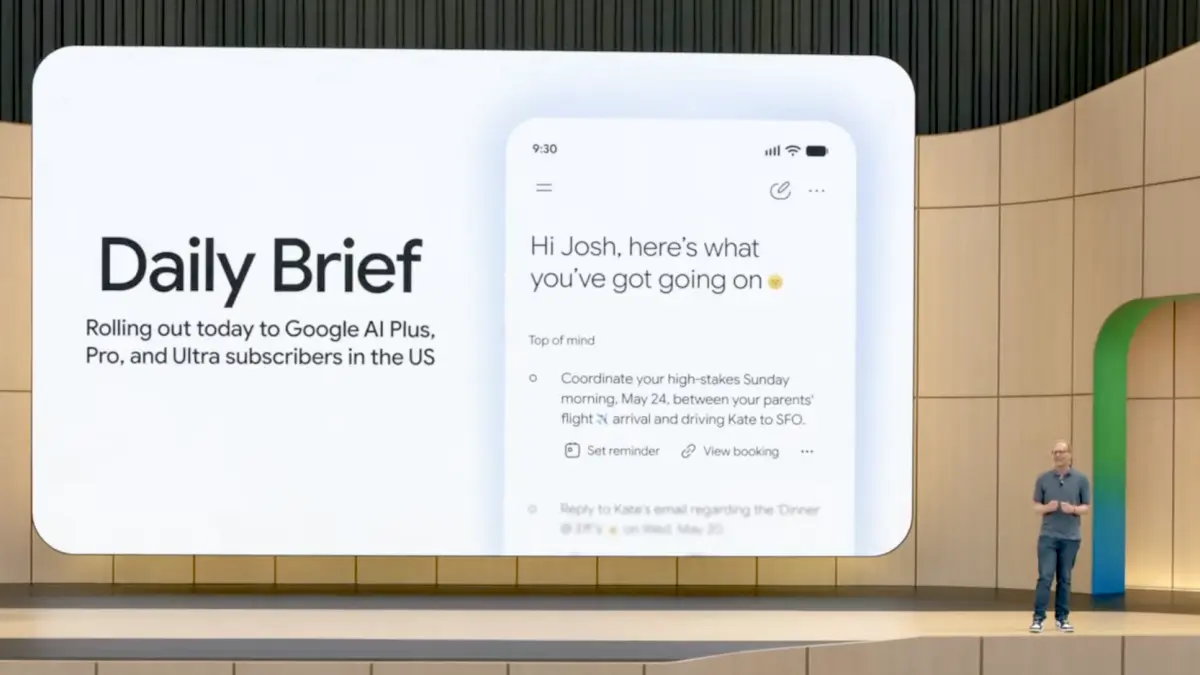
Google's annual I/O developer conference brought a wave of announcements, many centered on the company's ambitious push into AI agents. Among the most user-facing of these is a new feature called Daily Brief, which aims to simplify the start of a user's day by intelligently summarizing information from multiple personal sources, including email and calendar entries.
Announced on Tuesday, the Daily Brief is an opt-in service available immediately to Google AI Plus, Pro, and Ultra subscribers in the United States. The feature uses Google's Gemini AI to parse data from a user's Gmail inbox and Google Calendar, and then presents a concise, prioritized overview of what lies ahead. Rather than a static to-do list, the Daily Brief is designed to offer context and urgency, helping users immediately focus on what matters most.
The Daily Brief opens with a 'top of mind' section. Using Gemini's reasoning capabilities, the AI determines which event, task, or obligation should command the user's immediate attention. This could be a high-stakes Sunday morning with family travel, as demonstrated by Google Labs and Gemini VP Josh Woodward during the presentation. The idea is to cut through the noise and present a single, actionable priority area for the day.
Origins in Google Labs
The Daily Brief is not an entirely new concept for Google. It evolved from a Labs experiment called 'CC,' which generated similar daily digest emails. That service proved so popular that it maintained a waitlist of eager users. The CC emails included a 'top of mind' section, followed by an 'FYI' segment and a calendar summary. Daily Brief essentially formalizes and refines that approach, integrating it directly into the paid Google AI subscription tier.
Woodward described Daily Brief as a 'seamless, intuitive entry point into the world of AI agents.' This phrasing underscores Google's broader strategy: to make AI agents, which have often been discussed in abstract or technical terms, tangible and useful for everyday consumers. The agent here does not just answer questions; it proactively compiles and interprets personal data to offer a guided start to the day.
Key Facts About the Daily Brief
- Availability: Opt-in service for Google AI Plus ($8/month), Pro ($20/month), and Ultra (ranging $100–$200/month) subscribers in the U.S. as of announcement day.
- Data Sources: Combines information from Gmail and Google Calendar to generate the brief.
- Core Feature: 'Top of mind' section highlights the most urgent focus based on Gemini AI's analysis of the user's upcoming events and emails.
- Origin: Based on the popular Google Labs experiment 'CC,' which generated similar daily emails.
- Purpose: Provides a concrete example of how an AI agent can simplify personal productivity by reducing decision fatigue at the start of the day.
How It Works Under the Hood
To create the Daily Brief, Gemini must access and analyze a user's personal data. This involves natural language understanding to parse email content and calendar event descriptions, as well as prioritization algorithms to rank tasks by urgency and importance. The AI is trained to recognize patterns—such as travel itineraries, client meetings, or recurring deadlines—and present them in a coherent narrative format.
The brief is delivered as an email, but Google has hinted at future integrations into its ecosystem, perhaps within the Google app or even on wearable devices like smartwatches. The purely email-based format for now keeps it low-friction for users who already rely on Gmail as their primary communication hub.
Comparison with Other AI Assistants
Daily Brief enters a competitive landscape. Microsoft's Copilot can also summarize emails and calendars, and Apple Intelligence (expected later in 2025) aims to provide similar proactive insights. However, Google's advantage lies in its deep integration with Gmail and Calendar, which collectively hold billions of users' data. The 'top of mind' focus differentiates it from tools that simply aggregate events without prioritizing them.
Moreover, because Daily Brief is an agentic feature, it can evolve beyond simple summaries. Future versions might suggest actions, such as 'Send a note to confirm your flight' or 'Reschedule your dentist appointment,' based on contextual cues. This aligns with Google's broader vision of agents that not only inform but also act on behalf of the user.
Pricing and Adoption Challenges
Whether Daily Brief will drive subscription conversions remains to be seen. The Plus tier at $8 per month offers the lowest entry point, while the Ultra tier can cost up to $200 per month, targeted at heavy users who need advanced AI capabilities. For the average user, a daily email summarizing their schedule might not justify an additional subscription, especially since similar functionality is available free through Google Calendar's 'My Day' feature (though without AI context).
Google is betting that the quality of the AI-driven insights—the 'top of mind' prioritization, the natural language summary, the proactive tone—will make the feature indispensable for busy professionals. Early adopters from the CC waitlist have already demonstrated demand, and the company hopes to replicate that enthusiasm across its paid subscriber base.
From a technical perspective, the Daily Brief also serves as a stepping stone for Google's AI agent ecosystem. By getting users comfortable with agent-driven mail summaries, Google can later introduce more sophisticated agents that handle complex tasks like travel booking or meeting preparation. The Daily Brief thus acts as both a product and a teaching tool for the next phase of human-computer interaction.
Broader I/O Context
The Daily Brief was just one of many agent announcements at Google I/O. The company also showcased improvements to Gemini, its large language model, including better context understanding and multimodal capabilities. New tools for developers were introduced to build custom agents, and updates to Chrome and Android emphasized on-device AI processing. However, the Daily Brief is among the first agent features to reach a broad consumer audience directly through a subscription, signaling Google's confidence in its AI maturity.
Critics may question the privacy implications of an AI scanning personal emails to prioritize daily tasks. Google has emphasized that all data processing for Daily Brief adheres to its privacy policies, and users must opt-in explicitly. The AI does not share data across accounts, and users can review or disable the feature at any time. As agentic features become more common, trust in data handling will be a make-or-break factor for adoption.
Looking ahead, Google plans to extend Daily Brief with support for more data sources, such as Google Keep notes and third-party calendar integrations. Eventually, users might receive a brief that includes not just calendar events but also relevant news, weather, and project updates, all curated by Gemini. The goal is to create a single, intelligent entry point that eliminates the need to check multiple apps each morning.
For now, Daily Brief offers a glimpse into how AI agents can transform mundane daily tasks. Instead of manually sifting through emails and appointments, users can rely on Gemini to surface the most important information. This shift from reactive search to proactive assistance marks a significant evolution in how technology can serve individuals. As the AI industry matures, features like Daily Brief will likely become the norm, and Google's early move sets the stage for broader adoption of agentic workflows.
Source: Mashable News