

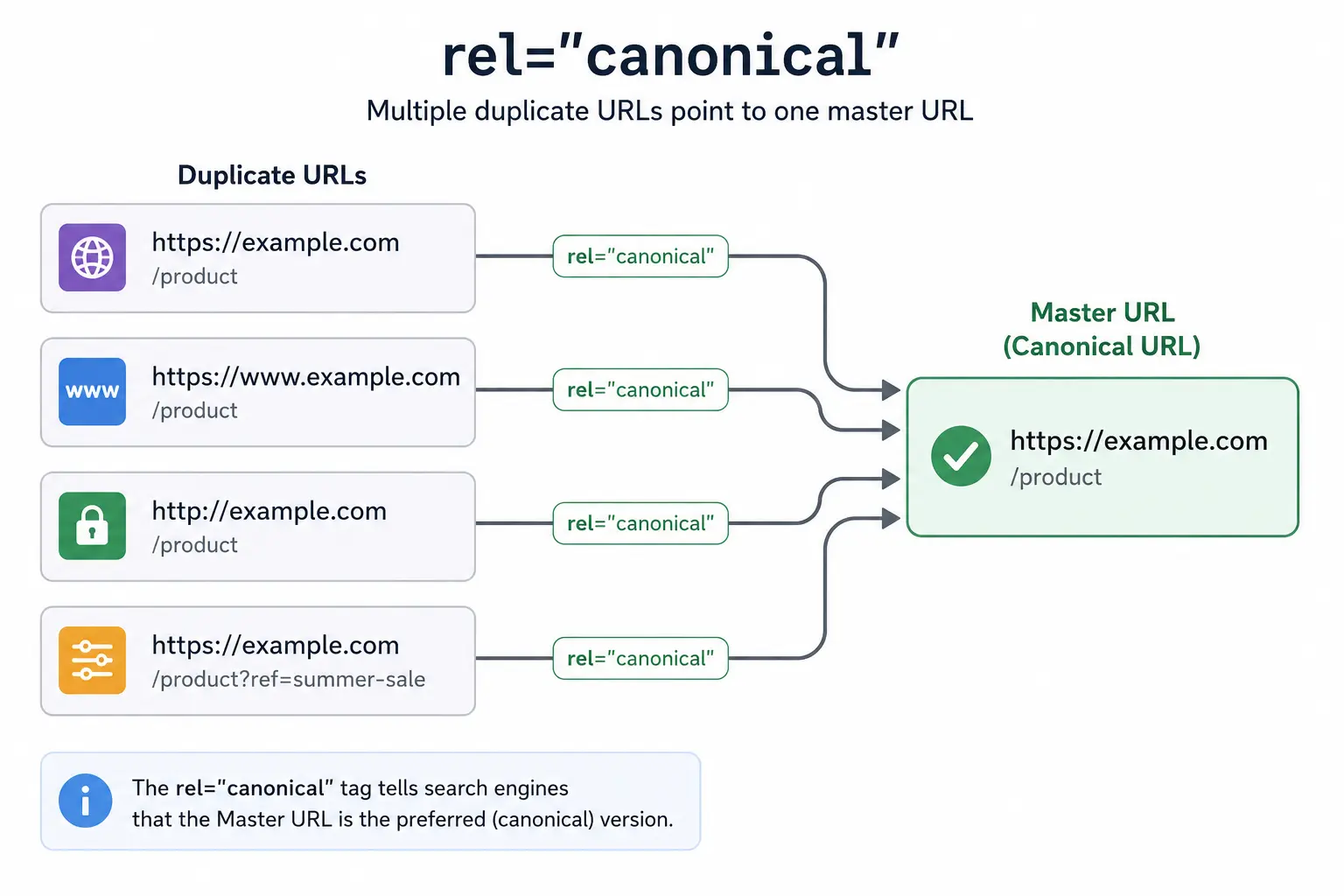
TL;DR: A canonical tag (rel="canonical") is a snippet of HTML code that tells search engines which version of a URL is the "master" copy. Using them prevents duplicate content issues by consolidating link equity to a single preferred page, ensuring your search rankings aren't split across multiple identical URLs.
Managing a website often feels like spinning plates. You're trying to scale your content, maybe looking into guest posting services to build authority, and suddenly you realize you have three different URLs showing the same blog post. It happens. Whether it's session IDs, tracking parameters, or syndicating your work to other platforms, duplicate content is an SEO silent killer. I've spent over a decade in the search marketing trenches, and I can tell you that ignoring your "canonicalization" strategy is a fast track to the second page of Google. In this guide, we'll break down exactly how to use these tags to keep your site clean and your rankings high.
What Are Canonical Tags and Why Do They Matter?
Canonical Tag: A piece of HTML code added to the <head> section of a webpage to indicate to search engines that this specific URL is the primary version of the content.
Think of it as a "standard" version. If you have a post about guest post backlinks appearing on your main blog and a "print-friendly" version, Google might get confused about which one to rank. By using a canonical tag, you're pointing a finger at the main article and saying, "Hey, this is the one that counts."
What most people overlook is that Google doesn't like to waste its crawl budget. If their bots are busy looking at five versions of the same page, they might miss your new, high-value content. It's not just about avoiding a "penalty"—it's about directing your "link juice" to the right place. When you secure high DA guest posting opportunities, you want those backlinks pointing toward a page that Google recognizes as the definitive source.
Why Canonical Tags Matter
The search world is changing. With the rise of AI Overviews and answer engines, clarity is everything. In 2026, the search engine's ability to identify the "source of truth" determines if you get cited in an AI-generated answer or buried.
I’ve seen plenty of sites lose 20-30% of their traffic simply because they didn't audit their URL structures. If you're investing in guest post outreach, you're working hard for every bit of authority. Without proper canonicalization, that authority gets diluted. For example, if your site generates unique URLs for mobile users or different regions without a canonical tag, you're essentially competing against yourself. In today's environment, search engines prioritize efficiency. They want one clear answer to a user's query, not a handful of "maybe" pages.
How to Implement Canonical Tags — Step by Step
Implementing these tags isn't rocket science, but you need to be precise. Here is the process I usually follow:
Identify your "Master" URL: Decide which version of the page is the most important. Usually, this is the cleanest URL without any parameters (like
?source=email).Access the
<head>section: You'll need to add a line of code to the top of your HTML. If you use a CMS like WordPress, SEO plugins often do this for you.Add the code snippet: The format looks like this:
<link rel="canonical" href="https://yourwebsite.com/main-page/" />.Self-Canonicalize: It’s a good habit to have every page point to itself as the canonical version if no duplicates exist. It prevents outsiders from creating "scraped" versions of your site that might confuse Google.
Verify in Search Console: After updating, use the URL Inspection tool in Google Search Console to make sure the "User-declared canonical" matches what Google sees.
The Counterintuitive Truth: Google Might Ignore You
Here is a bit of a "hot take" that most beginner guides won't tell you: A canonical tag is a hint, not a directive. Google treats it like a strong suggestion.
In my experience, if your canonical tag points to Page A, but your internal links all point to Page B, Google might decide you're wrong and pick Page B anyway. I've seen sites spend thousands on guest post link building pointing to a specific URL, only for Google to ignore their canonical tag because the site's architecture was a mess. Consistency is more important than the tag itself. If you tell Google one thing but show it another, the tag becomes useless. Don't just set the tag and walk away; make sure your site's navigation reflects that choice.
Expert Tips: What Actually Works for SEO
When you're dealing with white hat guest posting, you're often syndicating content. If you write an amazing piece for a guest post agency and they publish it on premium guest posting sites, you should ideally ask them to include a cross-domain canonical tag pointing back to your site. This tells Google that even though the article is on a high-authority site, your site is the original creator.
Another thing: be careful with "near-duplicates." If you have two pages that are 90% similar (like product pages for the same shoe in different colors), a canonical tag is usually better than a 301 redirect. It keeps both pages live for users but tells the search engine to treat them as one for ranking purposes.
I always suggest that SMB owners looking to buy guest posts focus on the long-term. Don't just chase a link; chase the structure that supports it. Niche guest posts are great, but if they point to a page that Google thinks is a duplicate, you're essentially throwing money down the drain. Manual outreach guest posting takes too much effort to let technical SEO errors ruin the results.
Best Press Release Submission Platforms for SEO & Brand Visibility
If you want to amplify your reach beyond dofollow guest posts, you need a solid strategy for news distribution. High-quality press release distribution sites offer a different kind of authority than traditional blog posts. While guest posting is about building a relationship with a specific audience, a press release agency can get your brand mentioned on major news networks simultaneously.
Using PR submission sites provides immediate "social proof" and helps in creating a diverse backlink profile. When search engines see your brand mentioned across multiple news distribution platforms, it signals trust and relevance. The beauty of online PR marketing is that it generates a spike in "branded searches," which is a huge ranking factor. I’ve found that combining press release backlinks with a consistent stream of high authority backlinks from guest posting creates a "moat" around your rankings that competitors find hard to bridge. Just remember to use these tools for genuine news—product launches, milestones, or research findings—to get the best engagement.
People Most Asked about Canonical Tags
Can I use canonical tags across different domains?
Yes, this is called a cross-domain canonical. It’s a great way to tell Google that content published on a third-party site is actually yours. It’s a common tactic when working with a guest post agency for content syndication.
Is a canonical tag better than a 301 redirect?
It depends on the goal. Use a 301 redirect if you want to permanently move a page and stop users from seeing the old one. Use a canonical tag if you want both pages to stay live for users but want search engines to only rank one.
Does a canonical tag pass "link juice"?
Probably, yes. In most cases, Google passes the ranking power from the duplicate pages to the canonical URL. This is why it's so important for your guest post link building strategy.
What happens if I have multiple canonical tags on one page?
It breaks. Google will usually ignore all of them. This often happens when different plugins or themes conflict. Always check your source code to ensure only one tag exists.
Can I canonicalize a page to a different language version?
No, you should use hreflang tags for that. Canonical tags are for identical or near-identical content, whereas hreflang is for content that has been translated.
How do I check if my canonical tag is working?
The easiest way is to use Google Search Console's "URL Inspection" tool. It will show you exactly which URL Google has chosen as the canonical version, regardless of what you’ve declared.