

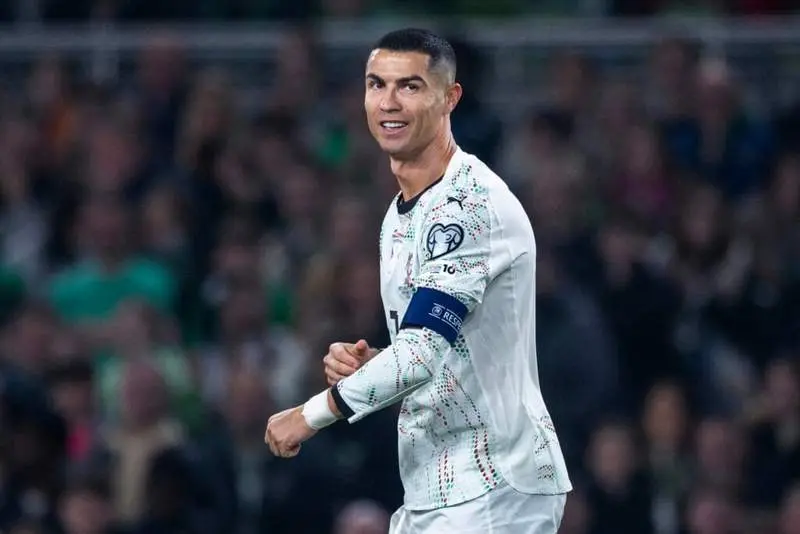
Portugal national team manager Roberto Martinez has made it clear that Cristiano Ronaldo is not motivated by money or individual achievements as he prepares for his sixth World Cup appearance in 2026. In an interview with Antena 1, Martinez dismissed any suggestion that the 41-year-old forward remains in professional football for financial reasons or to add to his trophy collection. Instead, Martinez emphasized that Ronaldo’s enduring motivation is a daily obsession to improve—a trait that has defined his two-decade career at the highest level.
“Cristiano does not play for money, he does not play for titles, he plays to improve. And that is incredible,” Martinez stated. He added, “Cristiano Ronaldo can win the Champions League, the Golden Shoe, and the day after Cristiano tries to improve.” These remarks come amid frequent speculation about Ronaldo’s move to Saudi Arabia’s Al-Nassr in 2023, which many critics interpreted as a lucrative retirement deal. However, Martinez’s comments redirect attention to Ronaldo’s internal drive rather than external rewards.
The Mindset of a Legend
Cristiano Ronaldo’s career is unparalleled in modern football. With five Ballon d’Ors, five Champions League titles, a European Championship, and a Nations League victory with Portugal, he has achieved virtually everything possible at both club and international levels. He holds records for most international goals (over 130) and most appearances for Portugal. Yet, Martinez argues that these accomplishments are not what keep Ronaldo playing at 41.
The Portugal boss elaborated on Ronaldo’s unique mentality. “It is unique to have a journey of 22 years for the National Team, the number of games he is playing, there is no other player. It is the hunger. We can measure everything from a player, but it is an aspect that is not possible,” Martinez said. This hunger, according to Martinez, is intangible and cannot be quantified by statistics. It is the same hunger that drove Ronaldo to evolve from a skinny winger at Sporting CP to a complete goal-scoring machine at Manchester United, Real Madrid, Juventus, and back to United before his move to Saudi Arabia.
Ronaldo’s work ethic is legendary. Former teammates and coaches often recount his relentless training routines, strict diet, and obsessive focus on recovery. Even at 41, he maintains a physique that rivals players a decade younger. Martinez’s comments suggest that this discipline stems from an internal desire to be better today than yesterday, regardless of the financial or reputational rewards.
The 2026 World Cup: Ronaldo’s Final Dance?
As Portugal prepares for the 2026 World Cup, which will be held in the United States, Canada, and Mexico, Martinez’s endorsement of Ronaldo’s motivation is significant. The tournament is widely expected to be Ronaldo’s last chance to add a World Cup to his collection, a missing piece in his otherwise glittering career. Portugal’s golden generation, including players like Bruno Fernandes, Bernardo Silva, and Rúben Dias, will look to support Ronaldo in his quest.
Martinez has faced criticism for relying too heavily on Ronaldo, especially after Portugal’s quarterfinal exit at the 2022 World Cup under Fernando Santos. Critics argued that Ronaldo’s declining mobility hurt the team’s tactical flexibility. However, Martinez has consistently defended Ronaldo’s role, pointing to his leadership and goal-scoring instinct. Under Martinez, Portugal has experimented with different formations, often using Ronaldo as a central striker with fast wingers creating chances.
Ronaldo’s goal-scoring record in the current World Cup qualifying campaign remains impressive. He has netted several crucial goals, proving that his finishing ability has not diminished despite his age. Martinez’s recent statements reinforce that Ronaldo’s selection is based on merit, not reputation or commercial value.
Beyond Money: The Narrative Shift
The topic of Ronaldo’s motivation has been a recurring theme in football media, especially after his lucrative contract with Al-Nassr. Reports suggest he earns over $200 million per year, making him one of the highest-paid athletes globally. Critics have argued that such a move indicated a shift in priorities from competitive success to financial security. Martinez’s comments directly counter that narrative, insisting that money has never been Ronaldo’s primary driver.
This is not the first time a coach or fellow player has defended Ronaldo’s motives. Former Manchester United teammates like Rio Ferdinand and Gary Neville have often spoken about Ronaldo’s obsessive dedication. Similarly, Jorge Mendes, Ronaldo’s long-time agent, has highlighted that Ronaldo has turned down even richer offers in the past to pursue challenges. Martinez’s words carry weight because he works with Ronaldo daily and sees his mindset firsthand.
The contrast with Lionel Messi is inevitable. While Messi moved to Inter Miami for a combination of lifestyle and financial reasons after winning the World Cup, Ronaldo’s move to Saudi Arabia was initially seen as a retirement league. However, Ronaldo’s performances in the Saudi Pro League have been exceptional—he broke the league’s single-season goal record and has continued to score for Portugal. This suggests that Ronaldo’s move was not about taking a step back, but about staying active and competitive in a league that allows him to continue playing at a high level.
What Drives Ronaldo?
Martinez’s insight into Ronaldo’s psyche offers a rare glimpse into what keeps one of football’s greatest players going. It is not the money, not the titles, but the personal challenge of improvement. Ronaldo has always been driven by a desire to be the best—not just compared to others, but compared to his own previous standards. This is why he famously demands the ball, takes free kicks despite criticism, and celebrates goals with the same intensity he did as a teenager.
Psychologists often describe this as a “growth mindset,” where failure is seen as a learning opportunity and success is never final. Ronaldo exemplifies this: after winning the Champions League, he immediately focuses on the next season. After breaking a record, he sets a new target. Martinez’s description—“the day after Cristiano tries to improve”—perfectly captures this relentless pursuit.
This mindset also explains why Ronaldo has been able to adapt his game as he ages. In his youth, he relied on explosive pace and dribbling. Now, he plays more as a poacher, conserves energy, and uses his exceptional positioning and finishing. He has reinvented himself multiple times, a trait that Martinez believes is rare among footballers.
As Portugal heads into the 2026 World Cup, Ronaldo’s motivation will be crucial. The team is deep, but they still look to their captain for leadership and moments of magic. Martinez’s confidence in Ronaldo’s hunger suggests that Portugal will enter the tournament with a focused and determined leader.
In a world where athletes are often accused of chasing paychecks, Martinez’s defense of Ronaldo serves as a reminder that some players are driven by something deeper. For Cristiano Ronaldo, the game has never been about the reward—it has always been about the pursuit of perfection. And as long as he feels he can improve, he will continue to play, regardless of how much money he has or how many titles he has already won.
Source: Yahoo Sports News